






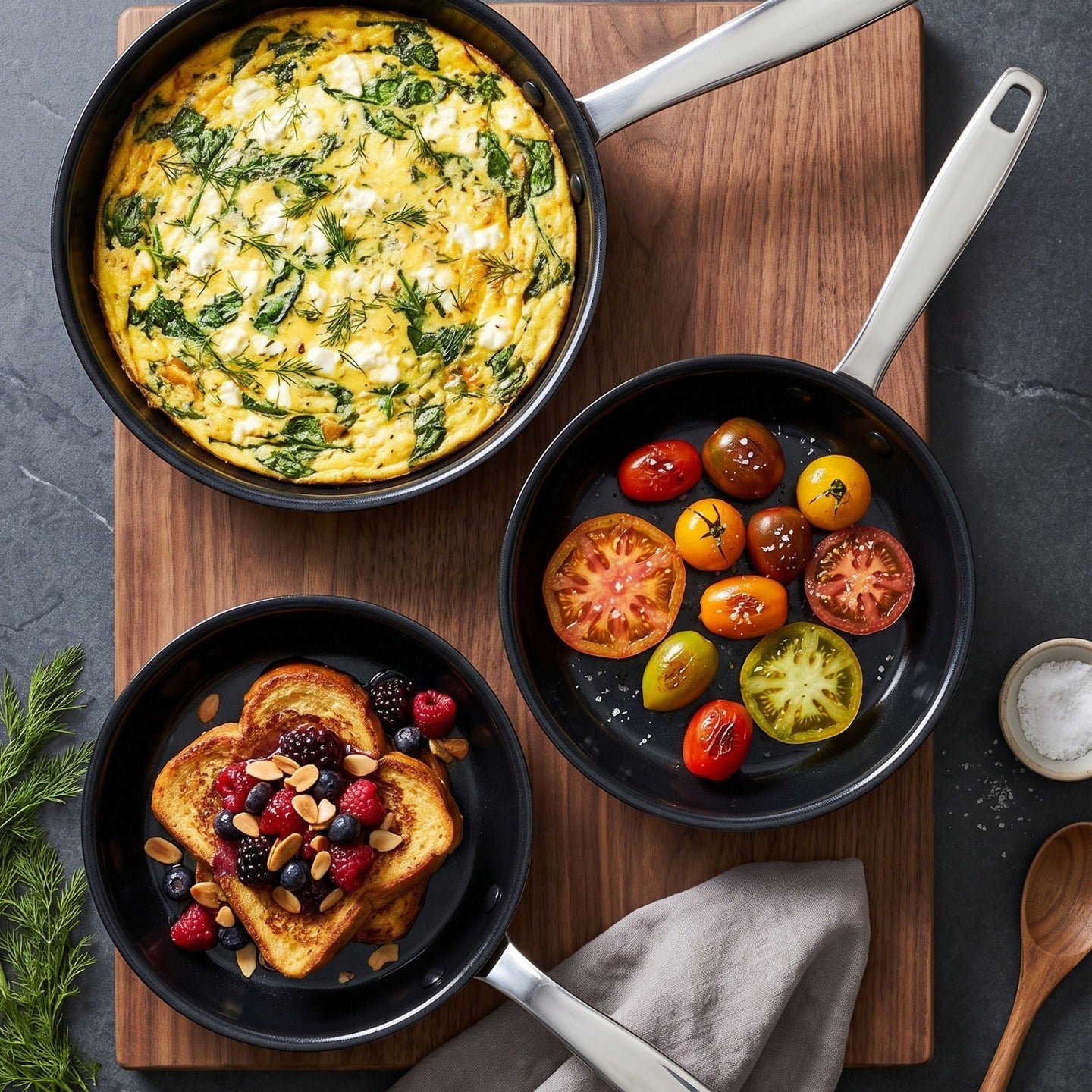
Best Induction Cookware (2026): What Works, What Doesn't, and How to Choose
Updated October 2026.
The best induction cookware has a magnetic (ferrous) base that is flat and sits close to your burner's size: fully-clad stainless for searing and everyday cooking, ceramic nonstick with a bonded magnetic plate for eggs, carbon steel for high heat, and enameled cast iron for braising. This 2026 guide covers stainless steel, nonstick and every other material on induction, so you can pick by how you actually cook.
Short answer: If a fridge magnet sticks firmly to the bottom of the pan, it will work on induction. Fully-clad stainless steel, cast iron and carbon steel all work beautifully. Ceramic nonstick works only when a magnetic stainless plate is bonded to the base. Plain aluminum, copper and glass do not work.
Induction compatibility: the verdict table
| Material | Works on induction? | Best for | Watch out for |
|---|---|---|---|
| Fully-clad stainless (5-ply or 3-ply) | Yes, with a magnetic exterior | Searing, sauces, all-round use | Some 18/10-only pans have no magnetic layer and fail. Test with a magnet. |
| Disc-bottom stainless | Yes, if the disc is magnetic | Boiling water, simple pots | Only the base heats, so the walls stay cool and thick sauces can scorch at the edge. |
| Cast iron and enameled cast iron | Yes | Braising, bread, slow cooking | Heavy. Lift rather than slide to protect the glass. |
| Carbon steel | Yes | High-heat searing, stir-fry | Needs seasoning and drying after washing. |
| Ceramic nonstick | Only with a magnetic base | Eggs, fish, easy cleanup | Use low to medium heat. Induction heats an empty pan very fast. |
| Pure aluminum, copper, glass, 18/10 with no magnetic layer | No | Other cooktops | Work only if a magnetic plate is bonded to the base. |
Related guides: best non-toxic cookware · are ceramic pans safe? · complete cookware buying guide
Ready to shop induction-ready cookware?
Alva's coated cookware is made without PFAS, PTFE or PFOA and independently tested by TÜV Rheinland against a 638-substance panel, with the lab reports published. Backed by 5–10 year warranties.
Compare Alva collectionsSee the lab reportsHow induction cooktops actually work
Induction burners heat the pan directly using a magnetic field, not a hot element. That means the cookware itself must be magnetic (contain iron) for the field to generate heat. It's why induction is fast, efficient and precise, but also why not every pan works on it.

Our Top Pick
Ceramic Nonstick Frying Pan
Easy ceramic nonstick for everyday meals. Made without PFAS, PTFE or PFOA, supported by published third-party testing, induction-ready, oven-safe to 400°F and backed by a 10-year limited warranty.
Shop the Maestro Frying PanThe 30-second magnet test
Hold a fridge magnet to the center of the pan's base. If it grabs firmly and you have to pull to take it off, the pan will work on induction. If it slides off or barely holds, the pan won't heat properly. Do this before buying anything if induction is your stove, and use it on the pans you already own before replacing them. It is more reliable than any label on the box.
- Use an ordinary fridge magnet. A very strong magnet can cling to a base that is only weakly magnetic, which makes a marginal pan look better than it is.
- Test the flat center of the base, not the rim or sides. The base is what sits on the coil. Many nonstick and disc-bottom pans are magnetic only on the bottom, so the sides tell you nothing.
- Then test near the edge of the base. If the magnet holds in the middle but not near the edge, the pan has a smaller bonded plate. It will work, but heat concentrates over the plate and the outer ring of the pan runs cooler.
- Look for the induction symbol. A coil of loops stamped on the base or printed on the packaging means the maker rates the pan for induction. The magnet is still the quickest confirmation.
Passing the magnet test tells you a pan will work. It doesn't tell you it will cook evenly. That comes from the four specs below, and it is why a cheap disc-bottom pan can pass the test and still brown badly at the edges.
What to look for in induction cookware
1. A magnetic exterior, not just a magnetic disc
The best clad pans use a ferritic (magnetic) stainless outer layer bonded across the whole base and up the sides, so the field heats the pan body itself. On Alva's Maestro stainless that is 18/10 inside, aluminum layers in the middle and magnetic stainless outside, clad from base to rim.
2. Fully clad, not disc-bottom
A fully clad pan has aluminum bonded between stainless layers from the base up the walls. A disc-bottom pan is a thin stainless body with a plate welded underneath. Both heat the base on induction, but the disc-bottom pan's walls stay cool, so food above the fill line steams rather than browns and sauces reduce unevenly. Look at the cut edge of the rim: on a fully clad pan you can see the layers as fine lines. More in clad vs disc-bottom construction.
3. Base diameter close to your burner
This is the induction-specific spec almost no maker prints. Most domestic elements are between 6 and 11 inches, and many hobs will detect a base only up to about 10 to 11 inches. A 12-inch pan on a 6-inch element heats a bright ring in the middle and stays cool at the rim. A very small base on a large element may not be detected at all, which is why an 8-inch pan sometimes refuses to start on a big hob. The size on the box is usually the rim, and the flat base is smaller, so measure your element and compare it with the base, not the rim. On a small or portable hob, a 9.5-inch pan usually heats more evenly than an 11 or 12. What size frying pan to buy works through the sizing in full.
| Frying pan size | Maestro stainless weight | Maestro ceramic nonstick weight | Best induction fit |
|---|---|---|---|
| 8" | 2.1 lb | 1.7 lb | Compact elements and single portions |
| 9.5" | 2.8 lb | 2.4 lb | Best all-round match for a typical 7 to 9 inch element |
| 11" | 3.7 lb | 3.1 lb | Family batches; pair with a larger element or a bridge zone |
4. A flat base, and keeping it flat
Induction only heats metal in direct contact. Set the pan on a countertop and press one edge: if it rocks, only part of it is touching the element, and you get a hot center and cold edges however good the cladding is. New pans should be flat. What makes them stop being flat is thermal shock, such as a screaming-hot pan under cold water. Thicker, multi-ply bases resist this better.
Also choose non-toxic materials: stainless, cast iron, carbon steel and ceramic made without PFAS, PTFE or PFOA are all safe choices. See Best Non-Toxic Cookware.
What doesn't work on induction
Pure aluminum, copper and glass won't work unless they have a bonded magnetic base plate. Many older or budget nonstick pans also fail the magnet test. The common trap is 18/10 stainless with no magnetic layer: it looks identical to the pans that work and fails the magnet test. Induction interface discs exist, but the hob heats the disc and the disc heats the pan, which is slower, less even and wastes most of the efficiency that made you choose induction. Treat a disc as a stopgap for one favorite pot, not a strategy.
Stainless steel on induction: 5-ply vs 3-ply and how to choose
Stainless is the material that satisfies induction most easily, provided the pan is built correctly: fully clad, a magnetic stainless exterior, a flat base and a base diameter that suits your burner. It heats quickly and evenly, sears and builds fond for pan sauces, and is non-reactive and durable.
5-ply vs 3-ply: both work on induction. Three-ply (stainless, aluminum, stainless) is lighter and cheaper, and a good 3-ply pan beats a poor 5-ply one. Five-ply is worth the extra weight on induction more than on gas: induction delivers heat fast, and some hobs pulse power on and off at low settings. A thicker multi-ply base smooths that out, holds temperature when cold food lands, and resists the warping that ruins base contact. Why the extra layers matter is covered in why 5-ply matters.
Every Alva Maestro stainless piece is fully clad 5-ply with an 18/10 cooking surface and a magnetic stainless exterior, with welded rivet-free handles, oven-safe to 500°F, dishwasher-safe (hand washing keeps the finish brightest) and a lifetime warranty. Designed in Belgium; manufactured in China. The layer-by-layer build, including the comparison with All-Clad D3, is on the Maestro Stainless spec page, and the full range is in the stainless steel collection.
Nine stainless pans compared on induction
All of these are fully clad and work on induction. The differences are in layers, oven ceiling, handle and price tier. Specs checked on each maker's US site in September 2026; prices change often, so check the maker's site for current pricing.
| Pan | Price tier | Construction | Oven max | Handle | Dishwasher | Warranty | Made in |
|---|---|---|---|---|---|---|---|
| Alva Maestro 11" | See product page | 5-ply | 500°F | Welded, rivet-free | Yes | Lifetime | China (designed in Belgium) |
| All-Clad D3 12" | Premium | 3-ply | 600°F | Riveted | Hand wash only | Limited lifetime | USA (global components) |
| All-Clad D5 12" | Premium | 5-ply | 600°F | Riveted | Hand wash only | Limited lifetime | USA (global components) |
| Made In Stainless Clad 12" | Mid-range | 5-ply, 2.7 mm | 800°F | Riveted | Yes, hand wash rec. | Lifetime | Italy |
| Misen Stainless 12" | Mid-range | 5-ply, 3.0 mm | 800°F | Riveted | Yes | Lifetime (defects) | China |
| Heritage Steel Eater 12" | Mid-range | 5-ply | 800°F | Riveted | Hand wash rec. | Lifetime | USA (global materials) |
| Tramontina Tri-Ply Clad 12" | Budget | 3-ply | 500°F | Riveted | Yes, hand wash rec. | Lifetime | Brazil |
| Cuisinart MultiClad Pro 12" | Mid-range (with lid) | 3-ply | 500°F | Riveted | Yes | Lifetime | Not stated |
| Demeyere Industry 5, 12.5" | Luxury | 5-ply | 500°F | Welded, rivet-free | Yes | Lifetime | Belgium |
Reading it honestly: on construction the Maestro sits in the 5-ply group with Made In, Misen, D5, Demeyere and Heritage, at the price tier of the 3-ply D3. Only two pans here have rivet-free welded handles, Alva's and Demeyere's luxury-tier pan, and rivet heads are what collect fond every week. Three brands beat our 500°F oven ceiling, which matters only if you broil in a frying pan. The Maestro 11" is the second-heaviest pan in the group; if you toss and flip one-handed, the 9.5" at 2.8 lb is the better buy. For more head-to-heads, see All-Clad alternatives and All-Clad vs Made In.
Who should buy what:
- Budget tier: Tramontina Tri-Ply Clad. Fully clad, magnetic, 500°F, lifetime warranty. You give up sidewall evenness (3-ply) and some flat base width, which on induction means less of the pan sits over the coil.
- Mid-range to premium: Alva Maestro, Made In, Misen, Heritage Steel, All-Clad D3. Pick Maestro for the rivet-free interior and dishwasher approval; Made In or Heritage if you want the 800°F ceiling; D3 for American assembly.
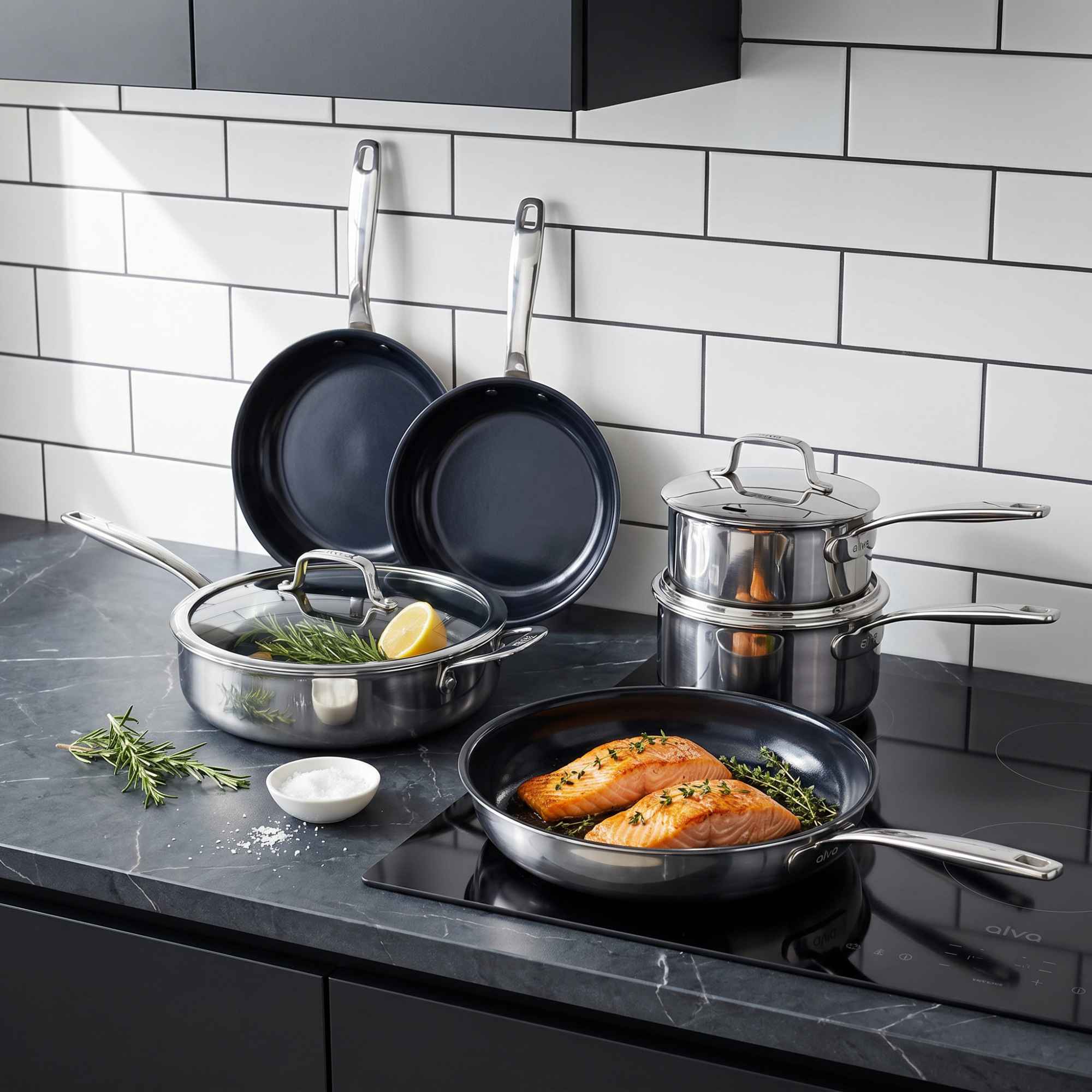
- A whole induction kitchen: the Alva 5-piece, 7-piece or 14-piece sets put 5-ply across fry pans, saucepan, sauté and stock pot. Browse cookware sets or compare in our stainless sets guide.
- Splurge: Demeyere Industry 5. Belgian-made, 5-ply, rivet-free, and the heaviest base in the group, which on induction is a real advantage for stability and flatness over years.
Nonstick on induction: ceramic needs a magnetic base
Nonstick is a coating, not a base material, so what matters on induction is what sits underneath it. Ceramic nonstick is usually built on forged or cast aluminum, which is not magnetic. Pans on plain aluminum will not heat on induction; pans with a bonded stainless steel induction plate will. Alva's ceramic pans are built with one, so they are induction-ready, and their coating is made without PFAS, PTFE or PFOA.
What to check before you buy a nonstick pan for induction:
- Magnet test on the base. A firm grip means it will heat. A weak pull or none means it won't, and the sides tell you nothing, so test the underside only.
- The word "induction" on the product page. Look for a stated induction rating or the coil symbol, then confirm with the magnet.
- Base diameter versus your element. If a pan won't switch on, the base is often too small for the ring: most hobs need a minimum base diameter before they detect a pan at all. Size notes are in the table above.
- A flat base. Aluminum-bodied pans can dome if they are overheated, so check for rocking on a counter.
Heat habits that protect the coating: start on low to medium rather than boost, because induction heats an empty pan very fast and high heat is what wears ceramic coatings. Use silicone, nylon or wood utensils, skip aerosol sprays, and hand wash once the pan has cooled. If a nonstick pan won't heat at all, an induction interface disc will make it work, but at the cost of speed and evenness, so treat that as a stopgap. For coating safety, see are ceramic pans safe?, and for care see the ceramic cookware guide. Browse the ceramic nonstick collection.
Use stainless for anything above medium heat. Keep one ceramic pan for eggs and delicate fish; most induction kitchens end up with both.
Best induction cookware (2026): our picks by category
Every Alva line is induction-ready, so these picks come down to how you cook rather than whether the pan will switch the hob on. Each pick has a spec block below so you can compare like for like. Current prices are on each product page.
| Category | Pick | Oven-safe | Dishwasher | Warranty |
|---|---|---|---|---|
| Best overall | Maestro 5-Ply Stainless Frying Pan | 500°F | Yes | Lifetime |
| Best nonstick | Maestro Ceramic Nonstick Frying Pan | 400°F | No, hand wash | 10-year |
| Best budget nonstick | Energy Ceramic Nonstick Frying Pan | Stovetop only | No, hand wash | 5-year |
| Best carbon steel | Black Angus Carbon Steel Frying Pan | 500°F | No | Lifetime |
| Best Dutch oven | Nori Enameled Cast Iron Dutch Oven, 5-Qt | 500°F | No, hand wash | Lifetime |
| Best saucepan | Maestro 5-Ply Stainless Saucepan | 500°F | Yes | Lifetime |
| Best stock pot | Maestro 5-Ply Stainless Stock Pot, 7-Qt | 500°F | Yes | Lifetime |
| Best set | Maestro 5-Ply Stainless Cookware Set, 7-Piece | 500°F | Yes | Lifetime |
| Best for small kitchens | Neat Nesting Ceramic Set, 5-Piece | 400°F | No, hand wash | 5-year |
Hand washing is recommended for the stainless pieces too, to keep the finish looking new, but they are the only Alva cookware rated dishwasher-safe.
Best overall: Maestro 5-Ply Stainless Frying Pan
Fully clad five-ply construction with a magnetic stainless exterior, so the induction field couples to the whole base rather than a disc in the middle, and the aluminum core carries heat up the sidewalls. The uncoated 18/10 interior sears, browns and builds fond for pan sauces. If you buy one induction pan, buy this one. For more stainless options, see the 5-ply stainless steel cookware guide.
- Construction: 5-ply fully clad, aluminum core, uncoated 18/10 stainless interior
- Induction base: magnetic stainless exterior across the full base
- Sizes: 8", 9.5" and 11", plus 2-piece and 3-piece sets
- Oven-safe: 500°F
- Dishwasher: safe; hand washing recommended to preserve the finish
- Utensils: metal-safe
- Warranty: lifetime
- Skip it if: you mostly cook eggs and want food to slide without any technique
Best nonstick: Maestro Ceramic Nonstick Frying Pan
Plain aluminum nonstick won't heat on induction. This pan bonds a stainless steel induction plate to a 4.5 mm forged aluminum body, so it works on induction while keeping aluminum's quick, even heating. It's made without PFAS, PTFE or PFOA, with the third-party lab reports published. Start on a low-to-medium setting rather than boost. More in the ceramic cookware guide.
- Construction: ceramic nonstick on 4.5 mm forged aluminum
- Induction base: bonded stainless steel plate
- Sizes: 8", 9.5" and 11", plus 2-piece and 3-piece sets
- Oven-safe: 400°F
- Dishwasher: no, hand wash
- Utensils: silicone, nylon or wood
- Warranty: 10-year limited
- Skip it if: you want a pan for high-heat searing
Best budget nonstick: Energy Ceramic Nonstick Frying Pan
The least expensive way to get a ceramic pan made without PFAS that works on induction, in four sizes up to 12.6 inches. The trade-off is the heat-resistant plastic handle, which makes the Energy pan stovetop only. Choose Maestro Ceramic if you ever finish dishes in the oven.
- Construction: ceramic nonstick on recycled aluminum
- Induction: rated for gas, electric, ceramic, halogen and induction
- Sizes: 8", 9.5", 11" and 12.6"; multi-pan sets also available
- Oven-safe: stovetop only
- Dishwasher: no, hand wash
- Warranty: 5-year limited
- Skip it if: you want to move the pan into the oven
Best carbon steel: Black Angus Carbon Steel Frying Pan
Carbon steel is solid ferrous metal, so it is naturally induction-friendly and reaches searing heat quickly. Black Angus arrives pre-seasoned, has a stay-cool stainless handle, and goes in the oven to 500°F. Prefer a hammered finish? The Artist Carbon Steel Frying Pan has the same 500°F rating and lifetime warranty. The lighter Forest Carbon Steel Frying Pan has a wood handle and is stovetop only, not oven-safe, with a 10-year warranty. See the full best carbon steel cookware guide.
- Construction: pre-seasoned carbon steel, no coating at all beyond the seasoning
- Induction base: solid carbon steel
- Sizes: 9.5" and 11", plus a 2-piece set
- Weight: 3.5 lb at 11"
- Oven-safe: 500°F
- Dishwasher: no; dry and oil lightly after washing
- Warranty: lifetime
- Skip it if: you want dishwasher convenience, or you cook a lot of acidic sauces before the seasoning has built up
Best Dutch oven: Nori Enameled Cast Iron, 5-Qt
Cast iron is naturally ferrous, so it is the most reliably induction-compatible material there is. Enameled means no seasoning and no rust, and the enamel handles tomato, wine and citrus without reacting. One caution specific to induction: lift it on and off rather than sliding, because a heavy cast iron base will scratch a glass cooktop. Compare sizes and alternatives in our best Dutch oven guide.
- Construction: enameled cast iron, enamel inside and out
- Induction base: solid cast iron
- Capacity: 5 qt, lid included
- Weight: 14.7 lb
- Oven-safe: 500°F
- Dishwasher: no, hand wash
- Warranty: lifetime
- Skip it if: lifting nearly 15 lb before adding food is a problem
Best saucepan: Maestro 5-Ply Stainless Saucepan
The same magnetic, fully clad construction as the frying pan, in a shape for sauces and grains. The cladding matters more than usual here: induction heats the base very fast, and layers that run up the sidewalls help stop sauces scorching at the bottom edge. More in our stainless steel saucepan guide.
- Construction: 5-ply fully clad, uncoated 18/10 stainless interior
- Induction base: magnetic stainless exterior
- Sizes: 1.5 qt and 3 qt, lid included
- Oven-safe: 500°F
- Dishwasher: safe; hand washing recommended
- Warranty: lifetime
- Skip it if: you mostly warm milk or porridge and want the easiest cleanup
Best stock pot: Maestro 5-Ply Stainless Stock Pot, 7-Qt
Big pots are where a weak induction base shows. A thin pot can boil fast over the coil while thick soups catch on the bottom. This one is fully clad with an aluminum core and a magnetic stainless exterior, so heat spreads across the base and up the sides for steadier simmering. Sizing advice is in our best stock pot guide.
- Construction: 5-ply fully clad, aluminum core, uncoated 18/10 stainless interior
- Induction base: magnetic stainless exterior
- Capacity: 7 qt, stainless lid included
- Weight: 5.2 lb empty
- Oven-safe: 500°F
- Dishwasher: safe; hand washing recommended
- Warranty: lifetime
- Skip it if: you cook for one or two and rarely batch-cook
Best set: Maestro 5-Ply Stainless Cookware Set, 7-Piece
The four shapes most induction kitchens reach for, all in magnetic fully clad stainless: a 9.5" frying pan, a 1.5-qt saucepan, a 4-qt sauté pan and a 7-qt stock pot, plus lids for the three pots (seven pieces counting lids). Pair it with one ceramic nonstick pan for eggs and you have a complete induction kitchen.
- Construction: 5-ply fully clad, uncoated 18/10 stainless interior
- Induction base: magnetic stainless exterior on every piece
- What's included: 9.5" frying pan, 1.5-qt saucepan + lid, 4-qt sauté pan + lid, 7-qt stock pot + lid
- Oven-safe: 500°F
- Dishwasher: safe; hand washing recommended
- Warranty: lifetime
- Skip it if: you already own a good pot or two; buy the individual pieces you're missing instead
Best for small kitchens: Neat Nesting Ceramic Set, 5-Piece
An 8.5" frying pan, 2-qt saucepan and 3.5-qt stockpot in induction-ready ceramic nonstick that nest into one stack, with glass strainer lids and pour spouts. The obvious pick if cabinet space, not performance, is your limiting factor. See how it compares in our nesting cookware sets guide.
- Construction: ceramic nonstick on 100% recycled aluminum
- Induction: rated for gas, electric, ceramic, halogen and induction
- What's included: 8.5" frying pan, 2-qt saucepan, 3.5-qt stockpot, two glass strainer lids
- Stacked size: 17.5" × 13.2" × 6.1"
- Oven-safe: 400°F
- Dishwasher: no, hand wash
- Warranty: 5-year limited
- Skip it if: you want stainless or high-heat searing
Not sure which line fits your hob and cooking style? Find your cookware or compare Alva collections side by side.
Induction quirks worth knowing before you blame the pan
- Boost mode plus an empty pan is how stainless gets blued and warped and how ceramic coatings wear. Induction reaches searing temperature far faster than gas, so preheat on medium and give it two minutes, not high and thirty seconds.
- The pan clicks or pulses on low. Cheaper hobs cycle power on and off rather than modulating it. A heavier, multi-ply base smooths that out.
- "Pan not detected" mid-cook is usually caused by sliding the pan off the coil. Nudge it back into the center of the ring.
Once it is on the hob, the technique is the same as any stainless pan: preheat, then oil, then food, and this is how to get burnt marks off.
How we chose
Induction heats through a magnetic field, so every pick here has a magnetic (ferrous) base that a fridge magnet grabs firmly, the one non-negotiable for induction. From there we prioritised a flat, fully-clad or solid ferrous base for even heating, base size relative to common burners, oven range, warranty, and non-toxic construction. Alva's coated lines are made without PFAS, PTFE and PFOA and independently tested by TÜV Rheinland against a 638-substance panel, with the lab reports published. The uncoated stainless, carbon steel and cast iron lines have no coating at all. Where a competitor spec appears, it is the manufacturer's published figure; we don't invent lab numbers.
Where none of these is the right answer
If your existing pans already pass the magnet test, you do not need to replace anything. Induction compatibility is a property of the metal, not a quality grade: a cheap magnetic pan works on induction and an expensive copper one does not. Replace pans because they are worn or warped, not because you switched cooktops.
Building an induction set
A fully-clad stainless skillet, an induction-ready nonstick, a saucepan, and a Dutch oven or stockpot cover most cooking, and all are available induction-ready. Browse cookware sets or all cookware. New to buying cookware? Start with the Complete Cookware Buying Guide.
Frequently asked questions
What cookware works best on an induction cooktop?
Fully-clad magnetic stainless steel is the best all-around choice; cast iron and carbon steel also work excellently. Any pan works if it is magnetic and has a flat base. Confirm with the magnet test.
How do I know if my cookware is induction-compatible?
Hold a magnet to the base. If it sticks firmly, the pan is induction-compatible. A weak pull or none means it will not heat. You can also look for the induction symbol (a looped coil) on the bottom or packaging, but the magnet is more reliable than any label.
Does all stainless steel work on induction?
No. Only stainless with a magnetic (ferritic) layer on the base works. Many 18/10-only pans are non-magnetic and will not be detected at all, while most quality fully-clad stainless has a magnetic exterior and works. Test with a fridge magnet on the base: if it grips firmly, the pan works. Alva's Maestro 5-ply has a magnetic stainless exterior, so every piece is induction-ready.
Is 5-ply worth it on induction?
More than on gas, yes. Induction delivers heat fast and some hobs pulse power on and off at low settings; a thicker multi-ply base smooths that out, holds temperature when cold food lands, and resists the warping that ruins base contact. Three-ply is lighter and cheaper and still works well, and a good 3-ply pan beats a poor 5-ply one.
Does nonstick or ceramic cookware work on induction?
Only if the pan has a magnetic base. Nonstick is a coating, not a base material, so what matters is what is underneath. Ceramic nonstick usually sits on a forged or cast aluminum body, which works on induction only when a magnetic stainless plate has been bonded to it. Pans on plain aluminum will not work. Alva's ceramic pans are built with a bonded stainless induction plate, so they are induction-ready.
Why doesn't my pan work on my induction stove?
It's likely non-magnetic (pure aluminum, copper or glass, which includes many lightweight nonstick pans) or has a warped base that prevents full contact. A second possibility is that the base is too small for the ring: most hobs need a minimum base diameter before they will switch on at all. Induction only heats magnetic cookware with a flat bottom.
Why does my induction pan heat unevenly?
Usually one of three things: the base is wider than the element, so only the middle heats; the base is not flat and part of it is not touching the glass; or the pan is disc-bottom rather than fully clad, so the walls stay cool. Match base diameter to your element and choose a fully clad pan and the problem generally disappears.
What size pan is best for an induction hob?
One whose base is close to your element's diameter, usually 6 to 11 inches. On a small or portable hob a 9.5-inch pan heats more evenly than a 12-inch, and a base much smaller than the ring wastes energy and heats unevenly. Check your hob manual for its minimum and maximum detectable pan size; many top out around 10 to 11 inches, and a larger pan will heat only in the center.
Do disc-bottom pans work on induction?
Yes, as long as the bonded disc is magnetic. Only the disc couples with the coil, though, so heat starts there while the thinner sidewalls stay cooler. That's fine for boiling water but makes thick sauces likelier to scorch at the bottom edge. Fully clad pans spread heat up the sides more evenly.
Can I use an induction adapter disc with my old pans?
You can, but it undoes most of the point. The hob heats the disc and the disc conducts heat into the pan, which is slower, less controllable and less efficient than induction heating the pan directly. It is a stopgap for one favorite pot, not a strategy.
Is stainless or nonstick better for induction?
Both work well on induction as long as the base is magnetic. Fully-clad stainless is the better all-rounder for searing, browning, pan sauces and oven work up to 500°F, and it suits anything above medium heat, since induction gets hot fast and that shortens the life of any coating. Ceramic nonstick is easier for eggs and delicate fish and wipes clean. Many kitchens keep one of each: a stainless skillet plus an induction-ready ceramic pan.
Will cast iron scratch an induction cooktop?
It can. Induction tops are glass, and a rough or heavy cast iron base will mark them if dragged. Lift pans on and off rather than sliding, keep the glass free of grit, and check the base for burrs on bare cast iron. Enameled cast iron is smoother and gentler on the glass, and as a ferrous material it needs no adapter.
Why does my pan buzz or rattle on induction?
A faint hum is normal. It is the magnetic field vibrating the layers of the pan, and it is loudest in multi-ply pans at high power; it usually quietens as you turn the power down. Rattling usually means a slightly warped base making uneven contact. Neither is dangerous, but a badly warped pan will heat unevenly.
Is induction cookware non-toxic?
It can be. Induction compatibility is about magnetism, not safety. Choose induction-ready pans made from non-toxic materials like stainless, cast iron, carbon steel, or ceramic made without PFAS, PTFE or PFOA, ideally with published lab testing.
Do you need special pots and pans for induction?
Not special, just magnetic. "Induction cookware" simply means cookware with enough iron in its base. Stainless steel, cast iron and carbon steel usually work as-is; aluminum, copper and glass do not unless a magnetic plate is bonded to the bottom. The magnet test settles it in five seconds. The same pan behaves identically on gas or a standard electric glass top.
Shop induction-ready cookware in the Maestro 5-ply collection or browse our best sellers.
Ready to buy? Start here
Every Alva line is induction-ready, with warranties from 5 years to lifetime. Free U.S. shipping over $99 · sold direct, no retail markup.

5-Ply Stainless Frying Pan
Start here. The 9.5" is the best match for a typical induction element; the 11" for family batches.
Buy now
Ceramic Nonstick Frying Pan
Bonded stainless induction plate, made without PFAS, PTFE or PFOA. For eggs, fish and easy cleanup.
Buy now
5-Ply Stainless Set, 7-Piece
Fry pan, saucepan, 4-qt sauté and 7-qt stock pot with lids, a whole induction kitchen in one box.
Buy nowShop all Maestro Stainless → or browse the ceramic nonstick collection.
Ready to pick your induction cookware?
See every Alva stainless piece and set side by side, with sizes and weights in one place, or go straight to ceramic nonstick. Free U.S. shipping over $99.

%20base%20that%20is%20flat%20and%20sits%20close%20to%20your%20burner's%20size:%20fully-clad%20stainless%20for%20searing%20and%20everyday%20cooking,%20ceramic%20non...)
Leave a comment
This site is protected by hCaptcha and the hCaptcha Privacy Policy and Terms of Service apply.