






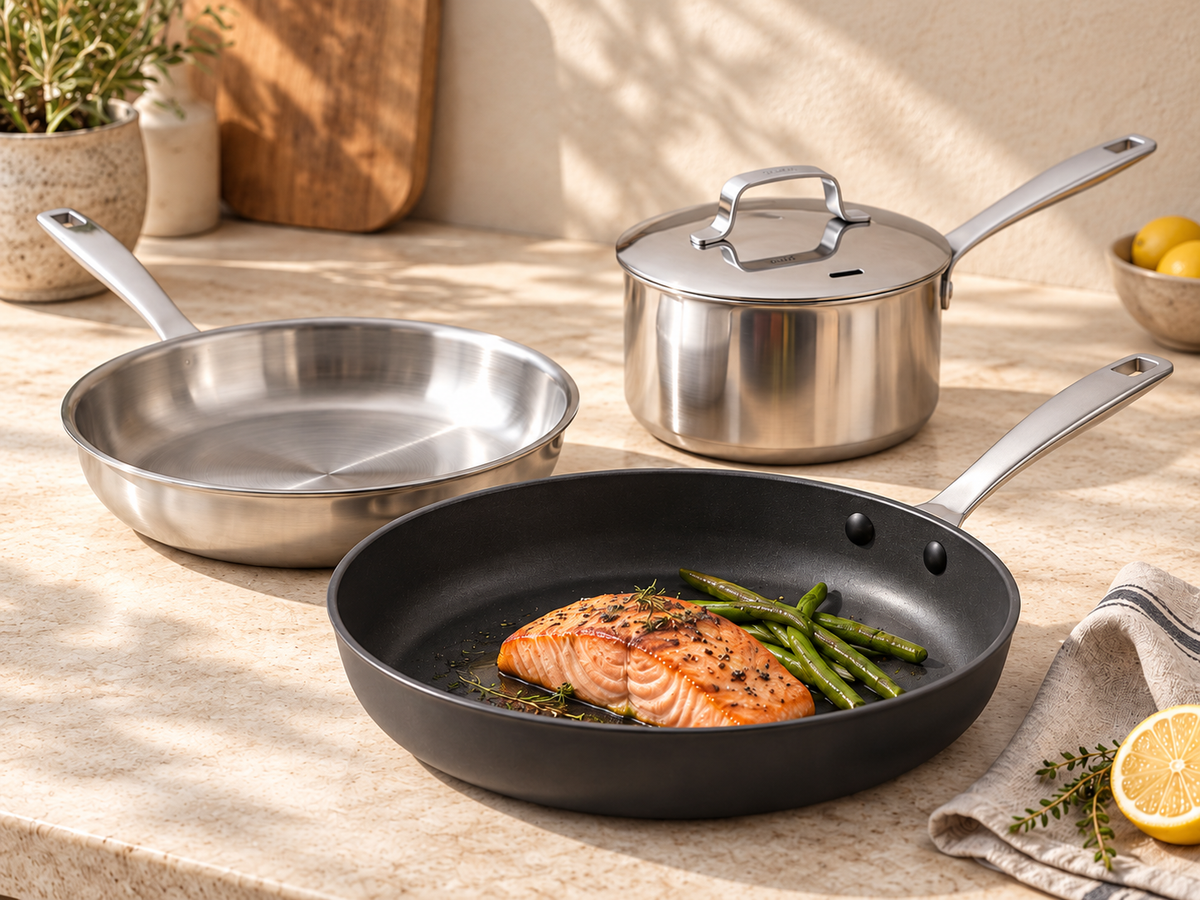
Best Cookware for Glass Top Stoves (2026): What Won't Scratch or Warp
The best cookware for a glass top stove is fully clad stainless steel or ceramic nonstick with a thick, perfectly flat base. Glass tops are radiant electric elements that transfer heat by direct contact, so any gap between pan and glass becomes a hot spot — flatness matters more than the material name on the box. Cast iron and carbon steel work too, but only if you lift them instead of sliding them.

Our Top Pick
5-Ply Stainless Frying Pan
Five bonded layers run edge to edge, so the base stays flat and moves heat sideways instead of concentrating it over the element ring. Oven-safe to 500°F and dishwasher-safe, with a 25-year limited warranty.
Shop the Frying PanIndependently tested. Alva publishes its third-party lab reports in full, with the lab, report number and date for each line. See the lab reports →
Why glass top stoves are fussy about pans
A gas burner wraps a flame around the bottom of a pan. An induction hob generates heat inside the pan's own steel. A glass (or ceramic) smooth top does neither — a radiant coil under the glass gets hot, and that heat crosses into your pan through whatever contact the two surfaces actually make.
That single fact drives every recommendation below:
- Flatness is everything. A base that's warped by even a hair leaves an air gap, and air is an insulator. You get a ring of scorching around the edge and a cool spot in the middle.
- Thin pans warp, and warping is usually permanent. Cheap single-ply aluminum and disc-bottom pans can bow when heated fast or rinsed cold. Once bowed, they wobble and never sit flat again.
- Base diameter should roughly match the element. A pan much smaller than the ring wastes heat and stresses the glass unevenly.
- Scratches come from movement, not from material. Dragging any pan across the glass with a grain of salt or sugar underneath is what leaves marks.
If you want the fuller picture of how each metal behaves, our guide to cookware materials breaks down every type side by side.
Best cookware materials for a glass top stove, compared
Swipe left or right to compare →
| Material | Glass top verdict | Why | Watch out for |
|---|---|---|---|
| Fully clad stainless (5-ply) | Best overall | Thick aluminum core spreads heat sideways, compensating for a radiant element's uneven ring. Won't warp at normal cooking temperatures. | Needs proper preheating so food doesn't stick. |
| Ceramic nonstick (clad base) | Excellent for eggs & delicate food | Smooth, light, easy to lift. Flat clad base sits flush. | Coating is not forever — medium heat only. |
| Enameled cast iron | Works, with care | Glazed bottom is smoother than bare cast iron; superb heat retention for braising. | Heavy. Must be lifted, never slid. Don't drop it. |
| Carbon steel | Works, with care | Light for its thickness, heats fast. | Ground base can be slightly rough; lift to move. |
| Bare cast iron | Riskiest | Holds heat well. | Rough sand-cast underside is the most likely thing in your kitchen to mark the glass. |
| Thin aluminum / disc-bottom | Avoid | Cheap and light. | Warps, then rocks. The classic glass-top failure. |
| Copper & stoneware | Avoid | — | Soft copper can leave residue marks; unglazed stoneware bottoms are abrasive. |
Our pick: the 5-Ply Stainless Frying Pan
For a smooth top, Alva's Maestro 5-Ply Stainless Frying Pan is the straightforward answer. Five bonded layers run edge to edge rather than a disc welded onto the bottom, so the base stays flat and moves heat sideways instead of concentrating it over the element ring — exactly the weakness a radiant coil has. It's oven-safe to 500°F, carries a 25-year limited warranty, and it's the one Alva line that is genuinely dishwasher-safe. It comes in 8-inch, 9.5-inch and 11-inch sizes. Free U.S. shipping over $99.
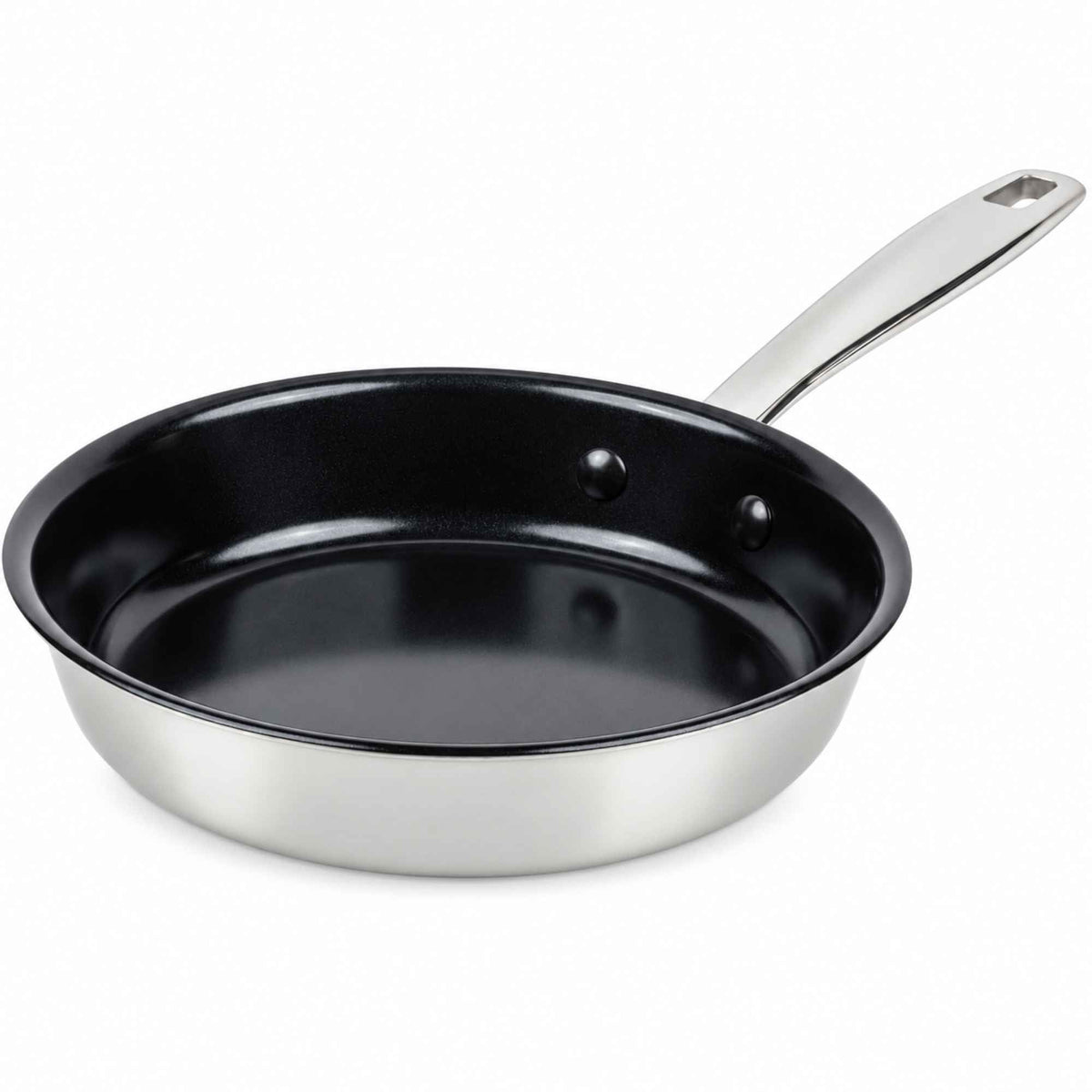
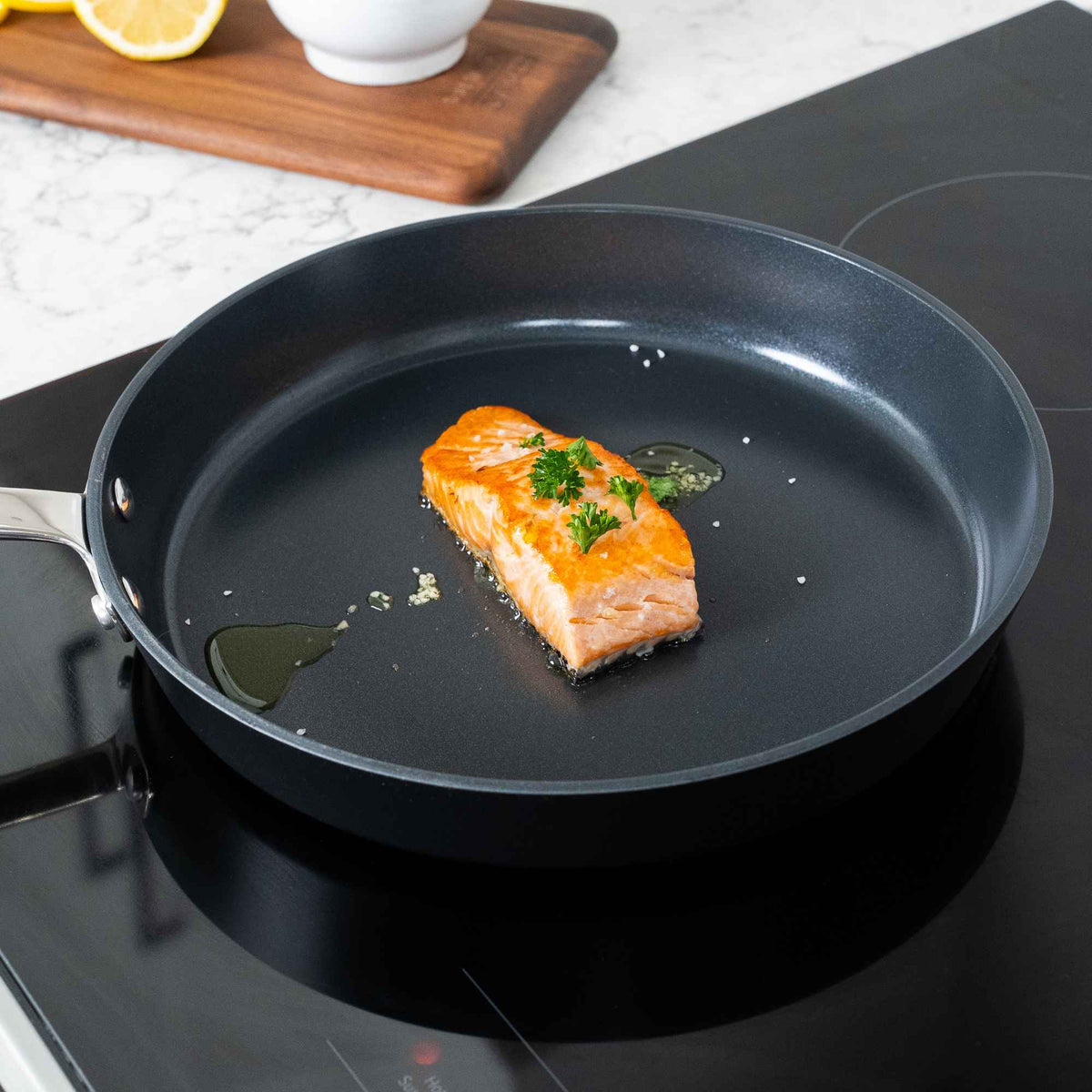
If most of your cooking is eggs, fish and pancakes, the Maestro Ceramic Nonstick Frying Pan is the lighter companion — easier to lift on and off the glass, made without PFAS, PTFE or PFOA, and backed by a 10-year warranty. Keep it to medium heat and below 400°F in the oven, and wash it by hand.
For low-and-slow braising, the Enameled Cast Iron Round Dutch Oven, 5-Qt is glass-top friendly in a way bare cast iron isn't, because the glazed base is smooth. Lift it on and off — don't slide it.
Not sure which of those three fits how you actually cook? Our framework for choosing cookware walks through it, and the stainless frying pan guide goes deeper on construction.
Where a glass top isn't the right fight
Two honest caveats, because no pan solves either one.
A glass top will never be as responsive as gas or induction. Radiant elements lag — they stay hot after you turn them down, which makes delicate sauce work and hard searing harder than on other cooktops. Buying better cookware genuinely helps with evenness, but it does not fix the lag. If you're weighing a cooktop as much as a pan, compare notes with our gas stove cookware guide, the induction cookware guide and our electric stove cookware guide for coil burners.
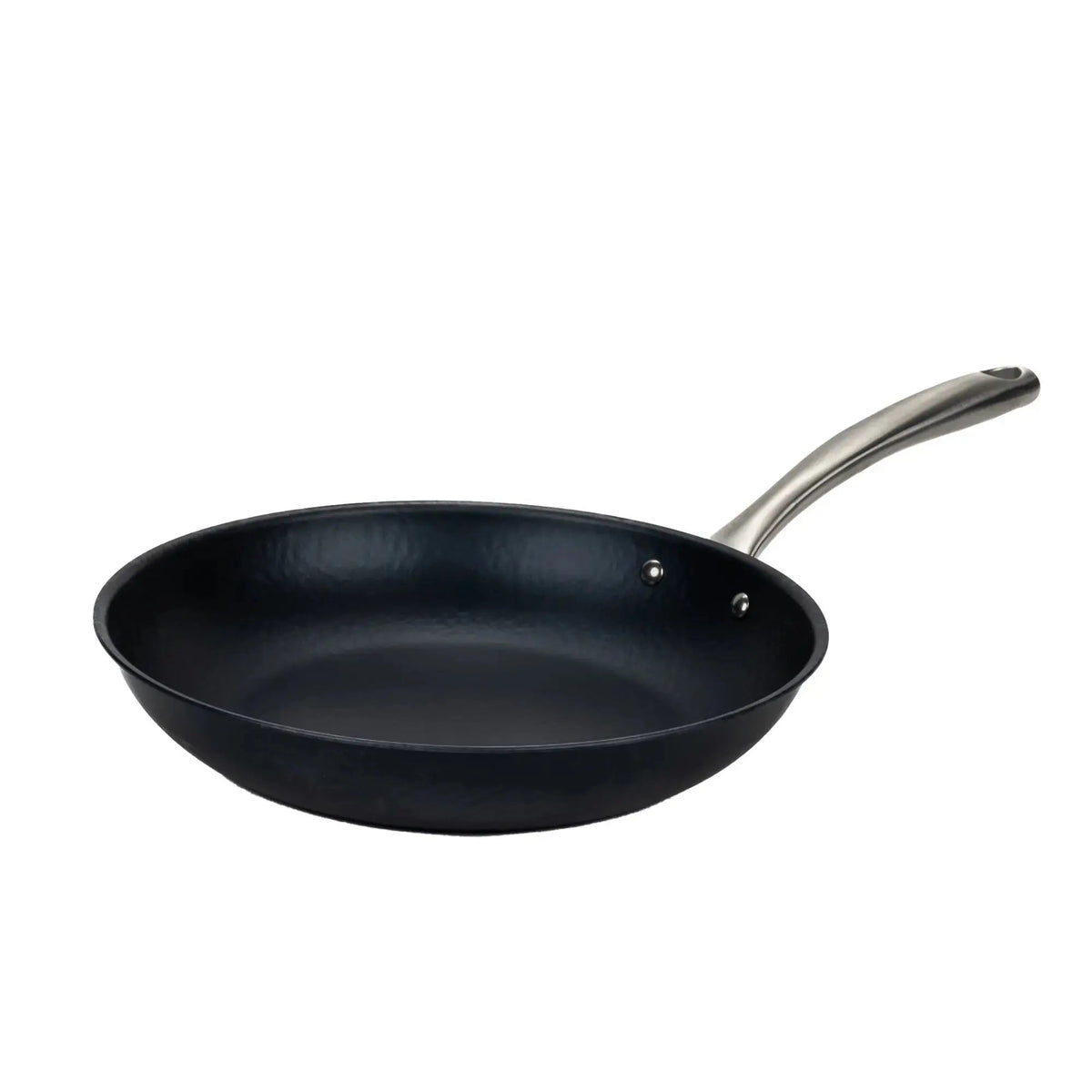
And if you love cast iron, you don't have to give it up. The advice to avoid cast iron on glass is overstated. The real risk is mechanical — dragging a heavy, rough-bottomed pan, or setting it down hard. Lift it, keep the glass clean, and enameled cast iron in particular is perfectly at home. What we would not do is use a bare, sand-cast skillet with a gritty underside on a cooktop you care about.
How to keep the glass unscratched
- Lift, never slide. This one habit prevents most cooktop damage.
- Wipe the glass and the pan bottom before cooking. A single grain of grit between two hard surfaces is what scratches.
- Clean spilled sugar immediately — melted sugar can pit the glass surface permanently, even after it cools.
- Don't let a pan boil dry on a radiant element.
- Never set a hot pan on a cold wet cooktop, or run cold water into a screaming-hot pan. Thermal shock is how flat bases become warped ones.
Frequently asked questions
Can you use cast iron on a glass top stove?
Yes, if you lift it rather than slide it. Enameled cast iron is the safer choice because its glazed base is smooth. Bare cast iron has a rougher sand-cast underside and is more likely to leave marks, so inspect the bottom before trusting it on your cooktop.
What cookware should you avoid on a glass top stove?
Avoid thin aluminum pans, disc-bottom pans, and anything already warped or wobbling. A base that doesn't sit perfectly flush creates an insulating air gap, which means slow, uneven heating. Unglazed stoneware and soft copper bottoms can also mark the glass.
Does cookware need to be magnetic for a glass top stove?
No. That requirement applies to induction, not to radiant glass tops. A glass or ceramic smooth top heats a coil beneath the glass and passes that heat to any pan by contact, so aluminum and copper-cored pans work fine. If you're unsure which type you own, a magnet that sticks firmly to the cooktop surface area suggests induction.
Is stainless steel good for a glass top stove?
Fully clad stainless is the best all-round match. It resists warping, holds a flat base over years of use, and its aluminum core evens out the ring-shaped heat a radiant element produces. Disc-bottom stainless, where a plate is welded to the base, is more prone to bowing.
Will heavy cookware crack a glass cooktop?
Only from impact, not from weight alone. The glass is engineered to hold a full stockpot. What cracks it is dropping something heavy onto it — so set heavy pots down with both hands, and don't store a Dutch oven above the stove.
Alva has been designing cookware in Belgium since 1949 and manufactures in China. Our coated lines are third-party tested by TÜV Rheinland; our uncoated stainless, carbon steel and cast iron have no coating at all.
Our top pick5-Ply Stainless Frying PanShop now →


Leave a comment
This site is protected by hCaptcha and the hCaptcha Privacy Policy and Terms of Service apply.