






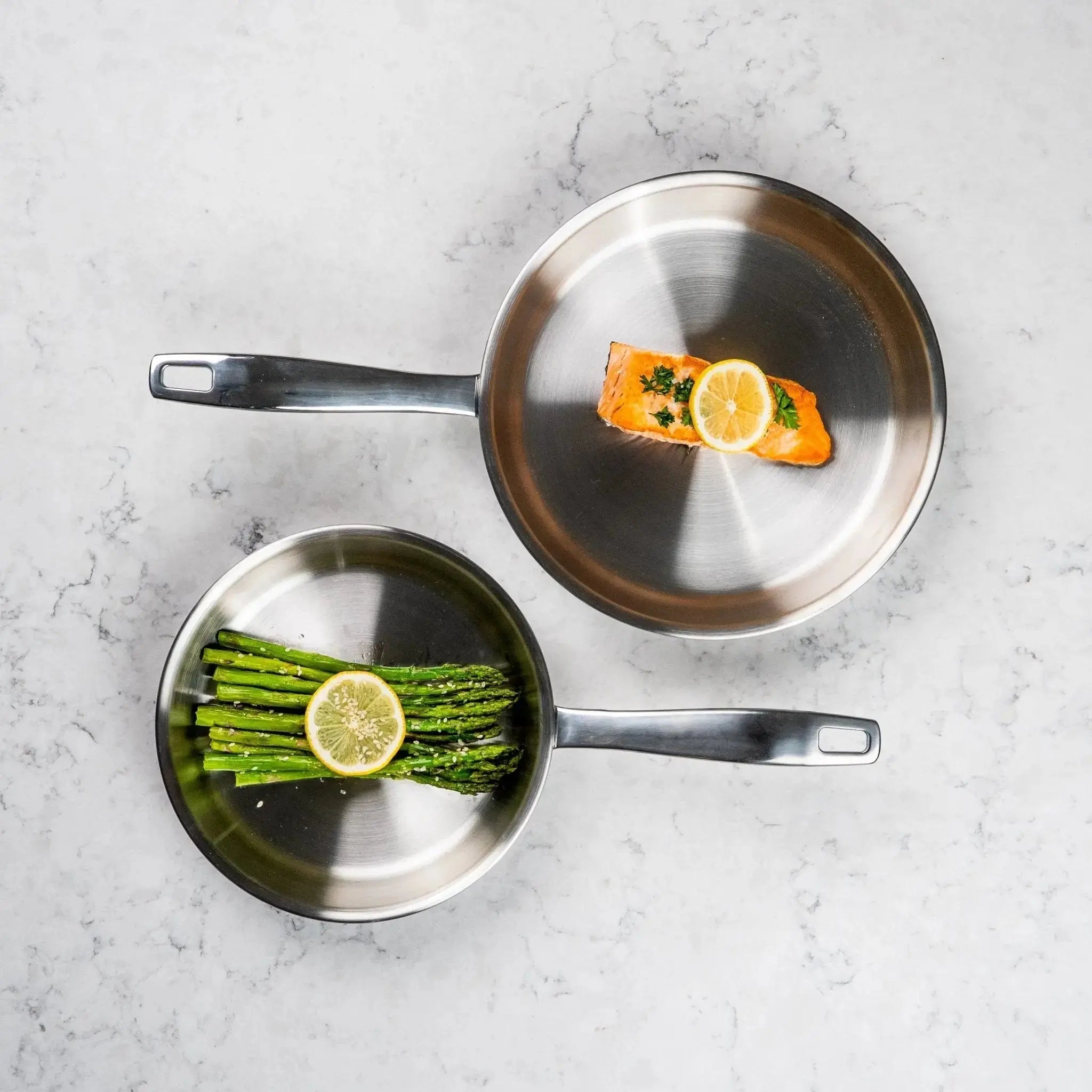
Best Stainless Steel Frying Pan (2026): What to Look For + Our Pick
The best stainless steel frying pan is fully clad — metal layers bonded from base to rim, not just a disc on the bottom — with an 18/10 cooking surface, a flat cooking area of at least 9 inches on a 12-inch pan, a handle that stays cool and doesn't trap food, and an oven rating high enough to finish a steak or roast a chicken thigh. Fully clad 5-ply pans, like the Alva Maestro (oven-safe to 500°F, rivet-free), spread heat more evenly than the 3-ply pans that dominate the budget end of the category.
By the Alva Cookware team · Updated September 17, 2026 · Competitor specs checked against manufacturers' published product pages in September 2026.
A stainless steel frying pan is the most-used pan in a serious kitchen: it sears, browns, builds pan sauces, goes under the broiler and lasts decades because there is no coating to wear out. It is also the pan that punishes a bad purchase, because a thin disc-bottom pan scorches at the edges and warps within a year. Here is how we judge one, the spec sheet on every pan people cross-shop against ours, and who should buy what at each price.
Shopping for stainless that lasts a lifetime?
Alva Maestro Stainless is fully clad 5-ply — budget pans in this category are typically 3-ply — with welded, rivet-free handles (no gunk ring), oven-safe to 500°F, dishwasher-safe, and backed by a lifetime warranty.
How we evaluate a stainless steel frying pan
We cook the things stainless is bought for — a skin-on chicken thigh seared and finished in the oven, a crêpe batter that shows every hot spot as a browning map, a steak deglazed into a pan sauce — and we check the following, in the order they end up mattering:
- Construction: fully clad or disc-bottom, and how many layers. Fully clad means the aluminum runs up the sidewalls, so the sides cook as evenly as the base. A disc-bottom pan has a thin stainless body with a plate welded underneath; the walls stay cold and food at the edge doesn't brown. Five bonded layers hold heat more steadily than three when cold food hits the pan. Our explainer on clad vs disc-bottom construction goes deeper.
- Evenness across the cooking surface. We look for a crêpe that browns to the same shade at the centre and the edge, and for no visible cold ring where the sidewall starts.
- Cooking-surface diameter, not rim diameter. A "12-inch" pan can have anywhere from 8.4 to 10 inches of flat bottom. That number decides whether four chicken thighs fit without crowding.
- Weight and balance. Under 3 lb you can flip and toss one-handed; over 3.5 lb you want a helper handle. Heavier isn't worse — it usually means thicker walls and less warping — but it changes how you use the pan.
- Handle: heat, comfort and attachment. Whether the handle stays cool after ten minutes on medium, and whether it is riveted or welded. Rivets protrude into the pan and collect food around them; welded handles leave the interior wall smooth.
- Oven and broiler rating, warp resistance, care. The oven ceiling, whether the base stays flat after a hot pan meets cold water, and whether the maker actually allows the dishwasher.
Where a spec below comes from a manufacturer, it is their published figure. Where a brand doesn't publish its weight or flat-bottom diameter — several don't — we quote America's Test Kitchen's measurement and mark it with an asterisk. We don't invent lab numbers.
Our pick: the Maestro 5-Ply Frying Pan
The Maestro 5-Ply Frying Pan checks every box above: fully clad 5-ply with three aluminum layers for even, responsive heat; an uncoated 18/10 cooking surface with no PFAS or PTFE by design; welded rivet-free handles; induction-ready; oven-safe to 500°F; genuinely dishwasher-safe; lifetime warranty; sold direct with no retail markup. It is the searing-and-sauce workhorse that pairs with everything (for batch browning and braising, see our best sauté pan guide).

Our Top Pick
5-Ply Stainless Steel Frying Pan
Fully clad 5-ply stainless steel for even heat, better browning and pan sauces. Uncoated, induction-ready, oven-safe to 500°F and backed by a lifetime warranty.
Shop the 5-Ply Frying PanIndependently tested. Alva publishes its third-party lab reports in full, with the lab, report number and date for each line. See the lab reports →
Maestro 5-Ply, size by size
| Size | Price | Weight | Overall (L × W × H) | Use it for |
|---|---|---|---|---|
| 8-inch | See product page | 2.1 lb | 15.5" × 8.6" × 2.6" | One or two eggs' worth of anything, a single chicken breast, toasting spices |
| 9.5-inch | See product page | 2.8 lb | 17.1" × 10.2" × 2.7" | Two portions; the size to buy if you cook mostly for one or two |
| 11-inch | See product page | 3.7 lb | 21.1" × 11.7" × 2.8" | Four chicken thighs, two steaks, a family stir-fry; the one to buy if you buy one |
| 2-Pc Set (8" + 11") | See product page | — | — | Small and large; covers most kitchens |
| 3-Pc Set (8" + 9.5" + 11") | See product page | — | — | All three sizes, for less than buying separately |
Every size: 18/10 stainless cooking surface · three bonded aluminum layers · magnetic stainless exterior for induction · fully clad base to rim · welded rivet-free handle · oven-safe to 500°F / 260°C · dishwasher-safe (hand wash keeps the finish brightest) · lifetime warranty · designed in Belgium, made in China. The full build sheet, including the layer-by-layer comparison with All-Clad D3, is on our Maestro Stainless spec page.
How the Maestro compares: All-Clad, Made In, Misen, Tramontina, Demeyere, Heritage Steel
The 11-inch Maestro sits in the "12-inch" class everyone else sells. Specs were checked on each maker's U.S. site in September 2026; prices change often, so check the maker's site for current pricing. Weights marked * are America's Test Kitchen's measurements where the maker doesn't publish one.
| Pan | Price tier | Construction | Oven max | Weight | Handle | Dishwasher (maker) | Warranty | Made in |
|---|---|---|---|---|---|---|---|---|
| Alva Maestro 11" | See product page | 5-ply, fully clad | 500°F | 3.7 lb | Welded, rivet-free | Yes | Lifetime | China (designed in Belgium) |
| All-Clad D3 12" | Premium | 3-ply, fully clad | 600°F incl. broiler | ~2.8 lb* | Riveted | Hand wash only | Limited lifetime | USA (global components) |
| All-Clad D5 12" | Premium | 5-ply, fully clad | 600°F incl. broiler | ~3.1 lb* | Riveted | Hand wash only | Limited lifetime | USA (global components) |
| Made In Stainless Clad 12" | Mid-range | 5-ply, fully clad, 2.7 mm | 800°F | 3.0 lb | Riveted | Yes, hand wash recommended | Lifetime | Italy |
| Misen Stainless 12" | Mid-range | 5-ply, fully clad, 3.0 mm | 800°F | 3.5 lb | Riveted | Yes | Lifetime (defects) | China |
| Tramontina Tri-Ply Clad 12" | Budget | 3-ply, fully clad | 500°F | ~3.2 lb* | Riveted | Yes, hand wash recommended | Lifetime | Brazil |
| Demeyere Industry 5, 12.5" | Luxury | 5-ply, fully clad, 3.3 mm* | 500°F incl. broiler | 4.4 lb | Welded, rivet-free | Yes | Lifetime | Belgium |
| Heritage Steel Eater 12" | Mid-range | 5-ply, fully clad | 800°F incl. broiler | ~2.9 lb* | Riveted | Hand wash recommended | Lifetime | USA (global materials) |
Reading it honestly: on construction the Maestro is in the 5-ply group with Made In, Misen, D5, Demeyere and Heritage, at the price of the 3-ply D3. Three brands rate their pans higher than 500°F in the oven — that matters if you live under the broiler and is covered below. Only two pans in the class have rivet-free handles: ours and Demeyere's, which sits in the luxury price tier. And only three makers say "yes" to the dishwasher outright: Alva, Misen and Demeyere — All-Clad and Heritage Steel say hand wash. The Maestro 11" is the second-heaviest after the Demeyere, which is the trade-off for a thick, warp-resistant wall; if you want a pan you can toss one-handed all evening, the 9.5-inch at 2.8 lb is the better buy. The set-by-set version of this comparison is in All-Clad alternatives, and what size frying pan to buy settles the 10-vs-12-inch question.
Who should buy what, by budget
- Budget: Tramontina's Tri-Ply Clad. It is fully clad, 500°F and dishwasher-friendly, and it wins the budget slot in nearly every test kitchen's roundup. You give up sidewall evenness (3-ply), a fairly narrow flat bottom and a handle nobody loves.
- Mid-range — where the value is: Alva Maestro 11", Made In, Misen and Heritage Steel, with All-Clad D3 just above in the premium tier. Four of the five are 5-ply; the D3 is the 3-ply outlier at the top of the price band, bought for the American manufacture and the 600°F rating. Pick Maestro for the rivet-free handle and the dishwasher; Made In or Heritage for the 800°F rating; Misen for the thickest wall at the lowest price.
- Splurge: All-Clad D5 (premium price tier) and Demeyere Industry 5 (luxury price tier). The D5 is a heavier, more sluggish D3 that most reviewers prefer less than its cheaper sibling; the Demeyere is the one pan in the class that is both 5-ply and rivet-free, and you pay considerably more than the Maestro for Belgian manufacture and an extra inch and a half of diameter.
Weight, balance and the handle
A 12-inch class stainless pan runs from about 2.8 lb (All-Clad D3, Heritage) through 3–3.7 lb (Made In, Misen, Tramontina, Maestro) to 4.4 lb (Demeyere). The lighter pans are easier to flip and toss with one hand; the heavier ones have thicker walls, hold heat more steadily when cold food goes in and are less likely to rock on a glass cooktop after a few years. Neither is wrong — but if you are near the top of that range, buy a size with a helper handle or plan on two hands for a full pan going into the oven.
Then there is the rivet question, which is the one that shows up every week rather than every year. On a riveted pan, two or three rivet heads sit inside the cooking surface where the handle attaches. Fond, batter and burnt oil collect in the ring around each one, and every test kitchen that scores cleanup has flagged it — Food Network docked both Made In and All-Clad D5 for "food stuck in rivets", and America's Test Kitchen marks down rivets and helper handles that trap grime. A welded handle leaves the interior wall smooth, so the pan wipes clean and there is nothing to loosen over years of use. On the Maestro and the Demeyere this is standard; everywhere else in the table it isn't.
Oven ratings: is 500°F enough?
The Maestro is rated to 500°F. All-Clad rates D3 and D5 to 600°F including the broiler; Made In, Misen and Heritage Steel quote 800°F. Here is what those numbers mean in practice. Every oven-finish technique — searing a steak and sliding it in at 400°F, roasting chicken thighs at 425°F, finishing a frittata at 375°F — sits well under 500°F. Home ovens top out at 500–550°F in bake mode. The place a higher rating buys real headroom is the broiler, where the element runs far hotter than the air temperature, and long, repeated broiling is where handle welds, rivets and finish take a beating. If you broil in a frying pan weekly, choose one of the 600–800°F pans; if you use the oven the way most cooks do, 500°F is not a limit you will meet.
Care: keeping stainless bright for decades
- Medium heat is the default. Stainless conducts heat through its aluminum core, not by brute force. A 5-ply pan on medium reaches searing temperature in a couple of minutes; on high it overshoots and the oil smokes.
- Preheat before the oil. Heat the dry pan until a drop of water beads and glides, then add fat, then food. This is the whole secret to cooking on stainless without sticking.
- Rainbow tint is heat, not damage. The blue-gold sheen after a hot sear is a thin oxide layer. A splash of white vinegar or a paste of Bar Keepers Friend takes it off; so does ignoring it.
- White film is your water. Chalky spots are mineral deposits from hard water; vinegar removes them.
- No cold water into a hot pan. Thermal shock is what warps a base. Let it cool for a minute first. This matters most on thinner 3-ply pans.
- Dishwasher: yes on the Maestro, but hand washing keeps the brushed finish brighter for longer, and several competitors (All-Clad, Heritage Steel) say hand wash only.
- Burnt-on fond: simmer an inch of water with a spoonful of baking soda for five minutes, then scrub with a non-scratch pad. Full walkthrough in how to clean a stainless steel pan.
How it compares to other materials
Choosing between materials? See ceramic vs stainless steel frying pan, stainless steel vs nonstick, and stainless steel vs cast iron — or our umbrella guide to the best non-toxic frying pan. Want the full kit? See our best stainless steel sets, and read why 5-ply matters.
Frequently asked questions
What size stainless frying pan should I buy?
A 10 or 12 inch pan covers most cooking. Ten inches is easier to handle and right for one or two people; twelve gives you room to brown food in a single layer without crowding, which is what actually produces a crust. If you are buying only one, take the 11 or 12 inch.
What is the difference between 3-ply and 5-ply stainless?
Ply is the number of bonded metal layers. Three-ply is stainless–aluminum–stainless; five-ply adds two more layers, usually a second and third aluminum layer. Five-ply holds temperature more steadily when cold food hits the pan, spreads heat with fewer hot spots and resists warping, at the cost of a little weight. Three-ply is lighter and cheaper, and a good 3-ply pan such as All-Clad D3 still outperforms a poor 5-ply one. Budget pans are typically 3-ply.
What does 18/10 stainless mean, and does 18/0 matter?
The numbers are the percentage of chromium and nickel in the steel. 18/10 (18% chromium, 10% nickel) is the corrosion-resistant, non-reactive grade used for cooking surfaces. 18/0 has no nickel; it is magnetic, so it is used on the outside of induction pans, but it pits more easily, so you want it on the exterior only. A well-made pan has 18/10 inside and a magnetic grade outside — that is how the Maestro is built.
Fully clad or disc-bottom — how can I tell?
Look at the rim. On a fully clad pan you can see the layers as fine lines along the cut edge of the rim, and the sidewalls are as thick as the base. On a disc-bottom pan the walls are thin and a visibly separate plate is bonded underneath. Disc-bottom pans heat the base fine but the walls stay cold, so food at the edges never browns.
Is a stainless steel frying pan worth it?
If you sear, brown or make pan sauces, yes. Stainless builds the browned fond that a nonstick surface prevents, takes any heat you throw at it, and has no coating to wear out — ours carries a lifetime warranty against a 10-year one on our ceramic. It is not the pan for eggs.
What stainless pans do chefs use?
Restaurant lines run cheap, heavy, riveted pans that get replaced when they warp. At home, the professional cooks we know reach for fully clad 5-ply for the same reasons above: even heat and a base that stays flat. Demeyere and All-Clad have the longest history in professional kitchens; Made In, Misen, Heritage Steel and Alva build to the same clad construction at direct-to-consumer prices.
Who should skip stainless?
Anyone who mainly cooks eggs, fish or anything low-fat and delicate, and anyone who doesn't want to learn the preheat-then-oil habit. A ceramic nonstick pan or a seasoned carbon steel pan will make you happier for those jobs. Most kitchens end up with one stainless pan for searing and one nonstick or carbon steel pan for eggs.
Is stainless steel induction compatible?
The Maestro 5-ply works on every cooktop, induction included, because its outer layer is magnetic stainless. Not all stainless is — some 18/10 pans have no magnetic outer layer and will not work on induction at all. Test with a fridge magnet on the base.
How do you keep food from sticking to stainless?
Preheat properly. Heat the dry pan until a drop of water beads and glides rather than spitting, then add your fat, then the food — and leave it alone. Protein grips cool metal and releases by itself once a crust has formed, so the instinct to move it early is what causes sticking.
What do the rainbow marks on my stainless pan mean?
That is heat tint, a harmless oxide layer that forms when the pan gets hot. White cloudy patches are mineral deposits from hard water. Neither is damage or a sign of a worn-out pan, and both come off with a little citric acid, white vinegar or a stainless cleaner.
Can you use metal utensils on stainless steel?
Yes — there is no coating to scratch, so metal spatulas, whisks and tongs are all safe to use; they may leave fine cosmetic scratches on the surface over time, which affect nothing but the shine. That is one of the practical advantages over any nonstick pan, along with being genuinely dishwasher-safe for the life of the pan.
Alva stainless has no nonstick coating — no PFAS or PTFE by design — see our safety standards.
Want to see the sizes side by side?
Every Alva stainless piece and set in one place — frying pans, saucepans, sauté pans and stock pots, all fully clad 5-ply and lifetime-warrantied. Free U.S. shipping over $99.
Recipes that reward a good stainless pan: garlic butter shrimp, shrimp scampi and quick-seared chicken livers.
Considering a hybrid pan instead? See the HexClad alternatives worth a look.
Our top pick5-Ply Stainless Steel Frying PanShop now →


Leave a comment
This site is protected by hCaptcha and the hCaptcha Privacy Policy and Terms of Service apply.