






What Size Frying Pan Should You Buy? 8 vs 10 vs 12 Inch
If you buy one frying pan, buy 11 or 12 inches: it holds four chicken thighs or two steaks in a single layer, which is what actually produces a crust. A 9.5- or 10-inch pan is right for one or two people and is easier to handle one-handed; an 8-inch is for eggs, single portions and toasting spices. Most kitchens end up with one large and one small.
By the Alva Cookware team · Published September 17, 2026.
Frying pan sizes are measured across the rim, not the cooking surface, which is why a "12-inch" pan from one maker fits four thighs and another fits three. Here is how the sizes map to real meals, why the flat-bottom number matters more than the label, how weight changes with size, and which Alva sizes to pair.

Our Top Pick
5-Ply Stainless Steel Frying Pan
8, 9.5 and 11 inches, fully clad 5-ply, rivet-free, oven-safe to 500°F, dishwasher-safe, lifetime warranty.
Shop the 5-Ply Frying PanFrying pan sizes at a glance
| Rim size | Feeds | What fits in one layer | Typical weight | Best as |
|---|---|---|---|---|
| 8" | 1 | 2 eggs, one chicken breast, a grilled cheese, a handful of nuts to toast | 1.4–2.1 lb | The second pan: breakfast, sauces, single portions |
| 9.5–10" | 1–2 | 2–3 eggs, two chicken breasts, one large steak, a two-person stir-fry | 1.8–2.9 lb | The only pan for a one- or two-person kitchen |
| 11–12" | 2–4 | 4 chicken thighs, two steaks, a pound of mushrooms without steaming, a four-person hash | 2.3–3.7 lb | The only pan for a family; the searing pan in any kitchen |
| 13–14" | 4–6 | Six thighs, a whole spatchcocked chicken, paella | 4–5.5 lb | Occasional; heavy, and wider than most burners |
The number that matters: cooking surface, not rim
Makers quote the diameter across the top of the rim. The flat bottom — the part food actually touches — is always smaller because the walls flare. A 12-inch stainless pan can have anywhere from about 8.4 to 10 inches of flat surface depending on how steep the sides are; America's Test Kitchen measured All-Clad D3's 12" at 9.5", Made In's at 8.75" and Tramontina's at 8.4". That inch and a half decides whether four thighs fit without crowding. Two rules of thumb:
- Steeper, straighter walls = more cooking surface for the same rim size, but less room to slide a spatula under food and less space for a sauce to reduce.
- Gently flared walls = less flat surface but easier tossing and flipping, and better evaporation for sauces. This is the classic French "frying pan" shape.
Alva publishes overall dimensions for every size — the 11" Maestro is 21.1" long including the handle, 11.7" across the rim — so measure your burner and your cabinet against the outer numbers, and judge the cooking surface by what you cook.
Sizing for what you cook
Searing meat: buy 11–12"
Crowding is the enemy of a crust. Meat that touches its neighbour steams in its own moisture instead of browning. Four bone-in chicken thighs or two 12-oz steaks need an 11–12" pan; in a 10" pan you cook them in two batches, which is fine but takes twice as long. If you sear for a family, this is the size, and the reason the 11" is the Maestro we'd buy first.
Eggs and breakfast: buy 8" or 9.5"
Two eggs spread to fill an 8" pan and hold their shape; in a 12" pan they slide around and the whites run thin. An omelette wants an 8–9.5" pan so it folds into thirds. Our omelette pan guide covers the shape in detail. Ceramic nonstick or a well-seasoned carbon steel is the material here, not bare stainless.
Stir-fries, hash and one-pan dinners: buy 11–12", or a wok
Volume matters more than surface. A pound of vegetables and a pound of protein need the room of a 12" pan to keep moving; a 10" pan overflows and steams. If stir-fry is a weekly habit, a flat-bottom carbon steel wok does it better than any frying pan.
Pan sauces and reductions: 9.5–10" is ideal
A sauce for two reduces faster and more controllably in a smaller pan; in a 12" pan a cup of wine spreads so thin it evaporates before it reduces. This is the argument for owning a 9.5" alongside the 11".
Cooking for one: 9.5–10" as the only pan
Big enough for a steak or two breasts, small enough to toss one-handed and fit the sink. The 9.5" Maestro is 2.8 lb; the 9.5" Forest carbon steel is 1.8 lb.
Weight goes up faster than size
A 12"-class pan holds roughly 40% more surface than a 10" but weighs 30–50% more, and that weight is at the end of a long handle. The Maestro 5-ply runs 2.1 lb (8") → 2.8 lb (9.5") → 3.7 lb (11"); the thin Forest carbon steel runs 1.4 → 1.8 → 2.3 lb; the Artist carbon steel 2.9 → 3.6 lb; the Maestro ceramic 1.7 → 2.4 → 3.1 lb. Under about 3 lb you can flip and toss one-handed; above 3.5 lb you'll want two hands or a helper handle to move a full pan into the oven. Heavier isn't worse — a thicker wall holds heat and resists warping — but it changes how you use the pan, so match the size to the hands that will lift it.
Burner size and induction
A pan should sit on a burner close to the diameter of its base. A 12" pan on a 6" electric coil heats in the middle and stays cool at the edge; on gas the flame licks up the sides and scorches the handle rivets. Induction is stricter: most hobs have a maximum detectable base diameter — often 10–11" — and a pan whose base is much larger than the coil heats only in the centre. If you cook on a small induction hob, a 9.5–10" pan is often the practical maximum for even heat, whatever the recipe says.
The sizes Alva makes, by line
| Line | 8" | 9.5" | 11" | Sets | Notes |
|---|---|---|---|---|---|
| Maestro 5-Ply Stainless | 2.1 lb | 2.8 lb | 3.7 lb | 2-pc (8 + 11) · 3-pc | Oven 500°F, dishwasher-safe, rivet-free, lifetime |
| Maestro Ceramic Nonstick | 1.7 lb | 2.4 lb | 3.1 lb | 2-pc · 3-pc | Oven 400°F, hand wash, 10-year |
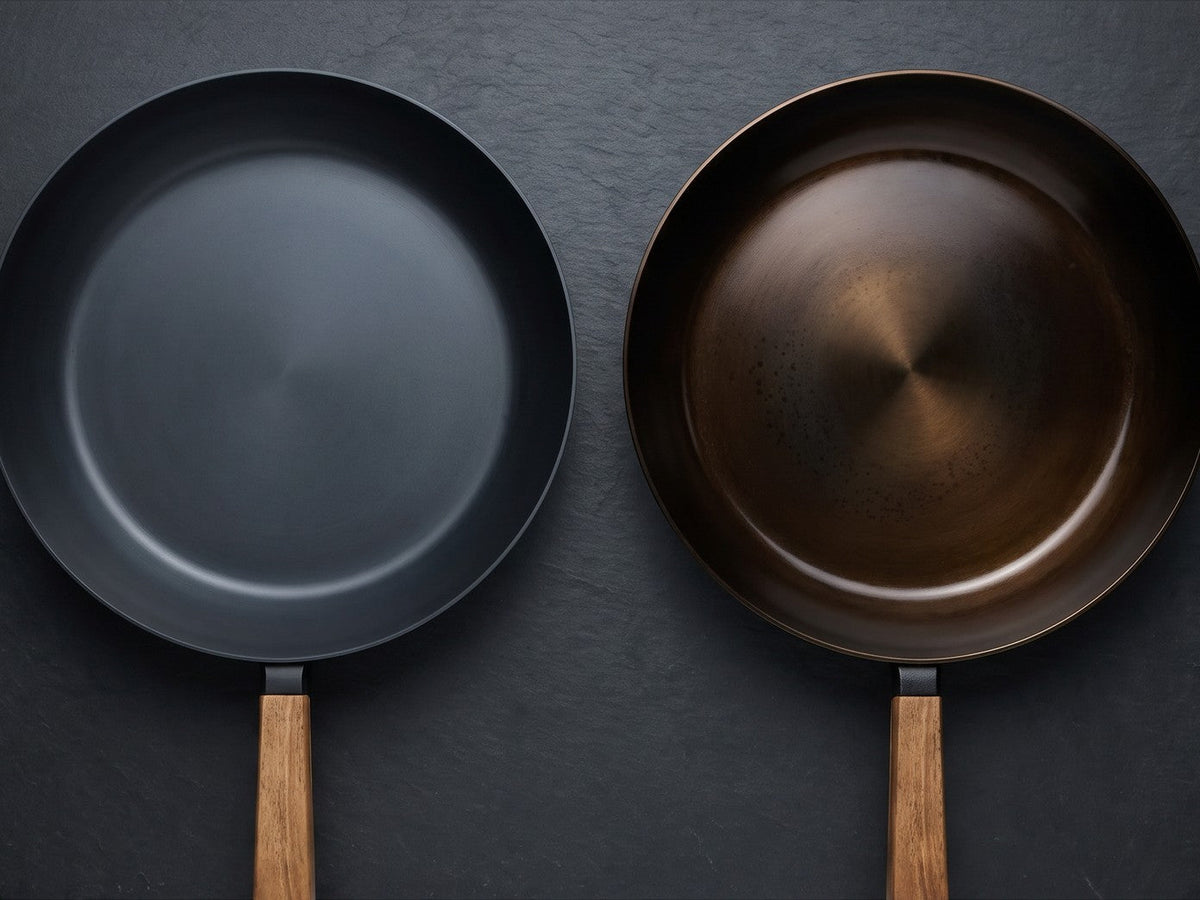
| Forest Carbon Steel | 1.4 lb | 1.8 lb | 2.3 lb | 2-pc (8 + 11) | Stovetop-only, 10-year, lightest Alva pans |
| Artist Carbon Steel | — | 2.9 lb | 3.6 lb | 2-pc (9.5 + 11) | Oven 500°F, lifetime, hammered finish |
| Black Angus Carbon Steel | — | See product page | See product page | 2-pc (9.5 + 11) | Oven 500°F, lifetime |
Free U.S. shipping over $99. The pairing we recommend most: an 11" for searing and one-pan dinners plus an 8" or 9.5" in a nonstick or carbon steel for eggs and sauces — the 2-piece sets exist for exactly that. If you're choosing the material as well as the size, start with the best stainless steel frying pan, carbon steel vs nonstick, and how many pots and pans you actually need; the saucepan version of this guide is what size saucepan.
Frequently asked questions
Is a 10-inch or 12-inch frying pan better?
12 inches if you cook for more than two or sear meat regularly — four thighs or two steaks fit in one layer. 10 inches if you cook for one or two, want a lighter pan you can toss one-handed, or cook on a small induction hob. If you can only own one, take the larger size and cook small batches in it.
What size frying pan do I need for a family of four?
11 to 12 inches. It holds four portions of protein in a single layer and a four-person stir-fry or hash. Add an 8- or 9.5-inch pan for eggs and sauces and you have the two pans most families use daily.
How is a frying pan measured?
Across the top of the rim, outside edge to outside edge. The flat cooking surface is always smaller — typically 1.5 to 3.5 inches less — because the walls flare outward. Two "12-inch" pans can have very different usable surfaces depending on how steep their sides are.
What size frying pan is best for eggs?
8 inches for one or two eggs or an omelette; 9.5 inches for three eggs or a two-person scramble. In a 12-inch pan eggs spread thin and overcook at the edges. Use ceramic nonstick or seasoned carbon steel rather than bare stainless.
Will a 12-inch pan work on my induction cooktop?
Usually, but check the hob's maximum base diameter — many detect up to 10–11 inches. A base larger than the coil heats only in the middle. Alva's stainless, carbon steel and ceramic lines are all induction-compatible; on a small hob the 9.5-inch size heats more evenly.
Is a heavier frying pan better?
Heavier usually means thicker walls, which hold heat when cold food goes in and resist warping. It also means harder tossing and lifting. Under 3 lb is comfortable one-handed; above 3.5 lb plan on two hands or a helper handle. Match the weight to how you cook, not to a rule.
Cook by size: skillet frittata (9.5"), crispy chicken drumsticks (11"), garlic butter shrimp (11").
Our top pick5-Ply Stainless Steel Frying PanShop now →


Leave a comment
This site is protected by hCaptcha and the hCaptcha Privacy Policy and Terms of Service apply.