






How Many Pots and Pans Do You Actually Need?
Most home cooks need just three to five pieces of cookware to handle ~90% of everyday meals. More pans rarely means better cooking - it usually means a fuller, more chaotic cabinet.
Quick guide: run any purchase through the small kitchen cookware checklist — nesting design, multi-use pieces, strainer lids, non-toxic materials.
If you've ever stared at a wall of pots and wondered how many you actually use, the honest answer is: not many. Below is the short list that covers nearly everything, plus how to get it in one space-saving set instead of a sprawling 12-piece box.

Our Top Pick
5-Piece Stackable Ceramic Nonstick Set
Exactly the three core pieces most kitchens need, plus lids — and they nest into the footprint of one pot. Made without PFAS, PTFE or PFOA, induction-ready, oven-safe to 400°F, and recognized in Oprah's Favorite Things.
From $229
Shop the Neat Stackable SetThe short answer: 3 to 5 pieces
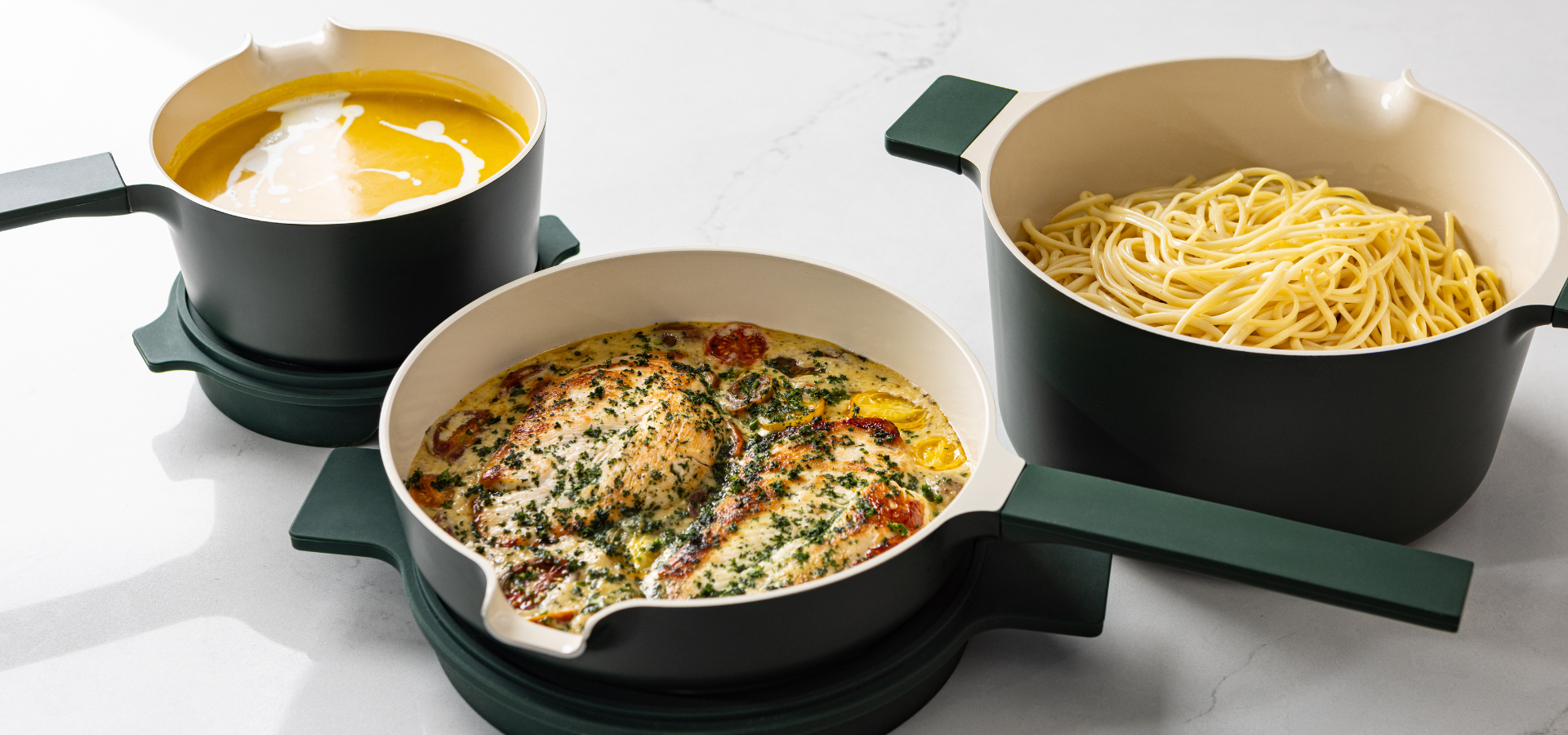
A frying pan, a saucepan, and a larger pot cover the overwhelming majority of home cooking. Add a Dutch oven and a second skillet and you can cook almost anything. Everything beyond that is for specific habits, not daily meals.
The core pieces (and what each one does)
- A frying pan (8.5–11″) - eggs, pancakes, sauteed vegetables, quick proteins. The most-reached-for pan in any kitchen.
- A saucepan (2–3 qt) with a lid - sauces, grains, oatmeal, reheating soup, cooking for one or two.
- A larger pot or stockpot (3.5–6 qt) - pasta for the family, batch soups, stocks, boiling.
That trio alone handles most weeknight dinners. The two optional add-ons:
- A Dutch oven - if you braise, bake bread, or make stews. See our Dutch oven comparison.
- A second skillet - so you can cook two things at once on busy nights.
Why more isn't better
Big boxed sets pad the piece count with near-duplicate sizes and lids you'll never separate. They look like value, but they eat your cabinet and add decision fatigue. A smaller set of pieces you actually use is easier to store, faster to clean, and cheaper to buy well once. For more on working in a tight kitchen, see our guide to the best non-toxic cookware for small kitchens. If you want the pared-down version of this list, use our minimalist kitchen essentials checklist.
The smart move: a curated set that nests
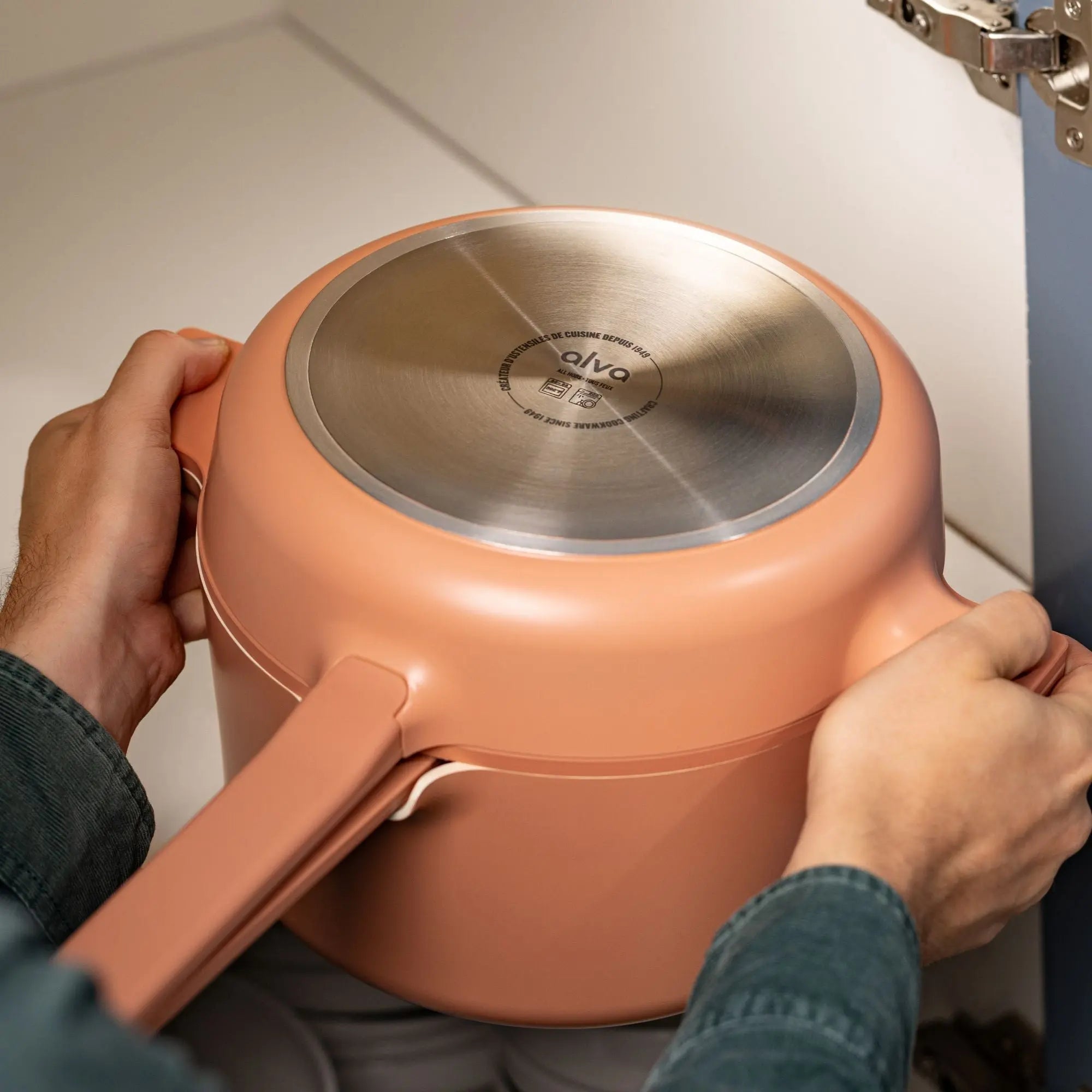
If you're buying fresh, the most efficient option is a stackable (nesting) set - the core pieces designed to stack into a single vertical tower instead of scattering across a cabinet.
The Alva Neat 5-piece set ($229) is built exactly for this: an 8.5″ frying pan, a 2-quart saucepan, and a 3.5-quart stockpot, with glass strainer lids that nest too - the whole set stores in roughly the footprint of one pot. The surface is a PFAS/PTFE/PFOA-free ceramic nonstick (independently tested), it works on every cooktop including induction, and it's oven-safe to 400°F. It covers the three core jobs above in one stack. Free U.S. shipping over $99.
When a bigger set does make sense
We would rather be straight about this than sell you the largest box. A 9 or 12-piece set is genuinely better value per piece, and it is the right buy if you are furnishing a kitchen from scratch, cook for four or more most nights, or want matching pieces throughout. What it is not is a shortcut to cooking better — and if you already own a decent pot or two, three excellent pans will serve you more than twelve mediocre ones. Compare the options in the cookware sets collection.
What you can usually skip
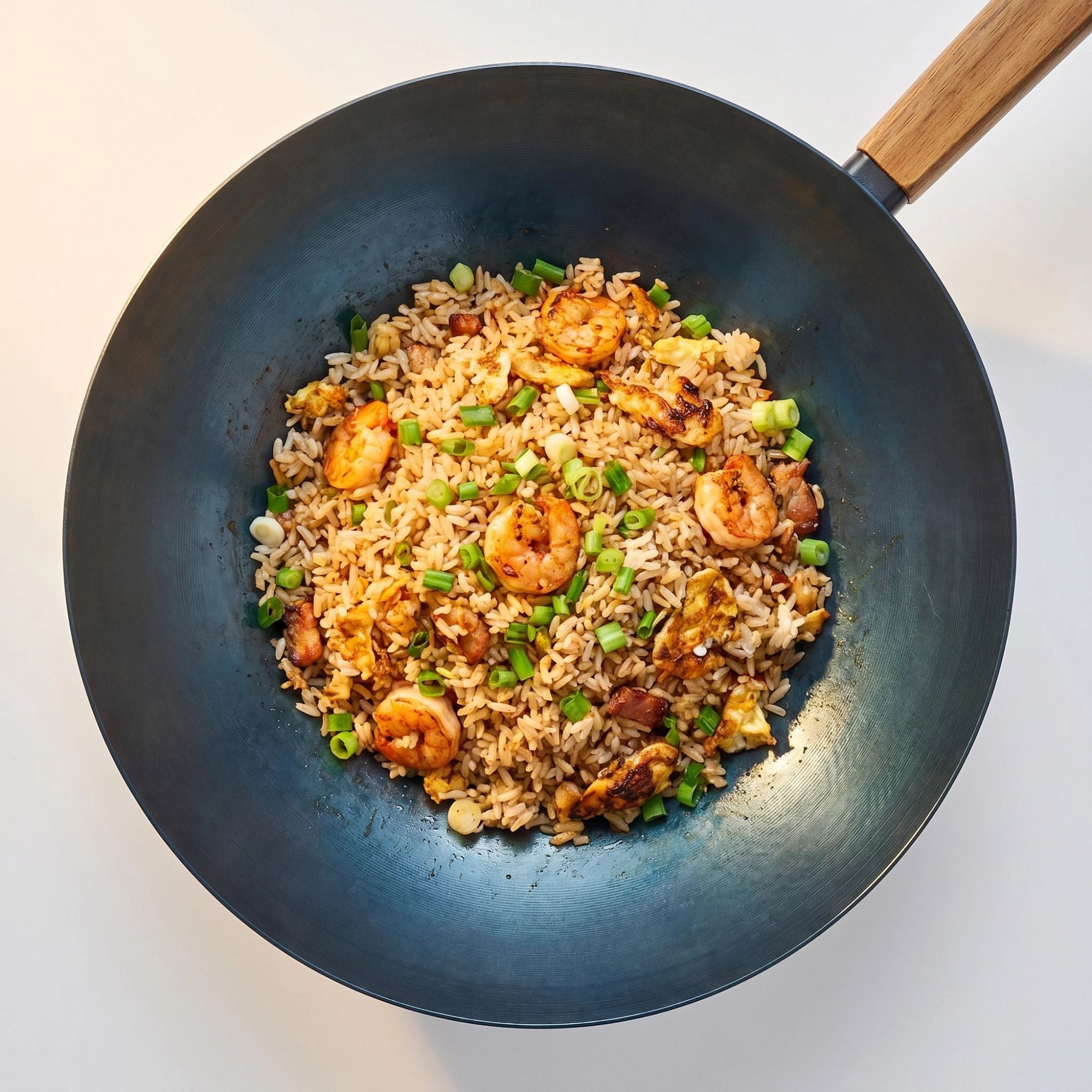
Single-use specialty pans, redundant sizes, and most "bonus" pieces in big sets. Buy specialty items (a wok, a grill pan, a tagine) individually, only when you actually cook that way - browse the full cookware collection when you do.
Frequently asked questions
How many pots and pans does one person need?
Two or three. A frying pan, a saucepan and one larger pot covers essentially everything a single person cooks, and a nesting set gives you all three plus lids in one stack. Buying more than that as a first purchase almost always ends with unused pieces at the back of a cupboard.
Is a big cookware set worth it?
It depends on the count being honest. Large sets often inflate the number by listing every lid as a piece and including near-duplicate sizes. A 12-piece set that is really seven pans and five lids is fine value if you are furnishing a whole kitchen — less so if you already own a pot.
What is the one pan to buy first?
A good frying pan, 10 or 12 inch. It does more work than anything else in the kitchen, and it is the piece where quality is most noticeable day to day. Make sure any coating is backed by published third-party testing — see our lab reports.
How many pans does a family of four need?
Four or five, and the sizes matter more than the count. You want a 12-inch frying pan rather than a 10, a 3-quart saucepan rather than a 2, and a pot of at least 5 quarts for pasta. A second skillet earns its place when two things need cooking at once.
Do you count lids as pieces?
Manufacturers usually do, and it is the single biggest reason set counts are misleading. Before comparing two sets on piece count, work out how many actual pans are in each. A 10-piece and a 7-piece set frequently contain the same number of cooking vessels.
Should I buy a set or individual pieces?
A set if you are starting from nothing — it is cheaper per piece and everything matches and stacks. Individual pieces if you already own some cookware, because you can buy exactly the gaps and spend the difference on better quality rather than on duplicates.
The bottom line
You need far less than the cookware aisle suggests. Pick three to five pieces you'll genuinely use - and if you want them in one space-saving stack, start with the Neat set.
Want to count the pieces yourself?
Every Alva set laid out with exactly what is in it — pans and lids listed separately — from a 3-piece starter to a full kitchen. Free U.S. shipping over $99.
Related reading: an answer-first comparison of the Alva lines, and see how Neat compares to other nesting & stackable cookware sets.
Our top pick5-Piece Stackable Ceramic Nonstick SetShop now →


Leave a comment
This site is protected by hCaptcha and the hCaptcha Privacy Policy and Terms of Service apply.