






Stainless Steel vs Hard-Anodized: Which Pan Should You Buy?
Hard-anodized cookware is aluminum with a hardened, oxidized surface — but on almost every consumer pan sold as “hard-anodized nonstick,” the slipperiness comes from an applied PTFE coating layered on top, and that coating wears out. Stainless steel has no coating to lose, so a good one lasts for decades, but it asks you to learn heat and fat control. Buy hard-anodized if you want cheap, low-effort eggs and accept replacing the pan every few years. Buy stainless if you want one pan you keep.
Independently tested. Alva publishes its third-party lab reports in full, with the lab, report number and date for each line. See the lab reports →
What “hard-anodized” actually means
Anodizing is an electrochemical process that thickens the natural oxide layer on aluminum. Hard-anodizing takes that further, producing a dense, dark grey surface that resists scratching and corrosion far better than raw aluminum, and stops the metal from reacting with acidic food the way a bare aluminum pan does.
That is the whole of it. Hard-anodizing is a surface treatment on aluminum — it is not a nonstick coating, and it does not make a pan release eggs. If a hard-anodized pan is marketed as nonstick, something else is doing that job.
Where the nonstick actually comes from
On the large majority of hard-anodized pans sold in the U.S., the release surface is a fluoropolymer coating — usually PTFE, the material commonly known by the brand name Teflon. The hard-anodized aluminum underneath is the body of the pan; the coating on top is what food touches.
That matters for two reasons. First, a coating is a consumable: it abrades, it loses release, and when it does, the pan is finished even though the aluminum body is perfectly intact. Second, if you are shopping specifically to avoid PFAS-class materials, “hard-anodized” on the box tells you nothing about what is on the cooking surface. If that is your concern, read our plain-English guide to PFAS, PFOA and PTFE before you buy.
A smaller number of hard-anodized pans are sold uncoated. Those behave much more like stainless: durable, no coating to fail, and no meaningful nonstick release.
Stainless steel vs hard-anodized, compared
| Hard-anodized aluminum (coated) | Fully clad stainless steel | |
|---|---|---|
| Cooking surface | Applied nonstick coating, usually PTFE | Bare stainless — nothing to wear off |
| Realistic lifespan | Limited by the coating, typically a few years of regular use | Decades; Alva’s 5-ply stainless carries a lifetime warranty |
| Release | Excellent when new, declines steadily | Requires proper preheating and fat; consistent for life |
| Browning & fond | Coating limits how hard you can sear | Builds fond, which is the base of pan sauces |
| Oven safe | Varies by brand and coating — check your manufacturer’s limit | Alva 5-ply stainless: 500°F |
| Dishwasher | Usually discouraged; accelerates coating wear | Alva Maestro 5-ply stainless is dishwasher-safe |
| Metal utensils | No | Yes |
| Induction | Only if a magnetic base is bonded on | Yes — magnetic steel exterior |
| Learning curve | Almost none | Real, but small: heat control and preheating |
How to decide
Choose hard-anodized if
You cook eggs, pancakes, delicate fish or crepes most mornings, you want zero technique, and you are comfortable treating the pan as a wear item you replace when release fades. It is the cheapest route to effortless release, and for that specific job it works.
Choose stainless if
You sear, brown, deglaze and make pan sauces; you want a pan that survives metal utensils, the oven and the dishwasher; or you are trying to buy fewer pans over your lifetime rather than more. Look for fully clad construction rather than a disc bottom — it is the single biggest determinant of whether a stainless pan heats evenly to the rim.
If you want both, the honest answer most experienced cooks land on is two pans: one clad stainless skillet for everything, plus one inexpensive coated pan reserved for eggs. That is also cheaper over ten years than replacing a premium coated pan four times.
Our stainless pick
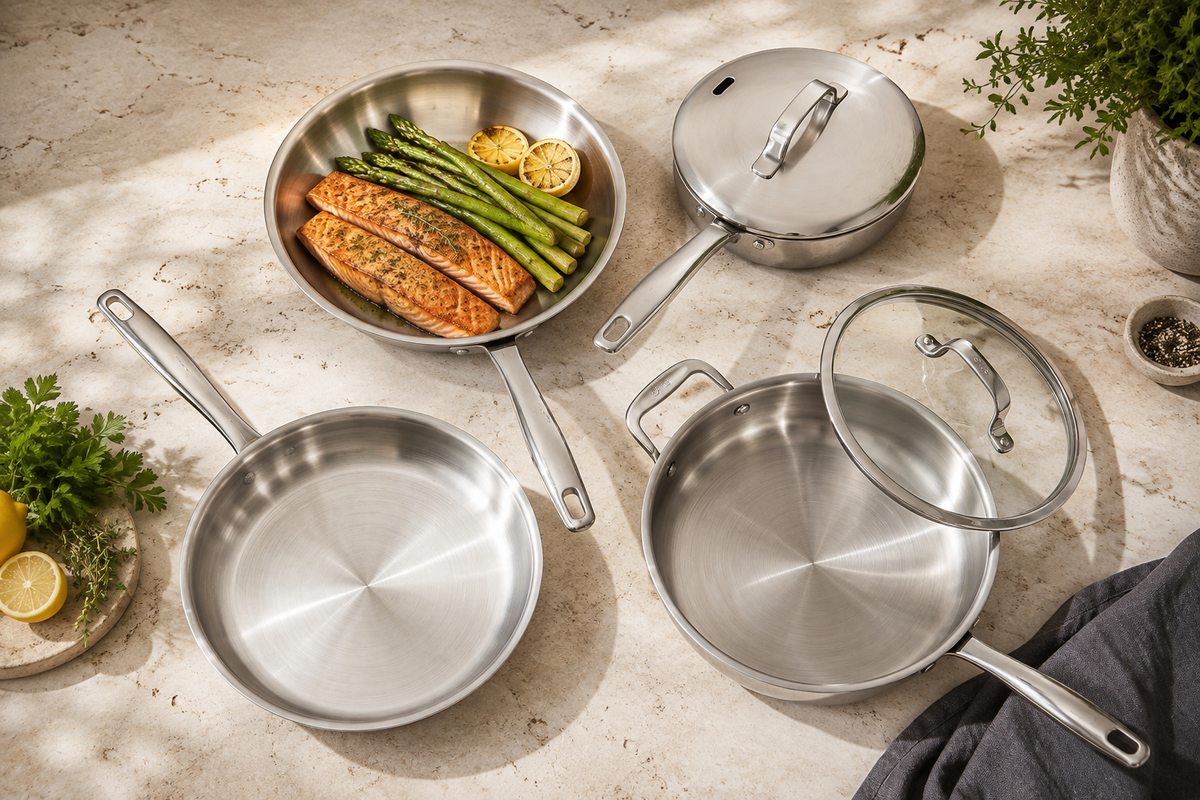
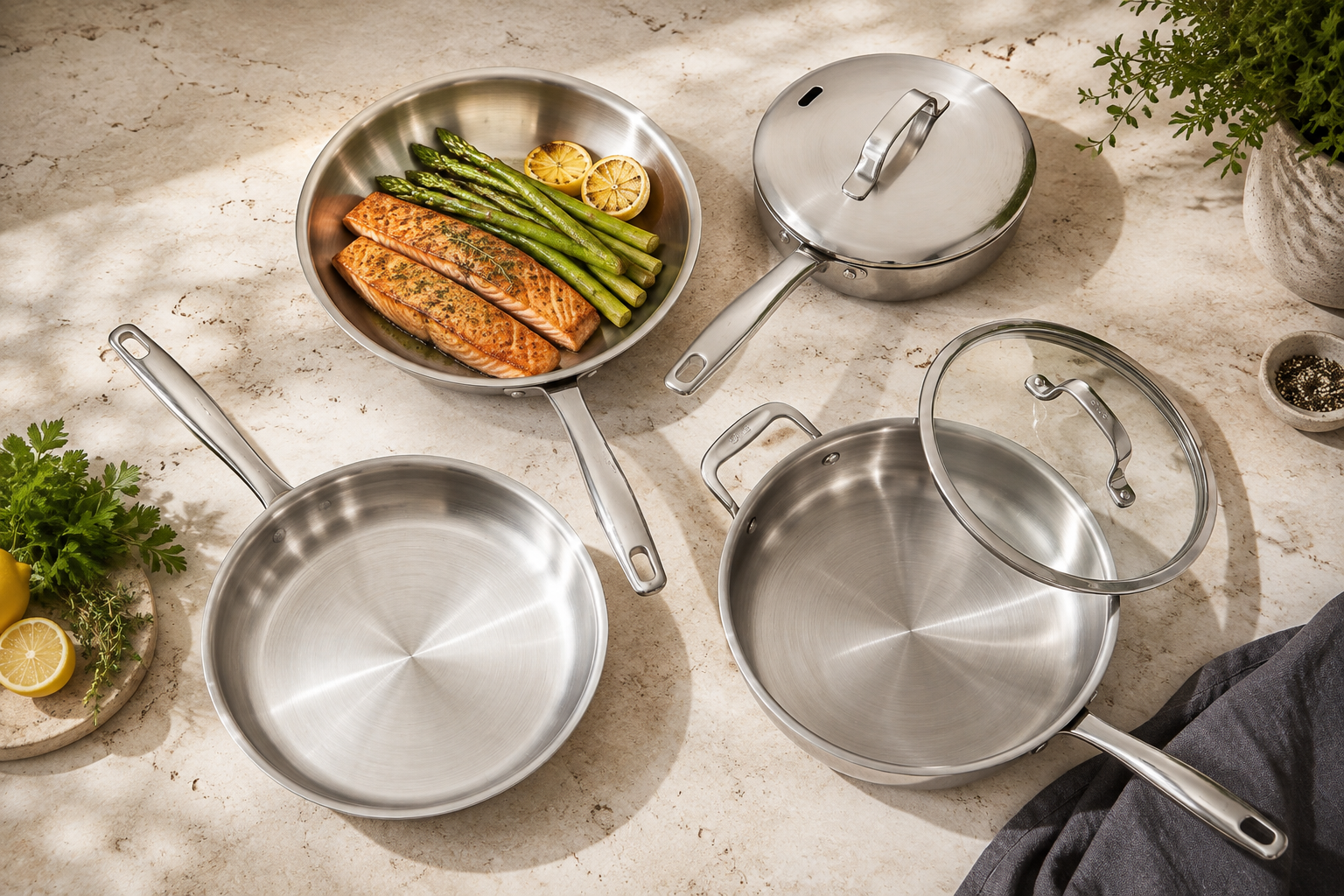
Alva’s 5-Ply Stainless Steel Frying Pan comes in 8-inch, 9.5-inch and 11-inch sizes. It is five bonded layers — aluminum cores between stainless skins — so heat spreads to the edge instead of pooling in a hot ring at the centre. It is oven-safe to 500°F, works on induction, takes metal utensils, is dishwasher-safe, and carries a lifetime warranty. Free U.S. shipping over $99.
Alva is designed in Belgium, where the company has been making cookware since 1949, and manufactured in China.
Where stainless is the wrong choice
We sell stainless, so it is worth being direct about its limits. If you cook a scrambled egg every single morning and have no interest in learning to preheat a pan, stainless will frustrate you — eggs will stick until your technique catches up, and some people never want to do that work. If you have limited grip strength, clad stainless is also noticeably heavier than an equivalent hard-anodized pan. And if your budget for a skillet is under $50, a coated pan is the more sensible buy; a cheap thin stainless pan is worse than a decent coated one.
Alva does not make hard-anodized cookware, so there is no version of this comparison where we are neutral. What we can tell you accurately is what the materials do.
Frequently asked questions
Is hard-anodized cookware safe?
The hard-anodized aluminum body is stable and non-reactive. The safety question people are usually asking is about the nonstick coating on top, which on most hard-anodized pans is PTFE. PTFE is stable at normal cooking temperatures but degrades when badly overheated, and it wears down with use. If avoiding fluoropolymers matters to you, hard-anodized does not tell you whether a pan has them — you have to check the coating.
Which lasts longer, stainless or hard-anodized?
Stainless, by a wide margin. A coated hard-anodized pan is retired when the coating gives out, usually after a few years of regular use. Bare stainless has no coating to fail, which is why it is routinely warranted for a lifetime.
Is hard-anodized cookware induction compatible?
Only if the manufacturer has bonded a magnetic stainless plate to the base. Aluminum is not magnetic on its own. Hold a fridge magnet to the bottom of the pan — if it grabs firmly, the pan will work on induction. Fully clad stainless works on induction as a matter of course.
Can you use metal utensils on hard-anodized pans?
Not on a coated one. Metal will score the nonstick layer and shorten the pan’s life. Bare stainless takes metal utensils without complaint.
Is hard-anodized better than regular nonstick?
The aluminum body is tougher and more warp-resistant than a thin stamped nonstick pan, so yes in that sense. But if both pans use the same class of coating, the coating still decides when the pan dies — a stronger body does not extend the life of the cooking surface.
Still weighing materials? Our ceramic vs stainless steel frying pan comparison covers the other coated route, and stainless vs carbon steel covers the other uncoated one. For the other common pairing, see aluminum vs nonstick pans.


Leave a comment
This site is protected by hCaptcha and the hCaptcha Privacy Policy and Terms of Service apply.