






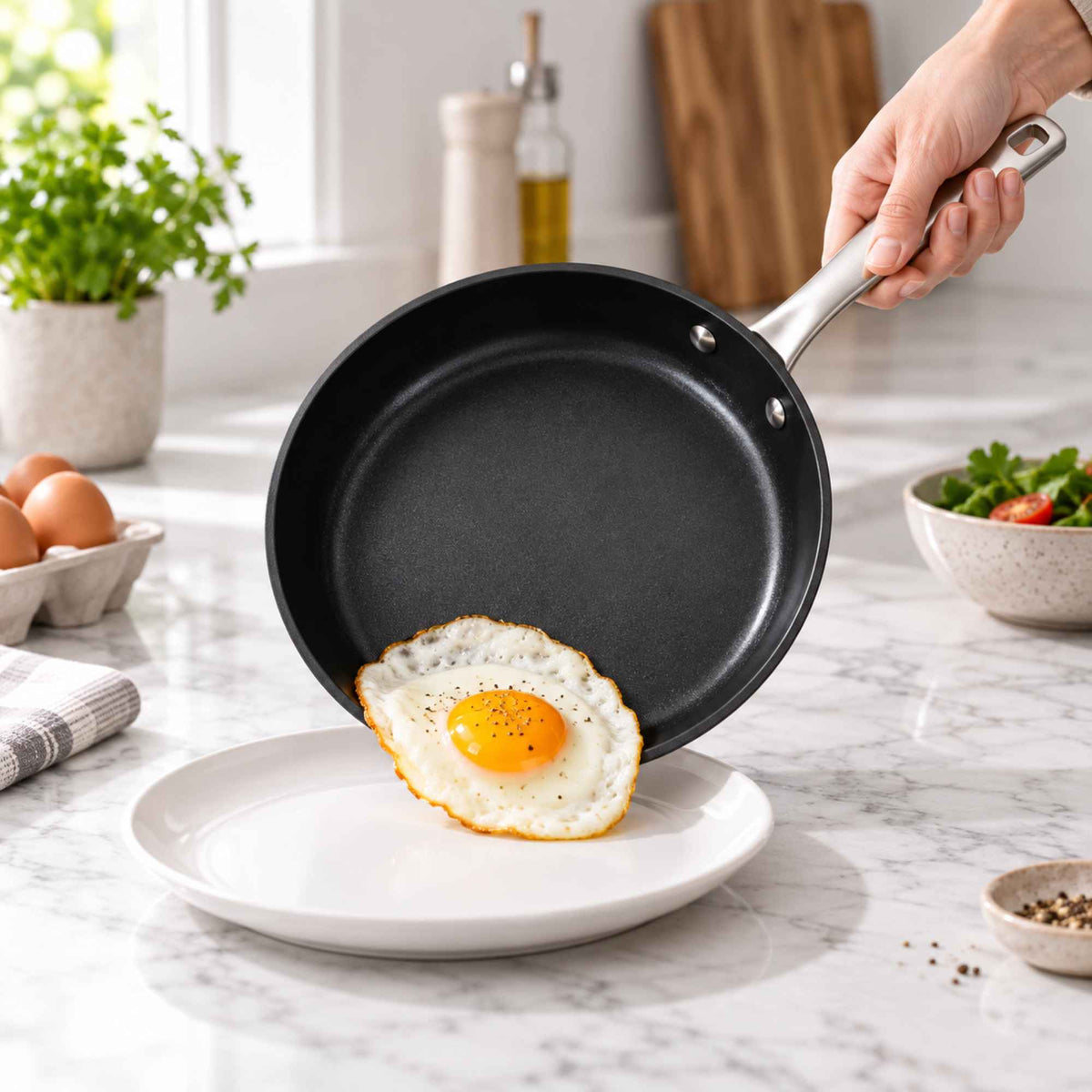
Ceramic vs Teflon Pans: Release, Heat and Lifespan Compared
Teflon-style PTFE nonstick usually keeps its slick release longer than ceramic, while ceramic (sol-gel) nonstick often releases just as well when new but tends to wear faster. PTFE is widely advised to stay below about 500°F; ceramic has no equivalent single ceiling, but it loses its release sooner if you run it hot. If you want the longest-lasting slick surface for the money, PTFE generally wins; if you want a nonstick made without PFAS and accept a shorter release life, choose ceramic and treat it gently.

Our Top Pick
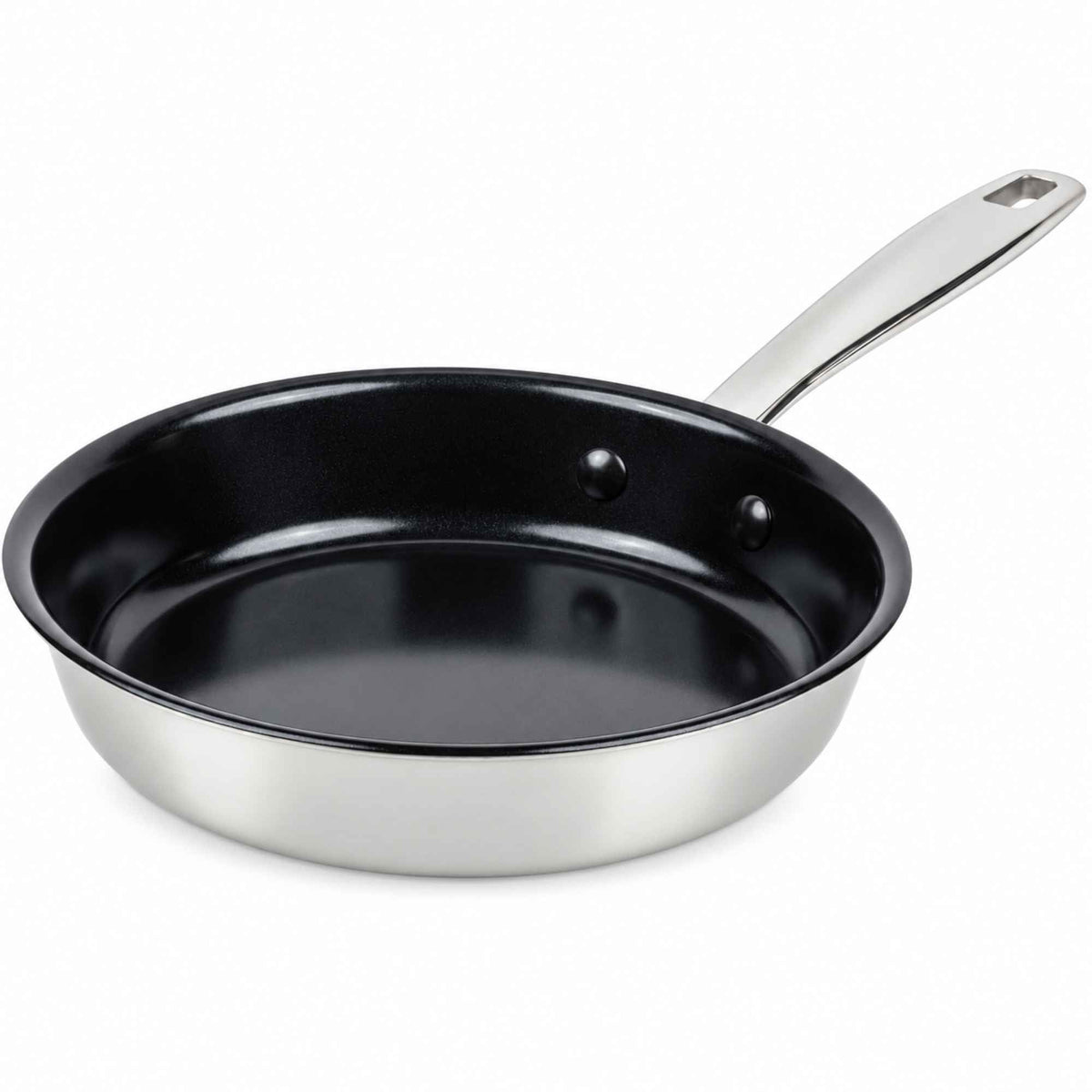
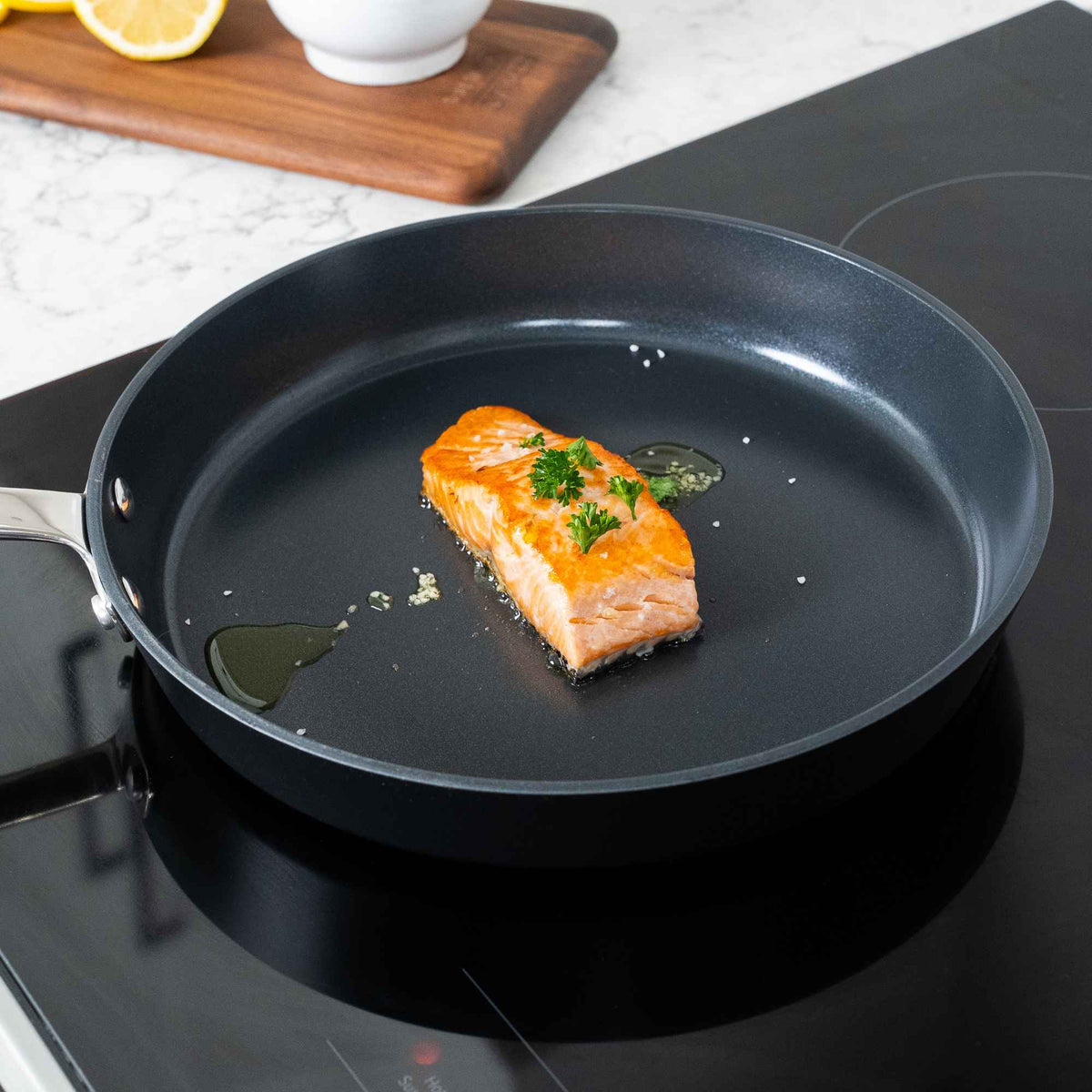
Ceramic Nonstick Frying Pan
A sol-gel ceramic coating made without PFAS, PTFE or PFOA, on a 4.5 mm forged aluminum body with a stainless steel induction base. Oven-safe to 400°F; hand wash only. $109.
Shop the Frying PanIndependently tested. Alva publishes its third-party lab reports in full, with the lab, report number and date for each line. See the lab reports →
This is a performance comparison, not a chemistry lesson. If you want the definitions first, read our plain-English guide to PFAS, PFOA and PTFE; if your question is about safety, see is ceramic cookware safe? Below, we look only at what you notice at the stove: how well food releases, how much heat each coating tolerates, how long each lasts, what care each needs, and what that works out to per year. We put this together from manufacturer guidance and published independent reviews, cited where used. We did not run our own side-by-side cooking tests for this article.
The quick difference
“Teflon” is a brand name for PTFE (polytetrafluoroethylene), the fluoropolymer used on most traditional nonstick pans. “Ceramic” nonstick is usually a sol-gel coating: a thin, glass-like layer that is bonded to the pan and cured. Both are thin coatings on a metal body, and both are consumables. Once the coating stops releasing, the pan has reached the end of its useful nonstick life, however sound the metal underneath is.
Ceramic vs Teflon, compared
Swipe left or right to compare →
| Ceramic (sol-gel) nonstick | PTFE (“Teflon”) nonstick | |
|---|---|---|
| Release when new | Excellent on good pans | Excellent on good pans |
| Release over time | Usually fades faster; more prone to chipping | Usually holds its slickness longer |
| Stovetop heat | Low to medium; high heat speeds up wear | Low to medium; widely advised to stay under about 500°F (260°C) |
| Oven rating | Set by each maker; Alva Maestro and Neat ceramic: 400°F (Energy is stovetop-only) | Set by each maker; commonly around 400–500°F |
| Typical useful life | A few years of regular use (one ceramic maker cites 2–5 years) | Several years; a quality coating can reach 5–7 years with good care |
| Metal utensils | No | No, unless the maker specifically rates it for metal |
| Cleaning | Hand wash with a soft sponge (Alva ceramic is hand-wash only) | Check the maker; hand washing extends coating life |
| Cooking sprays | Avoid; residue builds up and dulls release | Avoid for the same reason |
| Made with PFAS? | Sol-gel ceramic is not a fluoropolymer; look for independent testing | Yes; PTFE is itself a PFAS-class fluoropolymer |
How to read it: ranges are typical, not guarantees. Coating quality, how many layers are applied, and above all how you cook decide where a given pan lands. Lifespan and heat figures are drawn from the sources linked in the sections below; oven ratings are always pan-specific, so check your own pan’s instructions.
Food release: close when new, different after a year or two
Out of the box, a good ceramic pan and a good PTFE pan are hard to tell apart with an egg. In Consumer Reports’ most recent nonstick frying pan ratings, pans with ceramic coatings took the top three slots ahead of traditional nonstick. That is a strong result for ceramic, but it largely reflects release and evenness on relatively new pans.
The gap opens with time. America’s Test Kitchen notes that ceramic pans typically wear faster than traditional nonstick, and that chipping is now more common on ceramic. In practice, a ceramic pan tends to go from “eggs slide” to “eggs need a little butter” sooner than a comparable PTFE pan.
Heat tolerance: two different kinds of limit
The two coatings fail heat in different ways, and that matters more than any single number.
PTFE has a hard ceiling
The commonly cited guidance for PTFE nonstick is to keep it below about 500°F (260°C), above which the coating can begin to break down. An empty pan on a high burner can get there faster than most people expect, which is why PTFE pans are best preheated with a little fat in them and kept at low to medium heat. Searing hard in a PTFE pan is the wrong use of it.
Ceramic has a soft ceiling
A sol-gel ceramic coating is not a fluoropolymer, so it does not share PTFE’s 500°F guidance. That does not make it a searing pan. Repeated high heat is one of the main reasons ceramic loses its release: oils polymerize into a thin, sticky film, and the surface wears faster. Alva’s own care guidance for its ceramic is low to medium heat for exactly this reason. Oven ratings are set pan by pan; Consumer Reports notes that many nonsticks are oven-safe only to 400° to 500°F. Alva’s Maestro and Neat ceramic are oven-safe to 400°F, and the Energy line is stovetop-only. For the details, see can ceramic pans go in the oven?
The practical takeaway: PTFE has a firm upper limit you should respect every time; ceramic has no equivalent single number but pays for heat with faster wear. Neither is the pan for a hard sear. For that, you want uncoated stainless, carbon steel or cast iron.
Lifespan: how long each one actually lasts
No nonstick coating lasts forever, and the honest numbers are ranges:
- PTFE: the Cookware and Bakeware Alliance told America’s Test Kitchen that a pan with a quality coating can be expected to last five to seven years, up from two to three years a decade earlier. Budget pans with thinner coatings usually fall well short of that.
- Ceramic: GreenPan, a ceramic nonstick maker, told Consumer Reports its coatings are expected to last two to five years, possibly more with good care. Our own guidance is similar: a quality ceramic pan generally lasts a few years of regular use, and cheap ceramic much less.
Both ranges overlap, and care moves a pan within its range more than brand does. But on like-for-like quality and care, PTFE generally keeps its release longer.
Care: what shortens each coating’s life
The care rules are almost identical, which is useful: the habits that protect one protect the other.
- Keep the heat at low to medium. Most nonstick cooking needs no more than that.
- Skip aerosol cooking sprays. They leave a residue that bakes on and dulls release. Use a little oil or butter instead.
- Use silicone, nylon or wood. Metal utensils scratch both coatings.
- Hand wash with a soft sponge and let the pan cool first. Abrasive pads and sudden cold water are hard on both.
- Store with a protector if you stack pans.
Ceramic is slightly less tolerant of neglect, mostly because baked-on oil film shows up faster on it. Our step-by-step guide on how to make ceramic nonstick last covers cleaning off that film before you decide a pan is finished.
Cost per year: the honest arithmetic
Price divided by useful years is the fairest way to compare. As an illustration only, using round numbers rather than any specific product: a $40 PTFE pan that lasts five years costs about $8 a year. A $119 ceramic pan that lasts three years costs about $40 a year; if careful use gets it to five years, that drops to about $24 a year.
On cost per year alone, a decent inexpensive PTFE pan is hard to beat. You pay more for ceramic to get a nonstick made without PFAS and, on better pans, often a heavier body that heats more evenly. Whether that is worth it depends on how much the PFAS question matters to you. Our PFAS guide and best nonstick pans guide can help you weigh it.
One thing to be clear about: a long warranty on a nonstick pan does not extend the life of the coating. Alva’s warranty covers manufacturing defects, and gradual loss of nonstick performance is treated as normal wear, not a defect. Whoever makes your pan, read the warranty terms rather than the headline number.
Our ceramic pick
If you’ve decided on ceramic, Alva’s Ceramic Nonstick Frying Pan comes in 8-inch, 9.5-inch and 11-inch sizes. It has a sol-gel ceramic coating on a 4.5 mm forged aluminum body with a stainless steel induction base, works on gas, electric and induction, and is oven-safe to 400°F. The coating is made without PFAS, PTFE or PFOA, and Alva’s coated lines are covered by published TÜV Rheinland reports on a 638-substance PFAS panel. It carries a 10-year limited warranty against manufacturing defects. Hand wash only. Free U.S. shipping over $99.
If you would rather stop replacing coated pans altogether, the uncoated 5-Ply Stainless Frying Pan has no coating to wear out. Our ceramic vs stainless steel frying pan comparison covers that trade-off. Alva has designed cookware in Belgium since 1949; its pans are manufactured in China.
Where ceramic isn’t the right choice
We sell ceramic nonstick and not PTFE, so it is worth saying plainly where ceramic loses. If your only goal is the longest-lasting slick surface for the least money, a well-made PTFE pan generally keeps its release longer and costs less per year. If you regularly cook over high heat, or tend to walk away from a hot pan, ceramic will lose its release faster, and you would be better served by carbon steel or stainless. And if you want a dishwasher-friendly pan, ceramic is not it. Ceramic is the right choice when you want a nonstick made without PFAS and are willing to cook at moderate heat and hand wash to get the most out of it.
Frequently asked questions
Which lasts longer, ceramic or Teflon?
On like-for-like quality and care, PTFE (Teflon-style) nonstick generally keeps its release longer. A quality PTFE coating can last around five to seven years with good care, while one ceramic maker cites two to five years for its coatings. How you cook and clean moves either one within its range more than the brand does.
Can ceramic pans handle higher heat than Teflon?
Ceramic does not share PTFE’s widely cited limit of about 500°F, but that does not make it a high-heat pan: repeated high heat wears ceramic’s release quickly, so both coatings do best at low to medium heat. Oven ratings are set by each maker; Alva’s Maestro and Neat ceramic are oven-safe to 400°F, and Energy is stovetop-only.
Why is my ceramic pan losing its nonstick?
The usual causes are high heat, aerosol cooking sprays and baked-on oil film. Often the coating is not worn out but covered in a thin polymerized layer. Clean it with warm water, baking soda and a soft sponge, then cook at low to medium heat with a little oil or butter. If food still sticks after that, the coating has likely reached the end of its life.
Does the warranty cover the nonstick coating wearing out?
Not on Alva pans. Alva’s warranty covers manufacturing defects; gradual loss of nonstick performance is treated as normal wear. The Maestro ceramic line and Neat carry a 10-year limited warranty and Energy carries 5 years, but none of these extends the coating’s working life.
Is ceramic worth it if it wears faster than Teflon?
It depends on what you are paying for. On cost per year, a decent PTFE pan is hard to beat. Ceramic is worth it if you want a nonstick made without PFAS and are happy to cook at moderate heat and hand wash. If you want a pan that never needs replacing, choose uncoated stainless or carbon steel instead.
Own Scanpan? Its main lines contain PTFE. Compare Scanpan alternatives made without PTFE.
Our top pickCeramic Nonstick Frying PanShop now →

%20nonstick%20often%20releases%20just%20as%20well%20when%20new%20but%20tends%20to%20wear%20faster.%20PTFE%20is%20widely%20advise...)
Leave a comment
This site is protected by hCaptcha and the hCaptcha Privacy Policy and Terms of Service apply.