






Staub vs Le Creuset (2026): Which French Dutch Oven Should You Buy?
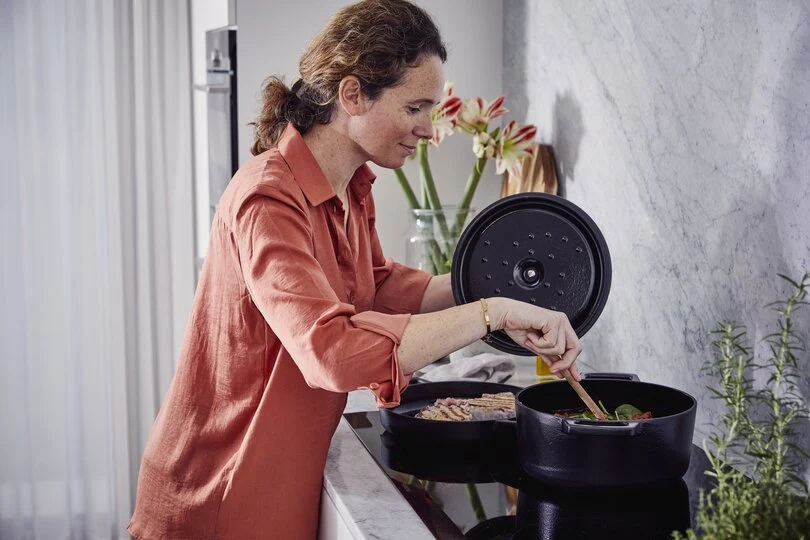
Staub and Le Creuset make equally capable French enameled cast iron Dutch ovens: both 5.5-quart rounds are oven-safe to 500°F, made in France and backed by a limited lifetime warranty. The real difference is the inside. Staub has a textured matte black interior and a spiked, self-basting lid built for searing and braising. Le Creuset has a light, smooth interior that makes it easy to watch browning and bread, and it's the lighter pot of the two. If you want the same core specs for less, look at the Alva Nori 5-Qt.
By the Alva Cookware Test Kitchen · Published September 29, 2026 · Specs checked against each maker's US product pages, September 2026; prices change often, so check the maker's site for current pricing.

Our Top Pick
Enameled Cast Iron Round Dutch Oven, 5-Qt
The lower-cost pick with the same core specs: oven-safe to 500°F, induction-compatible and a dark enamel interior. Backed by a 25-year limited warranty.
Shop the Dutch OvenIndependently tested. Alva publishes its third-party lab reports in full, with the lab, report number and date for each line. See the lab reports →
Staub vs Le Creuset is the classic high-end Dutch oven decision, and it's usually framed as a matter of taste. Most of it isn't. Both brands cast in France, both rate their pots to 500°F, both say the pots are dishwasher-safe and recommend hand washing, and both sell their 5.5-quart round for roughly the same money. What separates them is two design choices: the colour and texture of the interior enamel, and what happens under the lid. Those two things decide which pot suits the way you cook. Below we compare the published specs side by side and explain what each difference means in the kitchen. We also cover when a less expensive pot makes more sense.
Staub vs Le Creuset at a glance
We compared the size each brand sells the most of, the 5.5-quart round, using only what Staub (staub.com/zwilling.com) and Le Creuset (lecreuset.com) publish on their US product pages. The Alva Nori 5-Qt is included as a lower-cost reference point.
Swipe left or right to compare →
| Spec | Staub Round Dutch Oven, 5.5 qt | Le Creuset Signature Round, 5.5 qt | Alva Nori Round, 5 qt |
|---|---|---|---|
| Price tier | Premium | Luxury | Lower cost |
| Interior enamel | Textured matte black | Light-coloured, smooth | Dark (black) enamel |
| Lid design | Heavy lid with spikes (“bumps”) underneath for self-basting | Tight-fitting lid designed to circulate steam and return moisture; no spikes stated | Heavy lid; underside design not stated |
| Oven-safe (maker's rating) | 500°F | 500°F | 500°F |
| Knob heat limit | Not stated separately; Staub says knobs vary and to check each piece's specs | 500°F (Le Creuset FAQ) | Not stated separately |
| Weight | About 12.8 lb (independent measurement) | About 11.5 lb (independent measurement) | 14.7 lb |
| Wall thickness | About 4.2 mm (independent measurement) | About 3.6 mm (independent measurement) | Not stated |
| Dishwasher | Dishwasher-safe, hand wash recommended | Dishwasher-safe, hand washing recommended | No: hand wash only |
| Warranty | Limited lifetime | Limited lifetime | 25-year limited |
| Made in | France | France | China (designed in Belgium) |
How to read it: on the numbers that decide whether a Dutch oven can do the job (oven rating, warranty, induction compatibility), Staub and Le Creuset are identical. The rows that differ are interior, lid and weight. Those are the rows to decide on. Price tiers reflect each maker's list price for a standard colour. Prices change often, and both brands run promotions and factory-second sales, so check the maker's site for current pricing.
Specs checked on each maker's US site in September 2026: staub.com (5.5 qt Round Dutch Oven, Matte Black and Pure White), lecreuset.com (Signature Round Dutch Oven, 5.5 qt) and alva-cookware.us. Prices change often, so check the maker's site for current pricing. “Not stated” means the maker doesn't publish that figure on its US product page. We haven't estimated it.
The biggest difference: black matte vs light interior
Staub describes its interior as a textured black matte enamel that “ensures exceptional browning.” The fine texture gives oil somewhere to sit, and Staub says fats gradually condition the surface so release improves with use. It isn't seasoning in the bare-cast-iron sense. The dark colour also hides the staining that every enameled pot picks up after years of tomato sauce and seared meat.
Le Creuset goes the other way: a light-coloured, smooth interior that, in its own words, “allows easy monitoring of cooking progress.” That matters more than it sounds. When you're building fond for a stew, toasting spices or judging the colour of a roux, you can see what's happening on a light surface. On black enamel you're judging by smell and timing. The trade-off is that a light interior shows every stain and mark over time.
Neither is better in the abstract. If you sear hard and braise often, Staub's surface is built for that. If you bake bread, make pale sauces or simply like to see the bottom of the pot, Le Creuset's is easier to cook on.
Lids: self-basting spikes vs a smooth, tight-fitting lid
Staub's signature feature is the underside of the lid. Staub says the spikes and swirls there collect condensing steam and drip it back evenly onto the food, which it calls a “rain-forest effect.” It's designed for long, covered braises: short ribs, coq au vin, pot roast.
Le Creuset's Signature lid is smooth underneath. Le Creuset says its tight-fitting lids are designed to circulate steam and return moisture to the food. So both brands are solving the same problem. Staub puts the solution in the lid's texture. Le Creuset relies on the fit.
We haven't run a side-by-side braise, and we won't claim a measurable difference that neither maker has published. The practical point: both lids seal well. If you're going to use a spiked lid for the full effect, Staub is the only one of the two that has it.
Weight, handling and knobs
Neither brand publishes the weight of its 5.5-quart round on its US product page. Le Creuset does say its cast iron is the “lightest weight cast iron by quart on the market,” and Staub describes its lid as heavy weight. If you have to lift a full pot out of a hot oven, or if wrist strength is a concern, that's a real point in Le Creuset's favour. Pick both up in a store if you can.
Measured weights. Independent testing by Prudent Reviews weighed the 5.5-quart Staub at 12.8 lb and the 5.5-quart Le Creuset at 11.5 lb, and measured Staub's walls at 4.2 mm against Le Creuset's 3.6 mm. The Alva Nori 5-Qt is 14.7 lb. So Le Creuset is the lightest of the three, Staub sits in the middle, and the Nori trades the most weight for the lowest price.
On knobs: Le Creuset's FAQ says both the pot and the knob are oven-safe to 500°F, and some colourways carry a stainless steel knob it describes as safe at any oven temperature. Staub rates its Dutch ovens to 500°F with the lid on. Its care guide says knobs and accessories vary, so you should check the specs for your particular piece. That matters mostly if you bake bread at 500°F with the lid on. At normal braising temperatures, neither knob is a concern.
Handles. Le Creuset's side handles have the wider opening, about 1.25 inches against roughly 0.8 inches on Staub, which matters when you are lifting with thick oven mitts. Staub's knob is steel on a thin stem; Le Creuset uses a steel or synthetic knob on a thicker stem, depending on the colour.
Price, warranty and where they're made
At list price, the 5.5-quart Staub sits in the premium tier and the 5.5-quart Le Creuset Signature just above it in the luxury tier, but the gap between them is too small to decide on. Both are made in France. Staub says its pieces come from its own foundry there, and Le Creuset says it has crafted its pots in France since 1925. Both carry a limited lifetime warranty. Both sell the 5.5-quart in a wide range of colours.
Sizes and colours: what each brand offers
Staub makes more sizes: its round cocotte comes in nine sizes from 0.5 to 13.25 quarts, plus four ovals (1, 4, 7 and 8.5 quarts). Le Creuset's round Dutch oven comes in five sizes from 2 to 7.25 quarts, plus five ovals from 1 to 6.75 quarts. Le Creuset wins on colour, with about 20 exterior colours against Staub's nine. If you want an unusually small or very large pot, or a specific shade, that may settle it; for the everyday 5 to 5.5 quarts both brands have you covered, and the choice comes back to the interior and the lid. Not sure which size you need? See our Dutch oven size guide.
Staub or Le Creuset: which should you buy?
Choose Staub if…
- You mostly sear, brown and braise, and you want a matte interior built for browning.
- You like the idea of a spiked, self-basting lid for long, covered cooks.
- You'd rather the interior hide stains than show every mark.
Choose Le Creuset if…
- You want to see what's happening on the bottom of the pot: fond, roux, caramelisation.
- Weight matters to you. Le Creuset claims the lightest cast iron by quart.
- You bake a lot of bread and want a knob the maker explicitly rates to 500°F.
Either way, 5 to 5.5 quarts is the everyday size for most households and fits a standard boule. Our Dutch oven size guide goes through the other sizes quart by quart.
The value alternative: Alva Nori 5-Qt
If you like what Staub and Le Creuset do but not the premium-to-luxury price, the Alva Nori Enameled Cast Iron Round Dutch Oven, 5-Qt is the lower-cost option. On the specs that decide whether a pot can do the job, it matches them: oven-safe to 500°F, works on gas, electric, ceramic, halogen and induction, needs no seasoning, and carries a 25-year limited warranty. The enamel is non-reactive, so tomato, wine and citrus are fine, and like every Alva line it's made without lead or cadmium and lab-tested for both. Alva is a cookware maker designed in Belgium since 1949. The Nori is manufactured in China.
In the Staub-vs-Le Creuset split, the Nori sits on the Staub side: it has a dark enamel interior and a heavy lid. At 14.7 lb it's a substantial pot. That weight is thermal mass, which is what keeps a slow braise steady, but it's more to lift than a Le Creuset. For the wider field, see our Le Creuset alternatives comparison and our full Dutch oven buying guide, which explains how we choose our picks.
Where the Nori isn't the right choice
Be honest about what you're buying. If you want a light interior so you can watch your fond, the Nori's dark enamel won't give you that. Le Creuset will. If you want the lightest pot you can lift, the Nori isn't it. If you want dishwasher convenience, Alva says hand wash only, while Staub and Le Creuset both rate their pots dishwasher-safe. If French casting or a specific colour matters to you, the Nori is made in China and offered in a single finish. What you give up is weight, the choice of colours and the French badge. What you keep is a 500°F enameled cast iron pot with a 25-year limited warranty for noticeably less.
French-oven specs, without the French-oven price.
The Alva Nori 5-Qt Round: enameled cast iron, oven-safe to 500°F, induction-ready, 25-year limited warranty. Free U.S. shipping over $99.
Caring for either pot
Staub, Le Creuset and Alva give much the same care advice for enameled cast iron. Preheat gradually over low to medium heat, avoid sudden temperature changes (no cold water into a hot pot), use wooden or silicone utensils, and don't knock metal tools on the rim, where chips usually start. Staub specifically recommends a soak and baking soda or Bar Keepers Friend for stubborn residue. Our cast iron cleaning guide covers the routine step by step, and no-knead Dutch oven bread is a good first recipe for any new pot.
Frequently asked questions
Is Staub or Le Creuset better?
Neither is better overall. Both 5.5-quart rounds are made in France, oven-safe to 500°F and covered by a limited lifetime warranty. Staub suits cooks who sear and braise, thanks to its matte black interior and self-basting spiked lid. Le Creuset suits cooks who want a light interior to monitor browning and a lighter pot to lift.
Why is the inside of a Staub Dutch oven black?
Staub uses a textured matte black enamel that it says promotes browning and caramelization. Staub also says cooking fats gradually condition the surface, so release improves over time. It doesn't need seasoning like bare cast iron, and the dark colour hides staining.
Is Staub heavier than Le Creuset?
Yes, a little. Neither brand publishes the weight, but independent testing by Prudent Reviews measured the 5.5-quart Staub at 12.8 lb and the 5.5-quart Le Creuset at 11.5 lb, and found Staub's walls thicker (4.2 mm vs 3.6 mm). If lifting a full pot is a concern, Le Creuset is the easier of the two.
Can Staub and Le Creuset go in the dishwasher?
Both makers say their enameled cast iron is dishwasher-safe but recommend hand washing to preserve the enamel. The Alva Nori is hand wash only. Whatever the brand, hand washing with warm water, mild soap and a soft sponge is the safest routine for enamel.
Is there a cheaper alternative to Staub and Le Creuset?
Yes. The Alva Nori 5-Qt Round is a lower-cost option. It's enameled cast iron, oven-safe to 500°F, induction-compatible and covered by a 25-year limited warranty. It has a dark interior like Staub, weighs 14.7 lb, and is designed in Belgium and made in China. See our Le Creuset alternatives guide for more options at other prices.
Do you need to season a Staub or Le Creuset Dutch oven?
No. The enamel is a layer of glass fused to the cast iron, so there is nothing to season and nothing to rust. Wash, dry and cook. The same is true of the Alva Nori and any enameled cast iron pot.
Do Staub and Le Creuset work on induction?
Yes. Cast iron is magnetic, so both brands work on induction as well as gas, electric and ceramic glass. Lift rather than slide a heavy pot on a glass cooktop. The Alva Nori 5-Qt works on induction too.
Which size Staub or Le Creuset should you buy?
Five to 5.5 quarts suits most households of two to four and fits a standard loaf of no-knead bread. Go to about 7 quarts for a family of five or more, or for whole chickens. Our Dutch oven size guide goes through every size.


Leave a comment
This site is protected by hCaptcha and the hCaptcha Privacy Policy and Terms of Service apply.