






Building Trust Through Transparency: Why Alva Cookware Created a Testing & Certifications Hub
Trust in cookware should be earned with evidence. That is why Alva built a testing and certifications hub - so you can see the proof behind every claim.
Transparency by design
Rather than asking you to take non-toxic on faith, we publish what we test for and how. Every coated range is screened by independent labs for PFAS, PTFE, and PFOA - the details are in our safety standards.

Our Top Pick
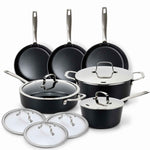
Ceramic Nonstick Cookware Set, 12-Piece
A complete ceramic nonstick kitchen in one set. Made without PFAS, PTFE or PFOA, supported by published third-party testing, induction-ready and backed by a 10-year limited warranty.
Shop the 12-Piece SetWhy it matters
Forever chemicals are exactly that - they do not leave the body. Removing that question from your kitchen is the whole point. For the background, read what PFAS, PFOA and PTFE actually are and see the best non-toxic cookware for 2026.
What the hub actually contains
The testing and materials page is one place where we publish the independent test reports for our coated cookware. The reports come from TÜV Rheinland, a third-party testing organization, and they cover the sol-gel ceramic nonstick coating used on our Maestro Ceramic, Neat and Energy pieces. For each report you can see who ran the test, when it was run, what sample was submitted, what was tested for and what the result was. We also link a one-page ceramic test summary for readers who want the conclusion without the full document.
The tests address the question people actually ask about a nonstick coating: whether PFAS, PTFE or PFOA are present. The exact parameters, methods and results are in the documents themselves rather than paraphrased here, so you can check them directly. Nothing on the page is a description of a certificate we hold privately.
Published report versus third-party tested
Many brands say their cookware is third-party tested. That phrase on its own tells you very little. It does not say which lab, which product, which substances, or what the result was. A brand can order one test on one sample, get a pass on one parameter, and truthfully describe the whole range as tested.
A published report is different. You can read the lab name, the report number, the date, the sample description and the analytical method, and you can check the result yourself. If a report is several years old, or covers a different product than the one you are buying, you can see that too. The difference is not the testing. It is whether you are asked to trust a sentence or shown a document.
How to read a test summary
- Lab and report number. Confirms the document is a real report and not a marketing graphic.
- Sample description. Should match the product or coating you are buying. A test on a lid is not a test on a frying pan.
- Substances tested. Look for named substances (PFOA, PTFE, specific PFAS compounds) rather than a general "free from harmful chemicals".
- Method and detection limit. "Not detected" always means not detected above a stated limit. A good summary states that limit.
- Date. Coatings and suppliers change. A recent report is worth more than an old one.
Our guide to how to tell if cookware is non-toxic walks through these checks in more detail, and is ceramic cookware safe explains what sol-gel ceramic is and what a test can and cannot tell you.
Coated and uncoated Alva lines
Only some of our cookware has a coating, and only coated cookware needs a coating test.
- Coated: Maestro Ceramic Nonstick, the Neat stackable set and the Energy range. All use a sol-gel ceramic nonstick coating made without PFAS, PTFE or PFOA, and these are the lines covered by the TÜV Rheinland reports on the hub.
- Uncoated: Maestro 5-Ply Stainless (an 18/10 stainless steel cooking surface), Artist, Black Angus and Forest carbon steel (bare steel that carries a seasoning layer), and Nori enameled cast iron (a vitreous enamel surface, not a nonstick coating).
Uncoated lines are not tested for PFAS because there is no nonstick layer for those substances to be in. Stainless steel is stainless steel. Carbon steel is iron and carbon. Saying an uncoated pan is made without PFAS is true, but it is true by construction rather than by test result, and we would rather be clear about that distinction than borrow credibility from a report that does not apply.
If the coated side of that list is what you want, our Ceramic Nonstick Cookware Set, 12-Piece uses the same sol-gel ceramic nonstick the hub's TÜV Rheinland reports cover, so you can read the document first and buy second.
What to ask any brand
If a brand says its cookware is safe, non-toxic or tested, these questions will tell you quickly whether there is anything behind the words.
- Which lab ran the test, and can I see the report?
- Which product or coating was tested, and is it the same one being sold now?
- Which substances were tested for, and what was the detection limit?
- When was the test done?
- Does the claim apply to the whole range, or to one product?
A brand that publishes will answer all five with a link. A brand that does not will usually answer with adjectives. For a wider look at which materials hold up to this scrutiny, see our best non-toxic cookware guide and the full safety standards we hold ourselves to.
Shop with confidence across nonstick, stainless, and cast iron - or browse the best-selling sets.
Frequently asked questions
Who tests Alva's coated cookware?
TÜV Rheinland, a third-party testing organization. Its reports cover the sol-gel ceramic nonstick coating used on Maestro Ceramic, Neat and Energy.
Are Alva's uncoated lines tested for PFAS?
No, because there is no nonstick coating for PFAS to be in. Stainless steel, carbon steel and enameled cast iron are made without PFAS by construction rather than by test result.
Is Alva cookware tested for lead and cadmium?
Yes. Every Alva line is lab-tested for lead and cadmium.
Where can I read the test reports?
On the testing and materials page, which lists the lab, report number, date, sample and result for each report, plus a one-page ceramic test summary.




Leave a comment
This site is protected by hCaptcha and the hCaptcha Privacy Policy and Terms of Service apply.