






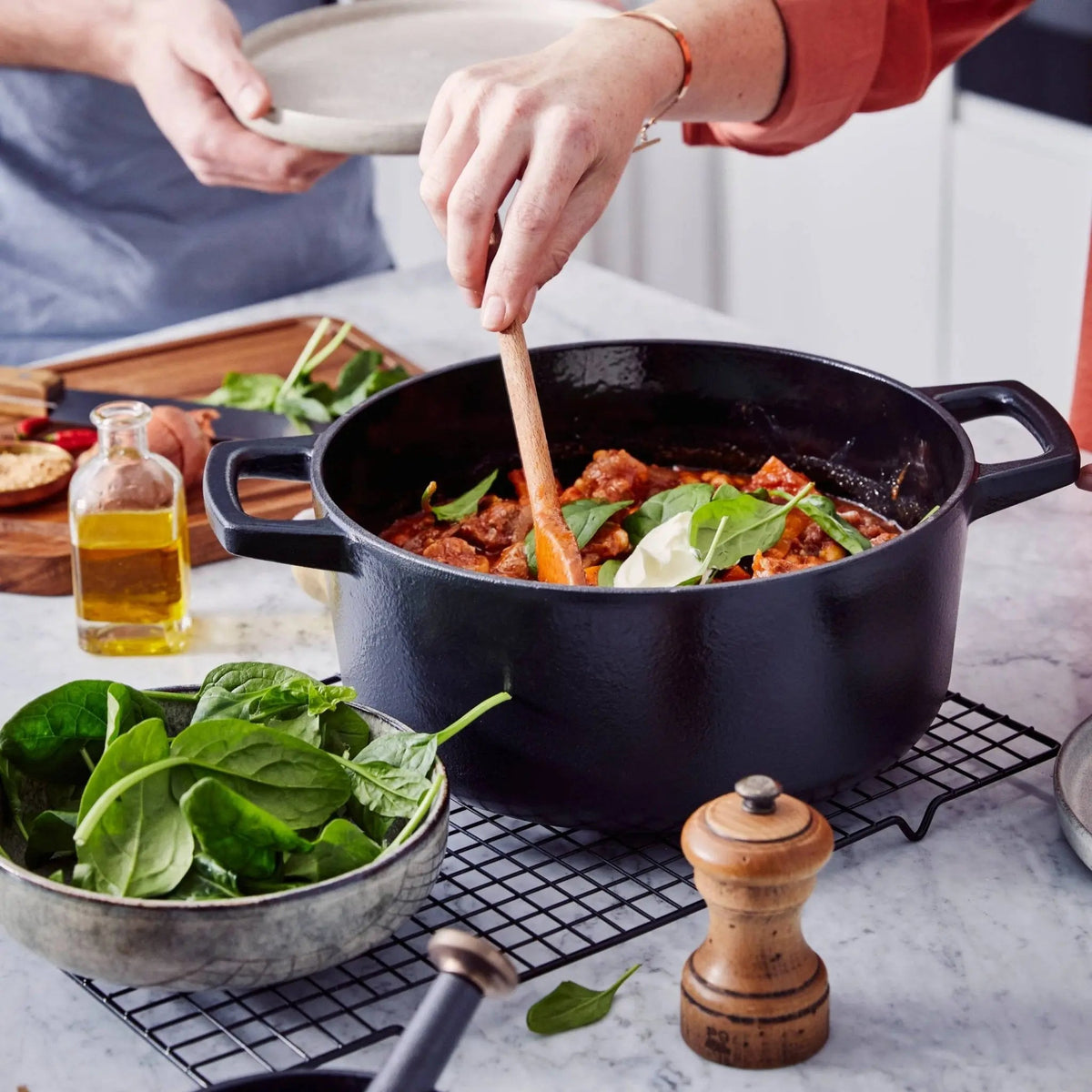
Best Dutch Oven (2026): An Honest Enameled Cast Iron Buying Guide
For most kitchens, the best Dutch oven is a 5- to 6-quart enameled cast iron pot with a heavy, tight-fitting lid rated for the same oven temperature as the pot. By budget: Lodge's 6-Qt (about $90-100) and Tramontina's 6.5-Qt (about $100) are the best cheap picks; Alva Nori 5-Qt and Made In 5.5-Qt ($299) are the mid-range picks; Le Creuset ($455) and Staub ($430) are the luxury picks. Enameled cast iron gives you the heat retention of raw cast iron without the seasoning routine, and it handles the wine and tomato braises that bare iron doesn't love. Size matters more than brand: 5 qt fits 2–4 people, 6–7 qt fits 4–6 and a whole chicken.
By the Alva Cookware team · Updated October 5, 2026 · Competitor specs and prices checked on each maker's US site in October 2026; prices change often, so check the maker's site for current pricing.
Dutch ovens are one of the few pieces of cookware where the physics do most of the work. A thick iron wall stores heat, the enamel gives you a non-reactive cooking surface, and a heavy lid traps steam so a braise self-bastes for three hours without you touching it. That's it. Which means the buying decision isn't really about who makes it — it's about size, lid, weight, oven ceiling and whether you'll actually lift the thing. Below: how we evaluate one, the specs of every pot people actually cross-shop, and where a Dutch oven is the wrong tool.

Our Top Pick
Enameled Cast Iron Round Dutch Oven, 5-Qt
Enameled cast iron holds steady heat for braises, bread, soups and one-pot meals—without seasoning—and is backed by a lifetime warranty.
Shop the Nori Dutch OvenIndependently tested. Alva publishes its third-party lab reports in full, with the lab, report number and date for each line. See the lab reports →
How we evaluate a Dutch oven
We cook in these pots the way you will — a Sunday braise, a loaf of no-knead bread that starts in a pot preheated to 450–500°F, a pot of chicken and rice, a batch of chili that sits on a low flame for an hour. Along the way, these are the things we check, in the order they end up mattering:
- Capacity and headroom. Can a 3-lb chuck roast or a 4-lb chicken sit in it with liquid halfway up and still leave an inch below the rim? A pot that fails this boils over in the oven; a pot that is far too big reduces your braising liquid to nothing.
- Lid seal and lid weight. We look at how much steam escapes at a simmer and how much liquid is left after a three-hour braise. Light lids and loose fits lose moisture; the meat dries out at the top.
- Oven ceiling — pot and knob. The lid knob is the real limit on many pots. Bread recipes preheat the covered pot to 450–500°F; a 350°F knob or lid rating quietly rules those out.
- Weight and handle grip. We lift each pot fully loaded, with oven mitts on, out of a hot oven. Handles you can only pinch with fingertips are a hazard at 20 lb.
- Enamel finish. Smooth, evenly applied, no pinholes at the rim, and — for cooking rather than looks — an interior colour you can judge browning against.
- Care realities. Whether the manufacturer allows the dishwasher, how stains lift, and how the exposed iron rim is protected against rust.
What we don't do is invent lab numbers. Where a spec below comes from a manufacturer, it is their published figure; where a brand doesn't publish its weight (Le Creuset and Staub don't), we use the weight measured by America's Test Kitchen or Serious Eats and mark it.
What actually matters when you buy a Dutch oven
1. Capacity (the decision most people get wrong)
Undersized Dutch ovens are the most common regret. Braises need headroom — meat, aromatics, and enough liquid to come halfway up the protein, without the whole thing threatening to boil over. Oversized ones are worse in a different way: too much surface area for a small batch means your liquid reduces to nothing before the meat is tender.
Swipe left or right to compare →
| Capacity | Feeds | Best for | Watch out for |
|---|---|---|---|
| 2.5–4 qt | 1–2 | Rice, small braises, side dishes, steaming | Too small for a whole chicken or a full bread boule |
| 5 qt | 2–4 | The everyday default — stews, soups, no-knead bread, 3 lb of short ribs | Tight for a 5 lb roast |
| 6–7 qt | 4–6 | Whole chicken, pot roast, batch cooking, entertaining | Heavy when full — 18–22 lb loaded is normal |
| 8 qt+ | 6+ | Big-batch chili, stock, holiday cooking | Genuinely hard to lift out of an oven with mitts on |
If you're buying one and only one, buy 5 qt for a small household and 6–7 qt for a family. Oval shapes are worth considering if you roast poultry or cook long cuts — a bone-in leg or a whole bird sits flatter in an oval than it does wedged into a round pot. The quart-by-quart breakdown, including what fits in each size, is in our Dutch oven size guide.
2. The lid: flat vs self-basting
The lid is doing more work than the pot. You want it heavy — light lids let steam escape and your braising liquid ends up on the oven floor instead of on the meat. Beyond weight, there are two designs:
- Flat or lightly domed lids (Alva Nori, Le Creuset, Lodge) let you stack a second pot on top in a crowded oven, and put coals on top if you cook outdoors. Condensation runs down the sides and back into the pot.
- Self-basting lids with spikes or dimples on the underside (Staub's spikes, Made In's "Cloud Cover" dimples) collect condensation and drip it back across the whole surface of the braise rather than down the walls. It is a real, if modest, advantage for long uncovered-top cuts like pork shoulder; it makes no difference to bread or soup.
Either way, check the knob: it must be rated for the same temperature as the pot. A plastic or low-temperature knob quietly caps how hot you can go — Cuisinart's Chef's Classic pot is rated 500°F but its cover only 350°F, which rules out most bread recipes as written.
3. Enamel quality and interior colour
Enamel is glass fused to iron. Good enamel is smooth, evenly applied, and free of pinholes at the rim. Interior colour is a usability question, not a cosmetic one:
- Light interiors (sand, cream, off-white — Le Creuset, Lodge, Made In) show the fond building as you brown, so you can judge exactly when to deglaze, and they show you the moment a sauce starts to catch. They do stain over years; a simmer of water and baking soda lifts most of it.
- Dark interiors (Alva Nori's dark enamel, Staub's black matte) hide stains and wear, and Staub's rougher texture holds a little oil, which some cooks like for searing. The trade is that you cannot see the fond, and you cook more by smell and timing.
Neither is better for the food. We build Nori with a dark interior, the same colour as its exterior, because it hides staining and wear over years of use; the trade-off is that browning and fond are harder to see, so you cook by smell, sound and the colour of the food itself.
4. Weight and handles
A 5- to 6-quart enameled Dutch oven weighs 11–16 lb empty and closer to 20 lb loaded. That weight is the feature — it's what gives you thermal mass — but it means the handles matter. Wide loop handles you can grip with a full oven mitt beat small tabs every time. If you have wrist or grip limitations, this is the one spec worth prioritising over capacity; the 2.5-Qt Nori with steamer basket is the lighter way in.
5. Oven-safe temperature
Check the ceiling before you buy, and check the lid separately. Most enameled cast iron, Alva Nori included, is rated to 500°F with the lid on, which covers essentially all braising, roasting and preheat-the-empty-pot bread baking. A few brands rate higher (Made In 580°F; Staub's pot body is often quoted higher than 500°F with the lid off), which only matters if you use a Dutch oven under a broiler. Some budget pots rate lower: Tramontina's 6.5-Qt is rated to 450°F.
The Alva Dutch ovens, spec by spec
Our Nori line is enameled cast iron with a dark enamel interior that matches the exterior, wide loop handles and a flat, heavy lid. All three are induction-ready, need no seasoning, are oven-safe to 500°F lid included, should be hand washed, and carry a lifetime warranty. Nori enamel is lead-free; like all Alva cookware it is made without lead or cadmium and lab-tested for both. Alva has been designing cookware in Belgium since 1949; our cookware is manufactured in China. Free U.S. shipping over $99.
Swipe left or right to compare →
| Nori piece | Price | Capacity | Weight with lid | Footprint (L × W × H) | Best for |
|---|---|---|---|---|---|
| Round Dutch Oven, 5-Qt | See product page | 5 qt | 14.7 lb | 16.5" × 12.4" × 5.5" | The everyday pot: stews, pot roast, short ribs, no-knead bread, 2–4 people |
| Oval Dutch Oven, 6-Qt | See product page | 6 qt | 16 lb | 14.5" × 11.2" × 5.9" | Whole chicken, bone-in roasts, long cuts, 4–6 people |
| Dutch Oven with Steamer, 2.5-Qt | See product page | 2.5 qt | — | — | Rice, grains, dumplings and vegetables for 1–2; the lightest way into enameled iron |
Colour: one finish, a black exterior with a matching dark interior. The Nori pieces also come together in the 12-Piece Enameled Cast Iron Set with the grill pan, roasting pan and tagine.
The 5-Qt is the one we'd point most households toward. Two things we hear most from owners: it is heavy, and the enamel is thick. Nick, an Alva customer: "Beautifully made, heavy construction, cast iron Dutch Oven with enamel finish. It's very solid and it's pretty heavy reflecting the solid base and reasonably thick walled design." That weight is the thermal mass doing its job — plan on lifting it with two hands.
The Dutch oven built to be handed down.
Alva's Nori enameled cast iron comes in 5-Qt round, 6-Qt oval and a 2.5-Qt with steamer — smooth enamel, no seasoning, stovetop to oven to table.
How the Nori 5-Qt compares: Le Creuset, Staub, Made In, Lodge, Tramontina, Cuisinart
These are the pots people cross-shop against ours, and the ones that come up most in Dutch oven roundups. Specs and prices below were checked on each maker's US site in October 2026, except weights marked *, which come from America's Test Kitchen, Serious Eats or retailer listings because the brand doesn't publish one. Prices change often, so check the maker's site for current pricing.
Swipe left or right to compare →
| Pot | Price (Oct 2026) | Weight with lid | Oven max (lid on) | Interior | Lid | Dishwasher | Warranty | Made in |
|---|---|---|---|---|---|---|---|---|
| Alva Nori Round 5-Qt | See product page | 14.7 lb | 500°F | Dark | Flat, heavy | No — hand wash | Lifetime | China (designed in Belgium) |
| Le Creuset Signature Round 5.5-Qt | $455 | ~11.4 lb* | 500°F | Sand (light) | Flat | Yes, hand wash recommended | Limited lifetime | France |
| Staub Round Cocotte 5.5-Qt | $429.99 | ~13.2 lb* | 500°F | Black matte | Self-basting spikes | Yes, hand wash recommended | Limited lifetime | France |
| Made In Enameled Cast Iron 5.5-Qt | $299 | 13.7 lb | 580°F | Light | Self-basting dimples | No — hand wash | Lifetime | France |
| Lodge Enameled 6-Qt | $99.95 list (often ~$90) | 13.5 lb | 500°F | Light | Flat | Hand wash recommended | Limited lifetime | China / Vietnam |
| Tramontina Enameled 6.5-Qt | $99.95 | ~13.9 lb* | 450°F | Not stated by maker | Flat | No — hand wash | Not stated on maker page | China |
| Cuisinart Chef's Classic 5-Qt | Budget | ~12.4 lb* | 500°F pot, 350°F cover | Enamel (colour not stated) | Flat | Yes | Lifetime | Not stated by maker |
Reading the table honestly: the Nori is the heaviest of the 5-quart pots, which is a thicker casting and more thermal mass but also a real consideration if lifting is an issue. It costs about half as much as Le Creuset or Staub for the same 500°F lid-on rating and a lifetime warranty. Made In's 580°F rating and dimpled lid are genuine advantages if you braise pork shoulder often or use the broiler. Lodge and Tramontina are the honest budget answers at around $100; Tramontina gives you a bigger 6.5-quart pot but a lower 450°F rating, so check your bread recipe. The Cuisinart's 350°F cover is the one spec in this table that changes what you can cook. For a wider field — Great Jones, Milo, Crock-Pot — see our Le Creuset alternatives comparison.
Who else to buy, by budget
- Budget tier (around $100): Lodge's 6-Qt is the pick — a light interior, 500°F lid on, and a brand that publishes its weight. Tramontina's 6.5-Qt is the bigger-pot alternative at the same price, rated to 450°F. The Cuisinart is fine for stews and soups but its 350°F cover rules out covered high-heat bread.
- Mid-range tier: This is where most people should shop. Alva Nori 5-Qt and 6-Qt oval give you the 500°F lid-on rating, a dark interior that hides staining, and a lifetime warranty; Made In ($299) adds the higher oven rating and a self-basting lid but must be hand washed; Great Jones's 6.75-Qt Dutchess is the large-family value.
- Luxury tier ($430-$455): Le Creuset and Staub. You are paying for French manufacture, decades of colour options and, in Le Creuset's case, the lightest 5.5-Qt pot in the class. The cooking result is not different at this price; the ownership experience is. See Staub vs Le Creuset.
Dutch oven vs braiser: which do you need?
A braiser is a wide, shallow, lidded pot, usually 3 to 4 quarts, built for browning meat in a single layer and then braising it covered. A Dutch oven is taller and narrower, and does the same job with more depth. For most kitchens, one Dutch oven covers both. The difference matters at the edges:
- Choose a braiser if most of your cooking is chicken thighs, short ribs, sausages or fish that you want browned across a wide surface before the lid goes on, and you cook for two to four people.
- Choose a Dutch oven if you also want to bake bread, make soup and stock, boil pasta, deep fry or cook for a crowd. The depth is what makes those jobs possible, and a braiser is too shallow for most of them.
Alva does not make a braiser. If braising is your main use, the closest we have is the Nori Oval Dutch Oven, 6-Qt, whose long shape gives a larger browning surface than the round pot, and the Round 5-Qt is the better all-rounder. See our Dutch oven size guide for how the round and oval shapes compare, and enameled vs bare cast iron for why enamel suits braising.
Enameled vs. bare cast iron: which one do you actually want?
Swipe left or right to compare →
| Enameled cast iron | Bare (seasoned) cast iron | |
|---|---|---|
| Seasoning required | No | Yes, ongoing |
| Acidic foods (tomato, wine, citrus) | Fine — enamel is non-reactive | Long acidic cooks can strip seasoning and pick up metallic notes |
| Searing performance | Very good | Excellent — slightly better release once well seasoned |
| Cleaning | Soap and water, hand wash | Hand wash, dry immediately, re-oil |
| Can chip | Yes — enamel chips if dropped or shocked | No enamel to chip |
| Price | Higher | Lower |
The short version: if you braise with wine and tomatoes, want to skip seasoning maintenance, and don't mind the price, enameled wins. If you mostly sear, cook over fire, and want the cheapest indestructible option, bare iron wins. Our full breakdown of the trade-offs lives in ceramic vs. cast iron and enameled cast iron vs cast iron, and if you've inherited a bare pan, how to season cast iron covers the maintenance side. Torn between a Dutch oven and a tagine for slow braises? Our tagine vs Dutch oven comparison settles it.
Sourdough and no-knead bread: round or oval, and what size
A Dutch oven is the home baker's steam oven: the preheated iron gives the loaf oven spring and the lid traps the moisture that lets the crust stretch before it sets. Three things matter for bread specifically:
- Shape follows the loaf. A round boule wants a round pot; a bâtard or long loaf wants an oval. The 5-Qt round Nori takes a 900 g–1 kg boule with room for it to spring; the 6-Qt oval takes a long loaf.
- 4 to 5.5 quarts is the sweet spot. Smaller and the loaf touches the lid; bigger and the loaf spreads instead of rising, because the walls aren't close enough to steam it.
- Lid-on rating of at least 450°F. Most recipes preheat the covered pot at 450–500°F. Nori is rated 500°F lid included, so the standard recipes work as written. This is where a low-rated cover (see the Cuisinart above) becomes a hard limit.
Our no-knead Dutch oven bread recipe is written for the 5-Qt and is the fastest way to understand what the heat retention is actually doing.
Where a Dutch oven is the wrong tool
This is the part most buying guides skip, so: a Dutch oven is genuinely bad at some things.
- Fast, high-heat stir-frying. The high straight walls trap steam and the mass is slow to respond to burner changes. You want a wok or a skillet.
- Everyday eggs and delicate fish. Enamel is not a nonstick surface. It will stick with low-fat cooking. Use a nonstick or a well-seasoned pan.
- Anyone who can't comfortably lift 15+ pounds. A loaded 6-qt pot coming out of a hot oven is a real handling risk. A 2.5–4 qt pot or a lighter stainless stockpot is the honest answer here, even though it's the less profitable recommendation.
- Boiling pasta water. It works, but you're waiting a long time for all that iron to heat up. A thin stainless pot boils faster and costs less.
Chips, stains and how to make one last decades
Enamel chips. Not from cooking, but from knocking the rim against a sink, dropping the lid onto the pot, or thermal shock from running cold water into a screaming-hot pot. Treat it as glass-coated, because it is. The rim is the vulnerable spot on every enameled pot — the enamel is thinnest where the lid meets the body — so the habits below are about the rim more than anything.
- Preheat gently. Medium heat, give it a few minutes. Blasting an empty enameled pot on high is the main cause of enamel damage.
- Never thermal-shock it. No cold water into a hot pot. Let it cool on the stovetop first.
- Hand wash only. Warm water, soap, a soft sponge. For stuck-on fond, simmer water in the pot for a few minutes and it lifts.
- Lift, don't drag, on glass and induction cooktops, and set the lid down on a towel rather than on the rim.
- Skip metal utensils if you can. Wood or silicone won't scratch the enamel.
- Store with the lid slightly ajar or a cloth between lid and rim so the rim doesn't chip and moisture doesn't trap.
Detailed cleaning steps, including stain removal, are in our guide on cleaning cast iron.
Frequently asked questions
What is the best Dutch oven?
A 5- to 6-quart enameled cast iron pot with a heavy lid rated to at least 450°F. By budget: Lodge 6-Qt or Tramontina 6.5-Qt (around $100), Alva Nori 5-Qt or Made In 5.5-Qt ($299) in the mid-range, and Le Creuset ($455) or Staub ($430) at the luxury end. The cooking difference between tiers is small; you pay more for enamel finish, weight, warranty and where it's made.
What size Dutch oven should I buy?
Buy 5 quarts if you cook for 2–4 people and 6–7 quarts for 4–6 people or if you want to roast a whole chicken. Five to six quarts covers the widest range of recipes — most braises, stews, and no-knead bread recipes are written for that range. Anything above 8 quarts becomes difficult to lift when full.
What size Dutch oven is best for sourdough?
Four to five and a half quarts, round for a boule and oval for a long loaf. A standard 900 g–1 kg loaf springs well in a 5-quart round pot; in an 8-quart pot it spreads instead of rising because the walls are too far away to trap steam around it. Check the lid is rated to at least 450°F, since most recipes preheat the covered pot.
Is enameled cast iron better than regular cast iron?
For Dutch ovens, usually yes. Enamel is non-reactive, so wine, tomato, and citrus braises won't strip seasoning or pick up metallic flavors, and there's no seasoning maintenance. Bare cast iron still wins on price and on very high-heat searing, and it can't chip. Choose enameled for wet cooking, bare iron for dry, high-heat cooking.
Light or dark interior — which is better?
Light interiors (Le Creuset, Lodge, Made In) let you see the fond building and catch a sauce before it scorches, so they are easier to cook by. Dark interiors (Alva Nori, Staub) hide staining and wear — Staub's matte finish also holds a little oil for searing — but you cook more by timing, smell and the colour of the food. Neither changes how the food tastes.
Can a Dutch oven go in the dishwasher?
Alva Nori should be hand washed, and that is our advice for any enameled pot: detergent cycles dull enamel over time and the exposed iron rim can rust. Some brands, including Le Creuset and Staub, do rate their pots dishwasher-safe but still recommend hand washing; Made In and Tramontina say hand wash only. Warm soapy water and a soft sponge is all it needs; for stuck-on food, simmer a little water in the pot first.
How hot can a Dutch oven go in the oven?
Alva's enameled cast iron Dutch ovens are oven-safe to 500°F, lid included. That covers preheat-the-empty-pot bread recipes, long low braises, and high-heat roasting. Most enameled cast iron, including Le Creuset, Staub and Lodge, is rated to 500°F with the lid on; Made In is rated to 580°F and Tramontina to 450°F. Always check the knob and cover rating separately — Cuisinart's cover, for example, is rated 350°F, which becomes the real limit.
Is a Lodge Dutch oven good enough?
For most home cooks, yes. Lodge's enameled 6-quart pot has a light interior, a 500°F lid-on rating and a limited lifetime warranty at around $100. What you give up against a mid-range or premium pot is enamel thickness and finish consistency at the rim, which is where chips start, and a lighter lid. If you cook in it every week, the step up is worth it; if it comes out once a month, Lodge is the sensible buy.
Lodge or Tramontina: which budget Dutch oven is better?
Both cost about $100. Lodge's 6-quart is rated to 500°F with the lid on and carries a limited lifetime warranty. Tramontina's 6.5-quart gives you a little more capacity but is rated to 450°F, and Tramontina says hand wash only. If you bake bread at 500°F, choose Lodge; if you mostly braise and want the extra room, Tramontina is fine.
Is a braiser the same as a Dutch oven?
No. A braiser is wider and shallower, usually 3 to 4 quarts, which gives more surface area for browning meat in one layer. A Dutch oven is taller and holds more liquid, which suits bread, soups and stocks. Both are heavy, lidded pots, and for most home cooks a 5 to 6 quart Dutch oven can do the braiser's job.
Why is enameled cast iron so expensive?
The cost is in the process, not the metal. Each pot is sand-cast individually, then enameled and fired in multiple coats, with a high reject rate for cosmetic flaws. Cheap enameled pots usually cut corners on enamel thickness and evenness, which is where chipping and staining start. If a Dutch oven under about $60 seems like a bargain, the enamel is generally where the savings came from.
Can I use a Dutch oven on an induction cooktop?
Yes. Cast iron is ferrous, so enameled cast iron works on induction with no adapter — it's one of the most induction-friendly materials there is. Just lift rather than slide it, since the weight can scratch a glass induction surface.
Recipes built for a Dutch oven: chicken and rice, Italian roast chicken and classic beef lasagna.
Torn between the premium names? See Staub vs Le Creuset, compared spec by spec.
Our top pickEnameled Cast Iron Round Dutch ovenShop now →


Leave a comment
This site is protected by hCaptcha and the hCaptcha Privacy Policy and Terms of Service apply.