






Article: Classic French Crepes Recipe (Thin, Tender, No Tearing)
Classic French Crepes Recipe (Thin, Tender, No Tearing)
Classic French crepes need just flour, eggs, milk, butter, and a pinch of salt — blitzed into a thin batter, rested for 30 minutes, then swirled into a hot, buttered pan for about a minute per side. The rest is what makes them tender instead of rubbery, and a low-sided nonstick pan is what makes flipping them easy. This recipe makes about 10 crepes, sweet or savory.
Why this pan
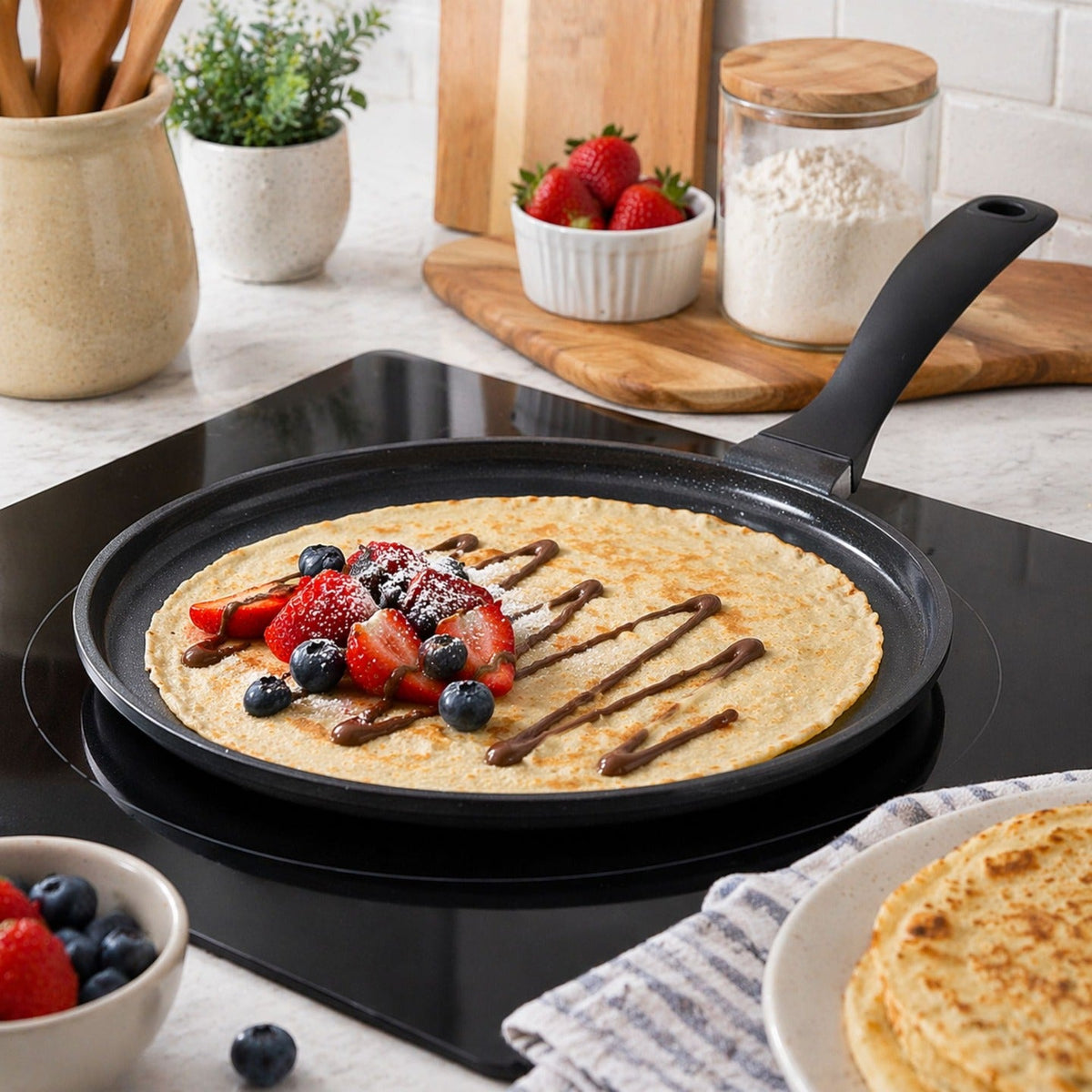
Crepe batter is thin enough that any sticking tears the crepe, and tall pan walls fight your spatula on every flip. We tested this recipe in the Alva Maestro Ceramic Nonstick Crepe Pan, 10" ($129): a low, sloping rim your spatula slides straight under, a sol-gel ceramic surface made without PFAS, PTFE, or PFOA that releases crepes with just a film of butter, and a 4.5mm forged base that heats evenly so there's no scorched center and pale rim. At 2.1 lbs it's light enough to lift and swirl one-handed, and the stainless base works on induction. For how it compares with carbon steel and stainless options, see our best crepe pan guide.

Our Top Pick
Ceramic Nonstick Crepe Pan, 10"
The pan we made this recipe in: PFAS-free ceramic, induction-ready and light enough to swirl one-handed. $129.
Shop the Crepe PanIngredients
Makes about 10 crepes (10-inch) · Prep 10 min · Rest 30 min · Cook 20 min
- 1 cup (125 g) all-purpose flour
- 2 large eggs, room temperature
- 1 1/4 cups (300 ml) whole milk, room temperature
- 1/4 cup (60 ml) water
- 2 tablespoons (28 g) unsalted butter, melted, plus more for the pan
- 1/4 teaspoon fine salt
- 1 tablespoon granulated sugar and 1 teaspoon vanilla extract (for sweet crepes; omit both for savory)
Instructions
- Blend the batter. Add the milk, water, eggs, melted butter, salt, and (if making sweet crepes) sugar and vanilla to a blender. Add the flour last and blend for 10–15 seconds until completely smooth. No blender? Whisk the eggs and half the milk into the flour to form a smooth paste, then whisk in the remaining liquids and butter.
- Rest the batter 30 minutes. Cover and refrigerate for at least 30 minutes (or up to 24 hours). This hydrates the flour and relaxes the gluten so the crepes are tender. Stir gently before using; it should be the consistency of heavy cream — add a tablespoon of water if it has thickened.
- Preheat the pan over medium. Heat the crepe pan over medium heat for 2 minutes. Add about 1/2 teaspoon of butter and wipe it over the surface with a folded paper towel so only a thin sheen remains.
- Pour and swirl. Lift the pan off the heat, pour a scant 1/4 cup (about 3 tablespoons) of batter into the center, and immediately tilt and rotate the pan so the batter runs out to the edges in a thin, even layer. Return it to the heat.
- Cook the first side. Cook for 45–60 seconds, until the surface looks dry and the edges turn golden and begin to lift from the pan.
- Flip. Slide a thin silicone or wooden spatula under the edge, lift, and flip. Cook the second side for 20–30 seconds, until spotted golden.
- Stack and repeat. Slide the crepe onto a plate and repeat with the remaining batter, re-wiping the pan with butter every 2–3 crepes. Stack the finished crepes and cover loosely with a clean towel to keep them soft and warm.
- Fill and serve. Fold into quarters or roll around your filling (ideas below) and serve warm.
Tips for perfect crepes
- The first crepe is a test. It calibrates the heat. If it browns in under 30 seconds, turn the heat down; if it takes over 90 seconds to set, turn it up slightly.
- Medium heat, not high. A screaming-hot pan sets the batter before it can spread. Ceramic nonstick performs best — and lasts longest — at low-to-medium heat.
- Butter, not spray. Aerosol cooking sprays leave a residue that builds up on ceramic. A paper-towel wipe of butter or neutral oil is all you need.
- Thin is the goal. If your crepes are thick and pancake-like, the batter is too thick or you're using too much. Thin with a splash of milk and pour a little less.
- Make ahead. Stack cooled crepes with parchment between them, wrap tightly, and refrigerate up to 3 days or freeze up to 2 months. Rewarm briefly in the pan over low heat.
- Filling ideas. Sweet: butter and sugar with a squeeze of lemon, Nutella and sliced banana, or berries and whipped cream. Savory (skip the sugar and vanilla): ham, Gruyère, and a fried egg, or sautéed mushrooms and spinach.
- Care. Let the pan cool, then hand-wash with warm soapy water and a soft sponge. Ceramic nonstick is hand-wash only, and soft utensils keep the surface like new.
Make it in the pan built for it: the Maestro Ceramic Nonstick Crepe Pan, 10" is $129, induction-ready, oven-safe to 400°F, and backed by a 10-year warranty — and it doubles as the pan for our fluffy buttermilk pancakes and your morning eggs (more in our best pan for eggs guide). Browse the rest of the lineup in all cookware. Free U.S. shipping over $99.
Frequently asked questions
Why do I need to rest crepe batter?
Resting for at least 30 minutes lets the flour fully absorb the liquid and the gluten formed during mixing relax. Rested batter spreads more easily and cooks into crepes that are tender and pliable rather than chewy or rubbery. It also lets air bubbles from blending settle out.
What's the difference between crepes and pancakes?
Crepe batter is much thinner and contains no baking powder or baking soda, so crepes cook flat and thin — about 1–2 mm — instead of rising. They're also cooked in a thin swirl across the whole pan rather than poured in small rounds.
Why are my crepes tearing or sticking?
Usually one of three things: the pan isn't hot enough yet (wait until a drop of batter sets within a few seconds), you're flipping too early (wait until the edges lift and the surface looks dry), or the batter is too thin. A low-sided nonstick crepe pan with a light wipe of butter solves most sticking problems.
Can I make crepes ahead of time?
Yes. The batter keeps in the refrigerator for up to 24 hours. Cooked crepes can be stacked with parchment between them, wrapped tightly, and refrigerated up to 3 days or frozen up to 2 months, then rewarmed briefly in the pan over low heat.
Can I make savory crepes?
Yes. Omit the sugar and vanilla from the batter, then fill with ideas like ham, Gruyère, and a fried egg, or sautéed mushrooms and spinach.




Leave a comment
This site is protected by hCaptcha and the hCaptcha Privacy Policy and Terms of Service apply.