






Best Saucepan (2026): What to Look For + Our Pick
The best saucepan is fully clad stainless steel: it heats evenly so sauces don't scorch, it's non-reactive (acidic tomato and wine sauces won't pick up a metallic taste), and it has no coating to wear out. Here's what separates a great saucepan from a flimsy one, what size to buy, and our pick.
Why stainless is the best saucepan material
A saucepan's job is gentle, even, liquid cooking - simmering sauces, reducing, cooking grains, reheating. That rewards even heat and a non-reactive surface, which is exactly what clad stainless delivers. Nonstick coatings wear out and don't love a long simmer; bare aluminum reacts with acidic foods. Fully clad stainless avoids both and lasts a lifetime. If you've already settled on steel, our stainless steel saucepan buying guide goes deeper on cladding, sizing and technique. (New to the format? See what is a saucepan, including how it differs from pots and sauté pans.)

Our Top Pick
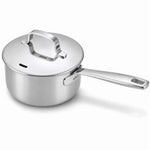
5-Ply Stainless Steel Saucepan with Lid
Fully clad 5-ply stainless steel for sauces, grains and gentle simmering. Uncoated, induction-ready and backed by a lifetime warranty.
Shop the 5-Ply SaucepanIndependently tested. Alva publishes its third-party lab reports in full, with the lab, report number and date for each line. See the lab reports →
What to look for in a saucepan
- Fully clad construction (ideally 5-ply) - aluminum cores bonded base-to-rim for even heat, not just a disc on the bottom. More on why in advantages of 5-ply.
- A well-fitted, vented lid - controls evaporation for simmering and reducing.
- A pouring rim - drip-free pouring matters more than you'd think for sauces and stocks.
- Induction-ready and oven-safe for flexibility.
- Comfortable, stay-cool handle and a real warranty.
What size saucepan do you need?
A 1.5-2 quart is the everyday workhorse - sauces, oatmeal, melted butter, cooking for one or two - and our pick for the best saucepan for oatmeal. A 3-4 quart handles family rice, boxed pasta, and reheating a full pot of soup. Most kitchens benefit from one of each; if you buy one, start with the size that matches how you cook most.
Our pick: the Maestro 5-Ply Stainless Saucepan
The Maestro Saucepan with Lid is fully clad 5-ply stainless from base to rim, so it heats evenly with no hot spots. It has a vented stainless lid, a drip-free pouring rim, welded stay-cool handles, works on every cooktop including induction, is oven-safe to 500°F and dishwasher-safe, and is backed by a lifetime warranty - sold direct, so you skip the retail markup. It has no nonstick coating - so no PFAS or PTFE by design. Free U.S. shipping over $99.
Get the most from it
Stainless rewards a little technique - preheat before adding oil, and build a pan sauce from the fond. See how to master pan sauces, and pair it with the Maestro 5-ply frying pan for a complete stainless setup.
Frequently asked questions
What is the best material for a saucepan?
Fully clad stainless steel, ideally 5-ply. It heats evenly with no hot spots, and crucially it is non-reactive — tomato, wine and citrus sauces will not pick up a metallic taste the way they can from bare aluminium. There is no coating to wear out, so it lasts decades.
What size saucepan do I need?
A 1.5 to 2 quart handles sauces, oatmeal, melted butter and cooking for one or two — it is the one that gets used daily. A 3 quart covers family rice, boxed pasta and reheating soup. Most kitchens end up with one of each, and if you are buying only one, the smaller size sees more use.
Is a nonstick saucepan better?
Not for most saucepan jobs. You rarely need release for liquid cooking, and long simmering at heat is exactly what shortens a coating's life. The one case for nonstick is milk, porridge and custards, where a coated pan is easier to clean — but stainless handles those fine with a little attention.
What is the difference between a saucepan and a pot?
Mostly proportion and intent. A saucepan is relatively tall and narrow with a long handle, built for stirring and pouring one-handed. A stockpot is wider and deeper with two loop handles, because full it is too heavy to lift with one hand. Saucepan for sauces and grains; pot for stock, pasta and soup.
Can you use a saucepan in the oven?
Ours goes to 500°F, lid included, because it is all stainless with no plastic parts. Check yours before assuming — silicone-sleeved or plastic handles usually cap the pan well below the metal's limit, and that is what fails first, not the pan body.
Why does milk always catch on the bottom of my saucepan?
Milk proteins settle and scorch on any hot base, and a thin pan makes it far worse because the heat concentrates in spots. A fully clad base spreads it evenly. Beyond that: medium heat rather than high, stir across the bottom rather than in circles, and rinse the pan with cold water before you add the milk.
The bottom line
For sauces, grains, and everyday simmering, choose fully clad stainless. The Maestro 5-Ply Saucepan is our non-toxic, lifetime-warranty pick. See our safety standards.
Comparing sizes and shapes?
Every Alva saucepan, saucier and stock pot in one place, with capacities and weights side by side — so you can pick the size that matches how you actually cook. Free U.S. shipping over $99.

,%20and%20it%20has%20no%20coating%20to%20w...)
Leave a comment
This site is protected by hCaptcha and the hCaptcha Privacy Policy and Terms of Service apply.