






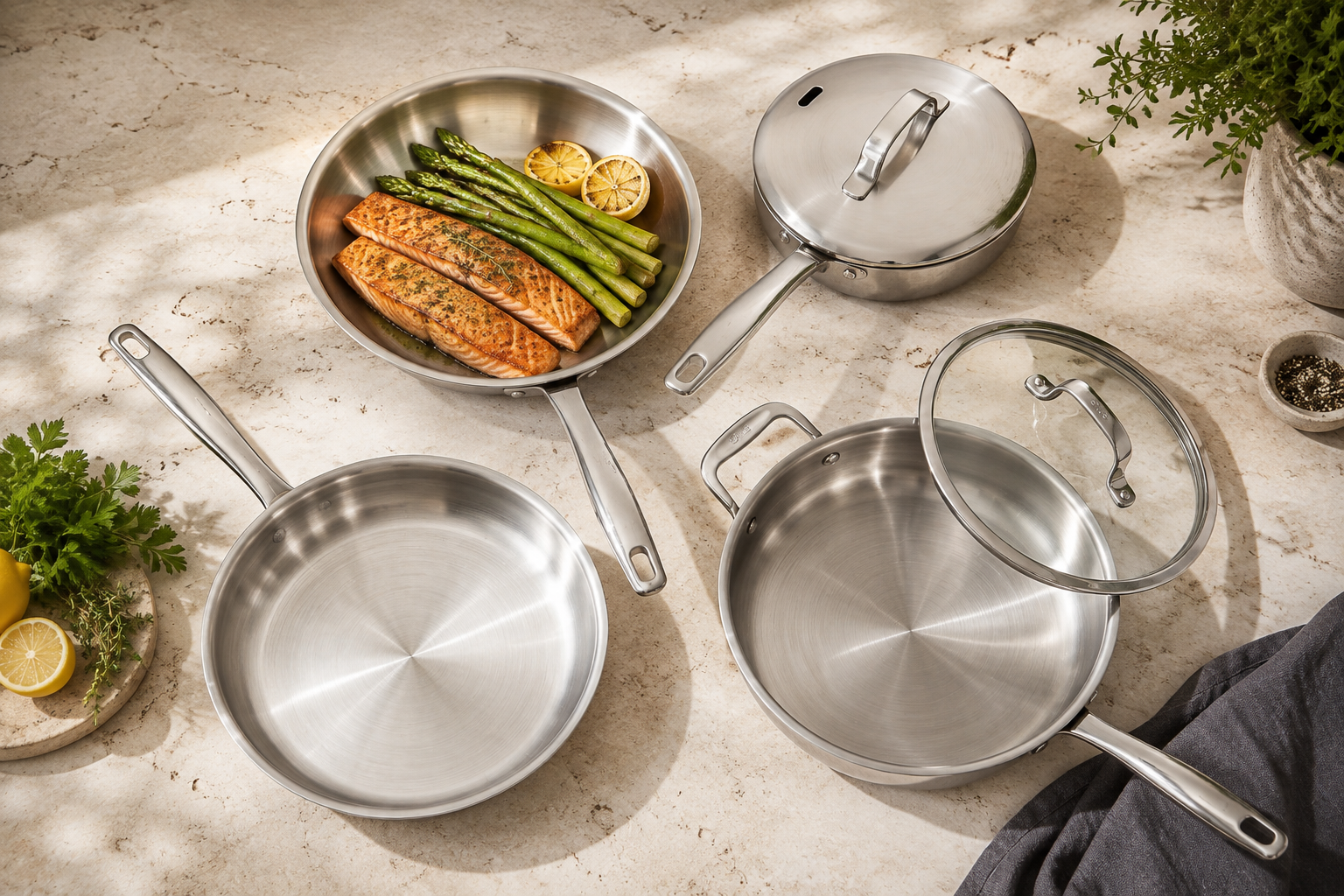
Best Stainless Steel Cookware for Induction (2026): What Works and What Doesn't
The best stainless steel cookware for induction is fully clad — aluminum bonded from base to rim — with a magnetic stainless exterior, a genuinely flat base, and a base diameter close to your hob's coil. That last one is the spec nobody checks and the one that causes most "my expensive pan heats unevenly" complaints. Our pick is the Alva Maestro 5-Ply ($129–$149 a pan, $399–$799 a set): 18/10 interior, magnetic exterior, rivet-free welded handles, 500°F, dishwasher-safe, lifetime warranty.
By the Alva Cookware team · Updated September 17, 2026 · Specs checked on each maker's US site in September 2026; prices change often, so check the maker's site for current pricing.
Induction is the fussiest cooktop about what you put on it, and stainless steel is the material that satisfies it most easily — provided the pan is built correctly. A magnet on the base is the minimum bar, not the finish line. Below: how induction actually heats a pan, the four specs that decide whether yours will cook evenly, nine pans compared, and what else in your kitchen already works on induction.
Why stainless suits induction
Induction needs cookware with a magnetic base. Fully clad stainless steel with a magnetic exterior heats quickly and evenly, sears beautifully, and is completely non-reactive and durable. Many budget induction pans use a bonded disc instead - here is how disc-bottom pans differ from fully clad ones.

Our Top Pick
5-Ply Stainless Steel Frying Pan
Fully clad 5-ply stainless steel for even heat, better browning and pan sauces. Uncoated, induction-ready, oven-safe to 500°F and backed by a lifetime warranty.
From $129
Shop the 5-Ply Frying PanHow we evaluate cookware for induction
Induction adds three questions on top of the usual ones about a pan. We check, in this order:
- Does the hob detect it, at every power level? A weakly magnetic base can register at high power and drop out on a low simmer, which is when most people notice the problem.
- Base diameter against the coil. A base much wider than the element heats in a ring and leaves the edges cool; much narrower and some hobs refuse to switch on at all.
- Flatness. Induction only heats metal in direct contact. A base that rocks, or one that has domed slightly from thermal shock, gives you a hot centre and cold edges no matter how good the cladding is.
- Cladding. Fully clad means the aluminum runs up the walls, so the sides cook too; a disc-bottom pan heats the plate and leaves the walls cold.
- Then the normal things — weight and balance, whether the handle traps food, the oven ceiling, and whether the maker actually allows the dishwasher.
Where a spec below comes from a manufacturer, it is their published figure. Weights marked * are America's Test Kitchen's measurements, used where the brand doesn't publish one. We don't invent lab numbers.
The magnet test — and what it doesn't tell you
Stick a fridge magnet to the base. If it grips firmly, the pan will work on induction. If it slides or falls, it will not — that rules out most 18/10-only stainless, all aluminum and all copper without a magnetic plate.
What the magnet does not tell you is how well the pan will cook. It says nothing about whether the aluminum runs up the sidewalls, whether the base is flat, or whether the base matches your hob. A cheap disc-bottom pan passes the magnet test and still browns badly at the edges. That is the whole reason this guide exists.
The four specs that actually decide it
1. Fully clad, not disc-bottom
A fully clad pan has aluminum bonded between stainless layers from the base all the way up the walls. A disc-bottom pan is a thin stainless body with a metal plate welded underneath. On induction, both heat the base — but the disc-bottom pan's walls stay cool, so anything above the fill line steams rather than browns, and sauces reduce unevenly. Look at the cut edge of the rim: on a fully clad pan you can see the layers as fine lines. Our explainer on clad vs disc-bottom construction goes deeper, and why 5-ply matters covers what the extra layers buy.
2. Base diameter vs your hob's coil
This is the induction-specific spec, and almost no maker prints it. Most domestic hobs have an element between 6 and 11 inches, and many have a maximum detectable base diameter of around 10–11 inches. Two failure modes follow. A 12-inch pan on a 6-inch element heats a bright ring in the middle and stays cool at the rim — the pan is fine, the match is wrong. A very small pan on a large element may not be detected at all, which is why an 8-inch pan sometimes refuses to start on a big hob.
Measure your element, then buy a pan whose base (not rim) is close to it. On a small or portable hob, a 9.5-inch pan usually heats more evenly than an 11 or 12. What size frying pan to buy works through the sizing in full.
3. A flat base, and keeping it flat
Set the pan on a countertop and press one edge. If it rocks, only part of it is touching the element. New pans should be flat; what makes them stop being flat is thermal shock — a screaming-hot pan under cold water. Thicker, multi-ply bases resist this better, which is one practical reason 5-ply is worth the weight on induction.
4. A magnetic exterior, not a magnetic disc
The best clad pans use a ferritic (magnetic) stainless outer layer bonded across the whole base and up the sides, so the magnetic field heats the pan body itself. That is how the Maestro is built: 18/10 inside, three aluminum layers, magnetic stainless outside, clad base to rim.
The Alva stainless range on induction
Every piece below is fully clad 5-ply with an 18/10 cooking surface and a magnetic stainless exterior, welded rivet-free handles, oven-safe to 500°F / 260°C, dishwasher-safe (hand washing keeps the finish brightest), and carries a lifetime warranty. Designed in Belgium; manufactured in China. Free U.S. shipping over $99.
| Piece | Price | Weight | Best for on induction |
|---|---|---|---|
| 5-Ply Frying Pan, 8" | $129 | 2.1 lb | Small hobs and single portions; the size most likely to be detected on a compact element |
| 5-Ply Frying Pan, 9.5" | $139 | 2.8 lb | The best all-round match for a typical 7–9" domestic element |
| 5-Ply Frying Pan, 11" | $149 | 3.7 lb | Four thighs or two steaks — pair it with a larger element or a bridge zone |
| 5-Ply Saucepan with Lid | $139 (1.5 qt) · $159 (3 qt) | 2.3–3.4 lb | Sauces and grains; induction's fast, fine low end is at its best here |
| 5-Ply Sauté Pan with Lid, 4-Qt | $209 | 6.2 lb | Batch browning and braises, stovetop to oven |
| 5-Ply Stock Pot with Lid, 7-Qt | $229 | 5.2 lb | Stock and pasta — where induction's boil speed genuinely beats gas |
| 5-Piece Set | $399 | — | 8" + 9.5" fry pans and a 3-qt saucepan, all with lids where applicable |
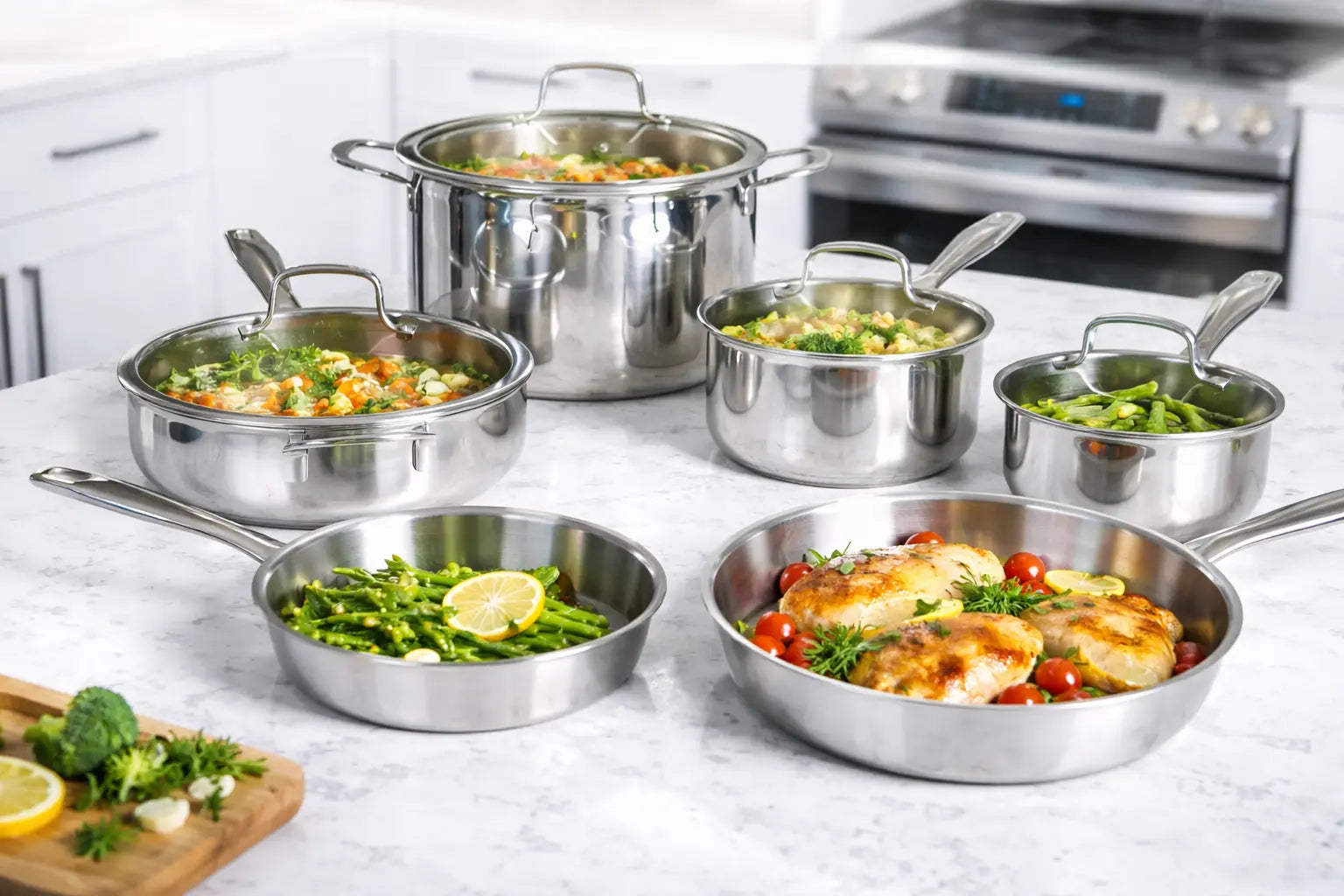
| 7-Piece Set | $499 | — | 9.5" fry pan, 1.5-qt saucepan, 4-qt sauté, 7-qt stock pot with lids |
| 14-Piece Set | $799 | — | Three fry pans, two saucepans, sauté and stock pot — a full induction kitchen |
The full build sheet, including the layer-by-layer comparison with All-Clad D3, is on our Maestro Stainless spec page.
How it compares: nine stainless pans on induction
All of these are fully clad and all work on induction — the differences are in layers, oven ceiling, handle and price. Specs checked on each maker's US site in September 2026; prices change often, so check the maker's site for current pricing. Weights marked * are ATK measurements.
| Pan | Price tier | Construction | Oven max | Weight | Handle | Dishwasher | Warranty | Made in |
|---|---|---|---|---|---|---|---|---|
| Alva Maestro 11" | $149 | 5-ply | 500°F | 3.7 lb | Welded, rivet-free | Yes | Lifetime | China (designed in Belgium) |
| All-Clad D3 12" | Premium | 3-ply | 600°F | ~2.8 lb* | Riveted | Hand wash only | Limited lifetime | USA (global components) |
| All-Clad D5 12" | Premium | 5-ply | 600°F | ~3.1 lb* | Riveted | Hand wash only | Limited lifetime | USA (global components) |
| Made In Stainless Clad 12" | Mid-range | 5-ply, 2.7 mm | 800°F | 3.0 lb | Riveted | Yes, hand wash rec. | Lifetime | Italy |
| Misen Stainless 12" | Mid-range | 5-ply, 3.0 mm | 800°F | 3.5 lb | Riveted | Yes | Lifetime (defects) | China |
| Heritage Steel Eater 12" | Mid-range | 5-ply | 800°F | ~2.9 lb* | Riveted | Hand wash rec. | Lifetime | USA (global materials) |
| Tramontina Tri-Ply Clad 12" | Budget | 3-ply | 500°F | ~3.2 lb* | Riveted | Yes, hand wash rec. | Lifetime | Brazil |
| Cuisinart MultiClad Pro 12" | Mid-range (with lid) | 3-ply | 500°F | ~3.75 lb* | Riveted | Yes | Lifetime | Not stated |
| Demeyere Industry 5, 12.5" | Luxury | 5-ply | 500°F | 4.4 lb | Welded, rivet-free | Yes | Lifetime | Belgium |
Reading it honestly: on construction the Maestro sits in the 5-ply group with Made In, Misen, D5, Demeyere and Heritage, at the price of the 3-ply D3. Only two pans in the class have rivet-free welded handles — ours and Demeyere's luxury-tier pan — and rivet heads are the thing that collects fond every week. Three brands beat our 500°F oven ceiling, which matters only if you broil in a frying pan. The Maestro 11" is the second-heaviest here; if you toss and flip one-handed, the 9.5" at 2.8 lb is the better buy. The set-by-set version of this comparison is in All-Clad alternatives, and All-Clad vs Made In covers the two brands people cross-shop most.
Who should buy what
- Budget tier: Tramontina Tri-Ply Clad. Fully clad, magnetic, 500°F, lifetime warranty. You give up sidewall evenness (3-ply) and a fairly narrow flat base — which on induction means less of the pan sits over the coil.
- Mid-range to premium — where the value is: Alva Maestro ($129–$149), Made In, Misen, Heritage Steel, All-Clad D3. Pick Maestro for the rivet-free interior and dishwasher approval; Made In or Heritage if you want the 800°F ceiling; D3 for American assembly.
- Buying a whole induction kitchen: the Alva 5-piece at $399 or 7-piece at $499 gets you 5-ply across fry pans, saucepan, sauté and stock pot. All-Clad's 10-piece D3 (3-ply) and Made In's 10-piece both sit in the premium price tier.
- Splurge: Demeyere Industry 5. Belgian-made, 5-ply, rivet-free, and the heaviest base in the class — which on induction is a genuine advantage for stability and flatness over years.
What else in your kitchen already works on induction
Stainless is the easy answer, not the only one. Anything ferrous works:
| Material | Induction | Notes |
|---|---|---|
| Fully clad stainless (magnetic exterior) | Yes | The best all-round match — even heat, no coating, oven-safe to 500°F |
| Enameled cast iron | Yes | Cast iron is ferrous, so no adapter needed. Lift rather than slide — the weight scratches glass |
| Carbon steel | Yes | Fast and responsive; Alva's Artist and Black Angus are also oven-safe to 500°F |
| Ceramic nonstick with a stainless induction base | Yes | Alva's ceramic pans bond a stainless base to a forged aluminum body; oven-safe to 400°F, hand wash recommended |
| Bare aluminum, copper, glass | No | Not magnetic. Interface discs exist but waste most of the efficiency that made you buy induction |
| 18/10 stainless with no magnetic layer | No | The common trap — looks identical, fails the magnet test |
For the full picture across every material see best induction cookware, and if you specifically want a coated pan on induction, does nonstick work on induction cooktops.
Induction quirks worth knowing before you blame the pan
- Buzzing or humming at high power is normal, and it is louder with multi-ply pans because the layers vibrate at slightly different rates. It is not a fault and it does not mean the pan is failing.
- Scratched glass comes from dragging, not from weight. Lift every pan, especially cast iron.
- Boost mode plus an empty pan is how stainless gets blued and warped. Induction reaches searing temperature far faster than gas, so preheat on medium and give it two minutes, not high and thirty seconds.
- The pan clicks or pulses on low. Cheaper hobs cycle power on and off rather than modulating it. A heavier, multi-ply base smooths that out — another practical argument for 5-ply on induction.
- Sliding pans is what triggers most "pan not detected" errors mid-cook; nudge it back over the coil.
Once it is on the hob, the technique is the same as any stainless pan: preheat, then oil, then food, and this is how to get burnt marks off.
Frequently asked questions
Does all stainless steel work on induction?
No. Only stainless with a magnetic (ferritic) layer on the base works. Many 18/10-only pans are non-magnetic and will not be detected at all. Test with a fridge magnet on the base: if it grips firmly, the pan works. Alva's Maestro 5-ply has a magnetic stainless exterior, so every piece is induction-ready.
Why does my induction pan heat unevenly?
Usually one of three things: the base is wider than the element, so only the middle heats; the base is not flat and part of it is not touching the glass; or the pan is disc-bottom rather than fully clad, so the walls stay cool. Match base diameter to your element and choose a fully clad pan and the problem generally disappears.
What size pan is best for an induction hob?
One whose base is close to your element's diameter — usually 6 to 11 inches. On a small or portable hob a 9.5-inch pan heats more evenly than a 12-inch. Check your hob's maximum detectable base size too; many top out around 10–11 inches, and a larger pan will heat only in the centre.
Is 5-ply worth it on induction?
More than on gas, yes. Induction delivers heat fast and some hobs pulse power on and off at low settings; a thicker multi-ply base smooths that out, holds temperature when cold food lands, and resists the warping that ruins base contact. Three-ply is lighter and cheaper and still works well — a good 3-ply pan beats a poor 5-ply one.
Why does my pan buzz or hum on induction?
It is the magnetic field vibrating the layers of the base, and it is loudest at high power and on multi-ply pans. It is normal, it does not damage the pan, and it usually quietens as you turn the power down.
Will cast iron scratch my induction cooktop?
Only if you slide it. Lift pans on and off rather than dragging them, and keep the glass free of grit. Enameled cast iron like the Alva Nori works perfectly on induction — cast iron is ferrous, so no adapter is needed.
Can I use an induction adapter disc with my old pans?
You can, but it undoes most of the point. The disc heats and then conducts heat into the pan, which is slower, less controllable and less efficient than induction heating the pan directly. It is a stopgap for one favourite pot, not a strategy.
Is stainless or nonstick better for induction?
Stainless for searing, browning and pan sauces, and for anything above medium heat — induction gets hot fast, which shortens the life of any coating. Keep one ceramic nonstick pan for eggs and delicate fish. Most induction kitchens end up with both.
Ready to buy? Start here
Every piece is fully clad 5-ply, induction-ready and covered by a lifetime warranty. Free U.S. shipping over $99 · sold direct, no retail markup.
5-Ply Stainless Frying Pan
Start here. The 9.5" is the best match for a typical induction element; the 11" for family batches.
From $129
Buy now
5-Ply Stainless Set, 7-Piece
Fry pan, saucepan, 4-qt sauté and 7-qt stock pot with lids — a whole induction kitchen in one box.
$499 · 14-piece $799
Buy now
5-Ply Sauté Pan with Lid, 4-Qt
Batch browning, braises and one-pan dinners — stovetop to oven, 500°F.
$209
Buy nowShop all Maestro Stainless → or compare the full range in our stainless sets guide.
Ready to pick your induction set?
See every Alva stainless piece and set side by side — fully clad 5-ply, magnetic base, with sizes and prices in one place. Free U.S. shipping over $99.


Leave a comment
This site is protected by hCaptcha and the hCaptcha Privacy Policy and Terms of Service apply.