






How to Store Pots and Pans in a Small Kitchen (11 Space-Saving Ideas)
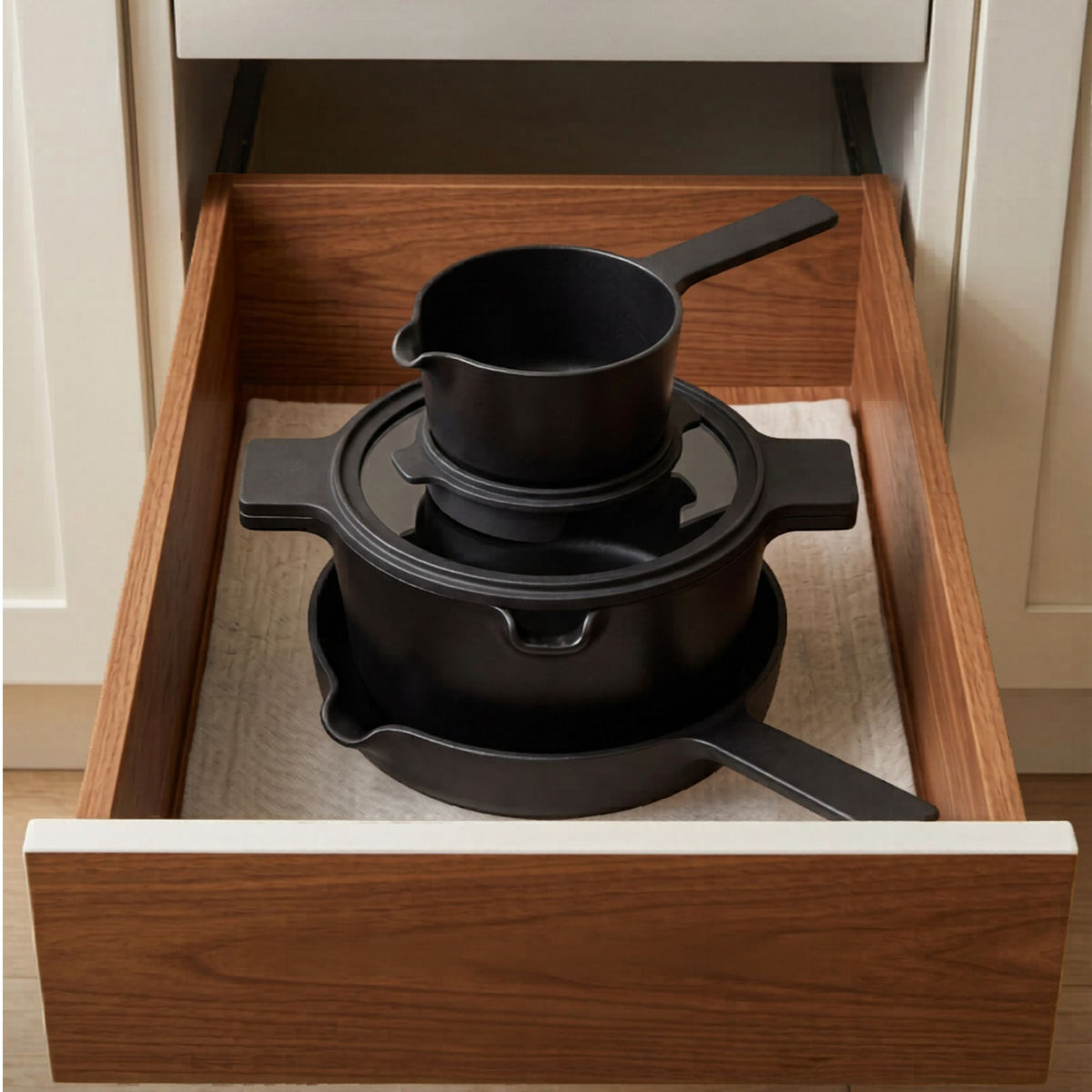
The fastest way to tame pots and pans in a small kitchen: store fewer of them, stand them up vertically, organize the lids separately, and use a nesting set so a whole set lives in the footprint of one pot.
Quick guide: run any purchase through the small kitchen cookware checklist — nesting design, multi-use pieces, strainer lids, non-toxic materials.
Pots and pans are bulky, awkward, and lid-heavy - which is why they take over small cabinets. Here are the space-saving moves that actually work, from quick fixes to the one change that frees the most room.

Our Top Pick
5-Piece Stackable Ceramic Nonstick Set
Five ceramic nonstick pieces that nest into one compact stack. Made without PFAS, PTFE or PFOA, induction-ready and designed for smaller kitchens, and recognized in Oprah's Favorite Things.
Shop the Neat Stackable SetStart by storing fewer pans
The biggest space win is owning less. Most kitchens only need a frying pan, a saucepan, and a larger pot - see how many pots and pans you actually need. Donate the duplicates and single-use pieces before you reorganize. If you're replacing what you pare away, our guide to non-toxic cookware for small kitchens is the place to start.
11 space-saving storage ideas
- Stand pans vertically with a cabinet divider or a wire file organizer - grab one without unstacking the rest.
- Store lids separately in a lid rack, tension rods, or on the inside of a cabinet door.
- Hang pans from a wall rail, pegboard, or ceiling rack to free cabinet space entirely.
- Use deep drawers for heavy pots - easier to reach than a low back cabinet.
- Add a shelf riser to split a tall cabinet into two usable layers.
- Hooks under shelves for frequently used pans.
- An over-the-cabinet-door rail for lids and small pans.
- A rolling cart for overflow in tight kitchens.
- Nest what you can - put smaller pans inside larger pots with a felt protector between coatings.
- Keep only daily pieces at hand; store seasonal/specialty items higher up.
- Switch to a nesting set - the single biggest space-saver (below).
The biggest space-saver: nesting cookware
If your pans don't stack neatly, no organizer fully fixes the problem. A stackable (nesting) set is purpose-built to solve it. The Alva Neat 5-piece set nests its frying pan, saucepan, stockpot, and glass strainer lids into one vertical stack that stores in the footprint of a single pot - and the strainer lids mean you can skip storing a colander entirely. It's ceramic made without PFAS, induction-ready, and oven-safe to 400°F. Free U.S. shipping over $99.
Protect your pans while they're stored
Stacking can scratch coatings. Use felt or paper protectors between nested pans, and avoid cramming. For coating care, see how to clean a nonstick pan. The same compact approach works on the road, too - see the best cookware for RVs.
Frequently asked questions
How do you store pots and pans in a small kitchen?
Pare down to the pieces you use, stand pans vertically with dividers so you can pull one without unstacking the rest, store lids separately, and use a nesting set so the whole set occupies one pot's footprint. Owning less is the biggest win of the four.
How do you store pans without scratching them?
Never stack bare coatings directly against each other. Put a felt pad, paper towel or cheap cloth between nested pans — the cooking surface is what you are protecting, and a pan sitting inside another will grind against it every time the cupboard is opened.
Where should you store lids?
Separately from the pans, which is the step most people skip. Lids stacked on pots make the whole stack unstable and force you to unpack three things to reach one. A rack on the inside of a cabinet door, or two tension rods creating vertical slots, handles them in space you were not using.
Is it bad to stack nonstick pans?
It is fine with protection between them, and a bad idea without. The coating is softer than the metal it sits against, so unprotected stacking is one of the most common causes of a nonstick pan wearing out early — often before any cooking damage.
Is hanging pots and pans a good idea?
Yes if you have wall space and a stud or proper fixing to hang from, because it moves the bulkiest items out of your cabinets entirely. The caveats: heavy cast iron needs a serious fixing, and hung pans collect kitchen grease and dust, so it works best for pans you use often.
What is the single biggest space-saver?
Switching to cookware that genuinely nests. Organizers help you use awkward space better, but a set designed to stack removes the problem instead of managing it — five pieces in the footprint of one, with no gaps between mismatched shapes.
The bottom line
Store fewer pans, go vertical, separate the lids - and if pans still overflow, switch to a nesting set that stores in one stack.
Replacing what you pared away?
Compare every Alva set — what is in each and how it stores — so you can buy for the cabinet you actually have. Free U.S. shipping over $99.
Related reading: see how Neat compares to other nesting & stackable cookware sets.
Our top pick5-Piece Stackable Ceramic Nonstick SetShop now →


Leave a comment
This site is protected by hCaptcha and the hCaptcha Privacy Policy and Terms of Service apply.