





Complete Cookware Buying Guide (2026): How to Choose the Right Pots and Pans
Short answer: For most home cooks, the best all-around cookware is a small core set built around three materials — 5-ply stainless steel for searing and sauces, a non-toxic ceramic nonstick pan for eggs and delicate foods, and one cast iron piece for high-heat and oven work. Buy fully-clad (not disc-bottom) pieces, make sure they work on your cooktop (especially induction), and prioritize materials that are genuinely non-toxic and lab-tested rather than marketing claims. You rarely need a 15-piece set — 5 to 7 well-chosen pieces cover almost everything.
Not sure which material is right for you?

Our Top Pick
Ceramic Nonstick Frying Pan
Easy ceramic nonstick for everyday meals. Made without PFAS, PTFE or PFOA, supported by published third-party testing, induction-ready, oven-safe to 400°F and backed by a 10-year limited warranty.
From $109
Shop the Maestro Frying PanTake our 2-minute quiz and get a personalized cookware recommendation based on how you cook — nonstick, stainless, carbon steel, or cast iron.
Find your cookware →This guide walks through every decision that actually matters, in the order it matters, so you can buy once and buy right.
1. Start with how you cook, not how many pieces you get
The biggest mistake in cookware shopping is buying by piece count. A 15-piece set is often padded with lids, a utensil, and pans you'll never use. Instead, start from the three or four things you cook most. If you sear steak and build pan sauces, you need clad stainless. If you cook eggs and fish daily, you want a reliable nonstick. If you bake cornbread or braise, cast iron earns its shelf space. Match the tool to the task and the set almost designs itself.
2. The materials, and what each is actually good at
Every cookware decision comes down to material. Here's the honest breakdown — for the full deep-dive, see Types of Pans: Your Complete Cookware Guide.
Stainless steel (fully clad / 5-ply)
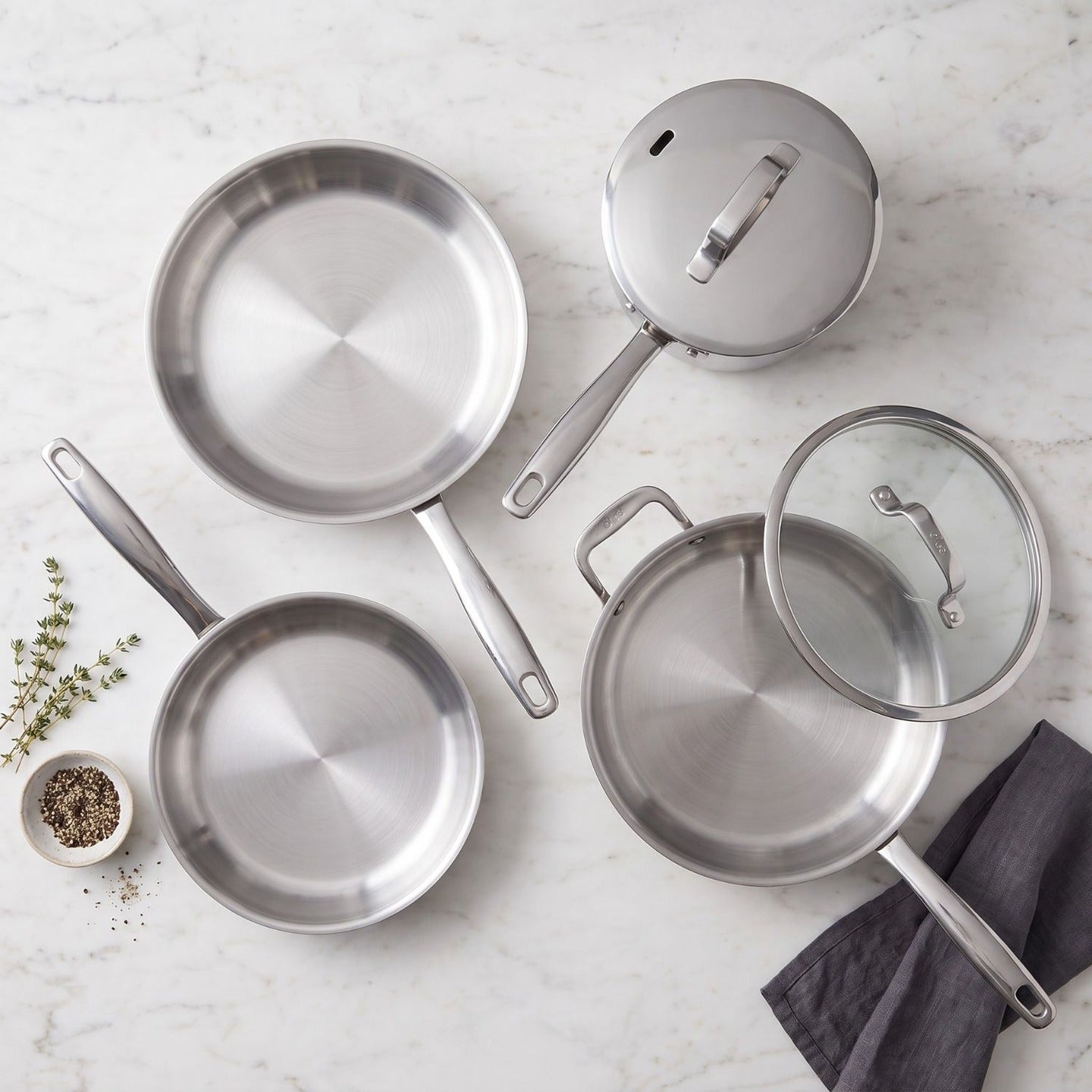
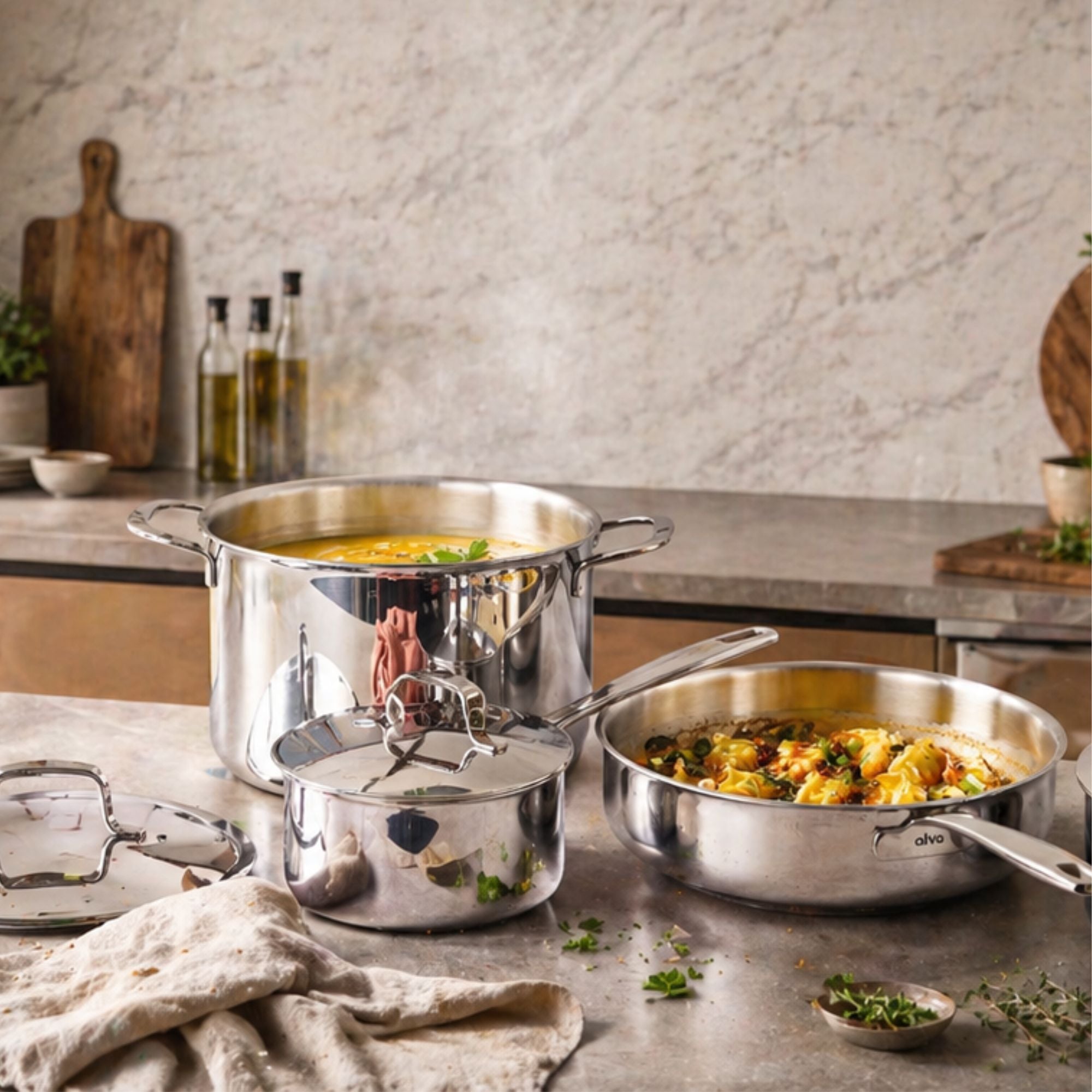
The workhorse. Great for browning, deglazing, sauces, and acidic foods. Look for fully clad construction (aluminum or copper layered through the entire pan, not just a disc on the bottom) for even heating. It's oven-safe, dishwasher-safe, and lasts decades. Downside: food sticks if you don't preheat properly. See Is Stainless Steel Cookware Safe? and shop the Maestro 5-ply collection.
Ceramic nonstick
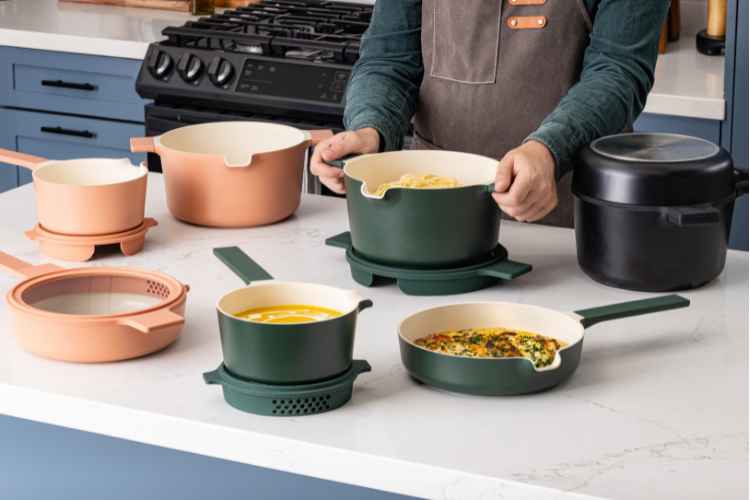
The modern, PFAS-free answer to nonstick. Excellent for eggs, pancakes, fish, and low-fat cooking. Coatings wear over time (2–5 years with good care), so treat it as a replaceable tool, not a lifetime pan. Compare it head-to-head in Ceramic vs Stainless Steel, and shop ceramic nonstick.
Cast iron & enameled cast iron
Unbeatable heat retention for searing, frying, and baking; enameled versions add braising and acidic cooking without seasoning upkeep. Heavy, and bare cast iron needs seasoning. Shop enameled cast iron.
Carbon steel
The chef's hybrid — heats fast like stainless, becomes naturally nonstick like cast iron once seasoned, and is lighter than cast iron. Ideal for high-heat searing and stir-fry. See Carbon Steel vs Cast Iron and shop carbon steel.
3. Construction: what separates cookware that lasts from cookware that warps
Two pans made of "stainless steel" can be wildly different. What to check:
- Fully clad vs. disc base: Fully clad heats evenly across the whole pan and up the sides. Disc-bottom pans heat unevenly and are usually cheaper. Prefer fully clad.
- Ply count: 3-ply is good; 5-ply adds even more even, stable heating and durability.
- Handle & rivets: Solid, well-riveted or seamless handles that stay cool. Loose handles are the first failure point.
- Weight & balance: Too light warps and hot-spots; too heavy is hard to maneuver. You want reassuring, balanced heft.
4. Non-toxic: how to separate real safety from marketing
"Non-toxic" is not a regulated term, so anyone can print it. What actually matters is what the cooking surface is made of and whether it's been independently tested. Avoid PFAS ("forever chemicals") in traditional nonstick if that's a concern for you; favor materials like stainless, ceramic, cast iron, and carbon steel; and look for brands that publish real lab tests for heavy metals like lead and cadmium. We break down exactly how to vet a claim in How to Spot Truly Non-Toxic Cookware, and we publish our own third-party results on our Testing & Materials page. For a curated shortlist, see 7 Best Non-Toxic Cookware Sets.
5. Match your cooktop — especially induction
Before you buy anything, confirm it works on your stove. Gas and standard electric take almost any cookware. Induction only works with magnetic (ferrous) cookware — most stainless, cast iron, and carbon steel qualify; some aluminum and older nonstick don't. A quick test: if a fridge magnet sticks firmly to the base, it'll work on induction. For a full rundown of what works on induction and what doesn't, start there; for the stainless-specific picks, see Best Stainless-Steel Cookware for Induction.
6. How to build the right set (without overbuying)
The essential 5-piece core most kitchens actually need:
- 10–12" clad stainless frying pan / skillet — searing, sauces, everyday cooking
- 8–10" ceramic nonstick pan — eggs, fish, pancakes
- 2–3 qt saucepan with lid — sauces, grains, small batches
- Large stockpot or Dutch oven — soups, pasta, braises
- One cast iron or carbon steel pan — high-heat searing and oven work
Prefer a matched set? A quality cookware set can be more cost-effective — just make sure every piece is one you'll use. Browse everything in Shop All Cookware.
7. Budget vs. investment: where to spend and where to save
Spend on the pieces you use daily and want to last decades — your main clad stainless skillet and a good Dutch oven or cast iron. Save on pieces with a natural lifespan, like ceramic nonstick, which you'll replace every few years regardless of price. A mid-to-premium fully-clad pan you use every day is almost always a better value than a cheap set you replace in two years.
8. Care that makes cookware last
Preheat stainless before adding oil to prevent sticking; avoid metal utensils and high heat on ceramic nonstick; season and hand-dry cast iron and carbon steel; and let hot pans cool before washing to prevent warping. Good habits routinely double the life of a pan.
Frequently asked questions
What is the best cookware material overall?
There's no single winner — the best kitchens mix materials. Fully-clad stainless steel is the best all-purpose choice for searing and sauces, ceramic nonstick is best for eggs and delicate foods, and cast iron or carbon steel is best for high-heat searing. Most cooks want two or three of these, not one.
How many pieces of cookware do I actually need?
Most home cooks are fully covered by 5 to 7 pieces: a clad stainless skillet, a nonstick pan, a saucepan with lid, a stockpot or Dutch oven, and one cast iron or carbon steel pan. Large sets often include pieces you won't use.
Is nonstick cookware safe?
Modern ceramic nonstick is made without PFAS ("forever chemicals") and is considered safe for everyday cooking. Traditional PTFE nonstick is safe at normal cooking temperatures but can degrade if overheated. If avoiding PFAS matters to you, choose ceramic, stainless, cast iron, or carbon steel — see our non-toxic guide.
What cookware works on an induction cooktop?
Induction requires magnetic cookware. Most stainless steel, cast iron, and carbon steel work; some aluminum and older nonstick pans don't. If a magnet sticks firmly to the pan's base, it's induction-compatible.
Is it better to buy a cookware set or individual pieces?
A set is more cost-effective if you'll use most of the pieces. If your cooking is focused, buying individual pieces avoids paying for pans you'll never touch. Either way, prioritize construction quality over piece count.
Ready to build your kitchen? Start with our best sellers or explore all cookware. Every Alva line is independently lab-tested — see the results on our Testing & Materials page.
Go deeper by material
Dedicated guides to each cookware material — what it is, safety, care, and how to choose:


Dejar un comentario
Este sitio está protegido por hCaptcha y se aplican la Política de privacidad de hCaptcha y los Términos del servicio.