






Best Stainless Steel Saucepan (2026): How to Choose, and Our Pick
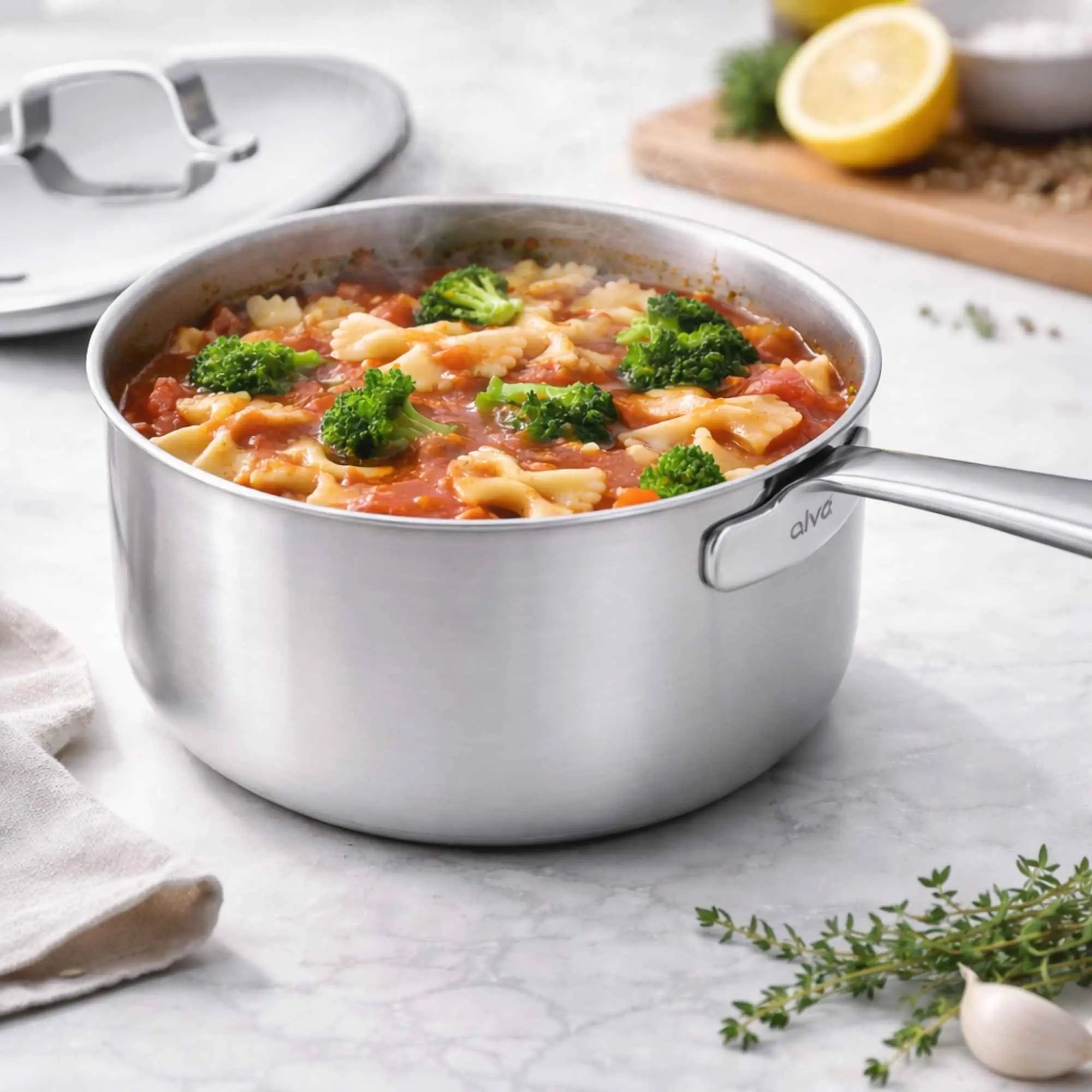
The best stainless steel saucepan is fully clad — bonded layers of steel and aluminium running from the base all the way up the sidewalls — with an 18/10 stainless interior, a lid that actually seals, and a handle that stays cool on the stovetop. Cladding up the walls is what prevents the scorch ring at the bottom edge, which is where sauces, custards and grains burn first. Our pick is the Alva Maestro 5-Ply Stainless Steel Saucepan with Lid, $139 for the 1.5-quart and $159 for the 3-quart.
What actually separates a good stainless saucepan from a cheap one
A saucepan lives on low and medium heat doing slow, fussy work: reductions, roux, rice, custard, warm milk. That workload punishes uneven pans. Almost every complaint about a stainless saucepan — scorching, sticking, a stubborn brown ring at the base — traces back to one of four things.

Our Top Pick
5-Ply Stainless Steel Saucepan with Lid
Fully clad 5-ply stainless steel for sauces, grains and gentle simmering. Uncoated, induction-ready and backed by a lifetime warranty.
From $139
Shop the 5-Ply Saucepan1. Fully clad beats disc-bottom
Disc-bottom pans bond a thick aluminium slug to the base only. The floor conducts heat well; the sidewalls are thin single-ply steel that heats slowly and unevenly. In a wide pot that barely matters. In a narrow saucepan, where a lot of your liquid is touching the walls, it matters a great deal: you get a hot ring where the disc ends and a cooler band above it, and reductions catch on that seam. A fully clad pan carries the aluminium core up the sides, so the whole interior heats at roughly the same rate.
2. An 18/10 stainless cooking surface
18/10 means roughly 18% chromium and 10% nickel. The chromium is what makes the surface non-reactive, so tomato, wine, lemon and vinegar reductions do not pick up a metallic edge or discolour the pan. Cheaper 18/0 interiors are more prone to staining and pitting over time.
3. Size — and most people buy too big
A 1.5–2 quart saucepan handles the majority of home cooking: a cup or two of rice, a pan sauce, oatmeal, reheating soup for two. A 3-quart is the right call if you regularly cook grains for four or more, blanch vegetables, or make stock-based sauces in volume. Going too large is a real cost: a small amount of liquid in a wide pan has more exposed surface, so it reduces faster than the recipe expects and scorches sooner.
4. Handle, lid and rim
A long hollow or riveted stainless handle stays noticeably cooler than a short solid one. A lid that sits flush controls evaporation, which is the whole point of a saucepan. And a slightly flared rim makes pouring a reduction into a jug much less messy than a straight-sided one.
Construction types compared
| Construction | How it heats | Best for | Watch out for |
|---|---|---|---|
| Fully clad multi-ply (3-ply, 5-ply) | Even across base and sidewalls; responds quickly to burner changes | Sauces, custards, rice, reductions, anything temperature-sensitive | Costs more; still needs proper preheating |
| Disc-bottom (impact-bonded base) | Good on the floor, weak on the walls | Boiling water, reheating, high-volume stockpots | Scorch ring where the disc ends |
| Single-ply stainless | Poor — steel alone is a bad conductor | Very light duty only | Hot spots directly over the flame |
Our pick: the Alva Maestro 5-Ply Stainless Steel Saucepan with Lid
The Maestro 5-Ply Stainless Steel Saucepan with Lid is fully clad — five bonded layers from the base to the rim — with an 18/10 stainless cooking surface and no coating to wear off. It runs $139 for the 1.5-quart and $159 for the 3-quart, both with a lid included.
- Interior: 18/10 stainless, uncoated and non-reactive, so acidic sauces are no problem
- Core: heat-conductive aluminium layers, fully clad from base to sidewalls
- Cooktops: gas, electric, ceramic, halogen and induction
- Oven safe: to 500°F / 260°C
- Utensils: metal-utensil safe; silicone, nylon or wood recommended to keep the finish looking new
- Cleaning: dishwasher safe — hand washing is still recommended for the best long-term appearance
- Warranty: lifetime, on the Maestro stainless line
Made without PFAS, PTFE, PFOA, lead or cadmium — there is no coating on an uncoated stainless pan to contain them in the first place. Alva cookware is designed in Belgium, where the company has been since 1949, and manufactured in China.
See the Maestro 5-Ply Saucepan → Free U.S. shipping over $99.
Where a stainless saucepan is the wrong tool
We would rather say this plainly than sell you the wrong pan. Stainless steel is not a nonstick surface, and no amount of cladding changes that. Scrambled eggs, delicate fish and thick porridge will stick unless you preheat properly and use enough fat — and even then, a nonstick or ceramic pan is simply easier for those jobs. Stainless also demands a bit of technique: preheat the empty pan, then add oil, then add food, and let the food release on its own rather than forcing it.
And if your saucepan genuinely only ever boils water for pasta or reheats canned soup, a fully clad pan is more pan than the job needs. The cladding earns its money on reductions and temperature-sensitive work. Be honest about which cook you are.
How to keep it looking new
Let the pan cool before washing — thermal shock is what warps bases. Use a soft sponge or non-scratch pad. For the rainbow tint that appears after high heat, or a scorched patch, Bar Keepers Friend restores the finish without damaging it. Low to medium heat does almost all the work in a saucepan; the burner rarely needs to go higher.
Frequently asked questions
Is a fully clad saucepan worth the extra money?
For sauces, custards, rice and anything that reduces, yes — the even sidewall heating is what prevents scorching at the bottom edge, and that is the failure mode people actually hit. For boiling water and reheating, a disc-bottom pan performs almost identically and costs less.
What size stainless saucepan should I buy first?
A 1.5–2 quart covers most everyday cooking for one to three people. Choose 3 quarts if you regularly cook grains for four or more, or make sauces in volume. If you are only buying one, the 3-quart is the more flexible size — you can cook small quantities in a large pan more easily than the reverse.
Does stainless steel cookware leach nickel into food?
In normal cooking, the amounts are extremely small, and the chromium layer on 18/10 steel is what keeps the surface stable and non-reactive. People with a diagnosed nickel allergy sometimes prefer to limit long acidic simmers in stainless. We covered the evidence in detail in our guide to nickel and stainless steel.
Can I put a stainless steel saucepan in the oven?
Alva 5-ply stainless is oven safe to 500°F / 260°C, lid included. Check your own pan's limit before you rely on it — handles and lid knobs, not the metal body, are usually what set the ceiling.
Why does food stick to my stainless saucepan?
Almost always because the pan was not hot enough before the oil went in, or because the food was moved too early. Preheat the dry pan over medium heat, add oil, then add food, and wait — properly seared food releases from stainless on its own.
Is a saucepan the same as a sauté pan?
No. A saucepan is tall and narrow, built to hold and reduce liquid; a sauté pan is wide and shallow with a large flat floor, built for browning. They are not interchangeable for most tasks — here is the full comparison, and if you are still working out what a saucepan is for, start here.
Comparing across materials rather than just stainless? See our broader guide to choosing a saucepan.


Laisser un commentaire
Ce site est protégé par hCaptcha, et la Politique de confidentialité et les Conditions de service de hCaptcha s’appliquent.