






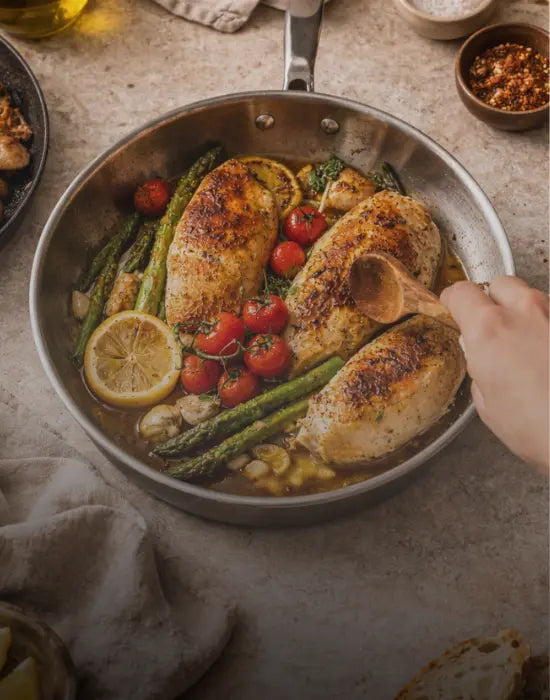
5-Ply vs 3-Ply Stainless Steel: Is 5-Ply Actually Worth It?
3-ply stainless steel bonds three layers — steel, aluminium, steel. 5-ply adds two more, for steel / aluminium / steel / aluminium / steel. The extra layers mean more thermal mass: better heat retention and less temperature crash when cold food hits the pan. 3-ply is lighter, cheaper, and heats faster. Both are good. And for most cooks, neither number matters as much as one thing nobody advertises — whether the pan is clad to the rim or just a disc on the bottom.
Shopping for stainless that lasts a lifetime?
Alva Maestro Stainless is fully clad 5-ply — most pans in this category are 3-ply — with welded, rivet-free handles (no gunk ring), oven-safe to 500°F, dishwasher-safe, and backed by a lifetime warranty.
What the numbers actually mean
"Ply" is just the count of bonded metal layers. Stainless steel is durable and non-reactive but a genuinely poor conductor of heat. Aluminium conducts beautifully but reacts with acidic food and can't take metal utensils. Clad cookware solves both problems by sandwiching them: steel where the food is, aluminium where the heat needs to move.

Our Top Pick
5-Ply Stainless Steel Frying Pan
Fully clad 5-ply stainless steel for even heat, better browning and pan sauces. Uncoated, induction-ready, oven-safe to 500°F and backed by a lifetime warranty.
From $129
Shop the 5-Ply Frying Pan| 3-ply | 5-ply | |
|---|---|---|
| Layers | Steel / aluminium / steel | Steel / aluminium / steel / aluminium / steel |
| Heats up | Faster | Slower |
| Holds heat | Less | More |
| Weight | Lighter | Heavier |
| Responds to a heat change | Quicker | Slower |
| Price | Lower | Higher |
Where 5-ply genuinely wins: the temperature crash
Here's the thing thermal mass actually buys you. Drop a cold steak into a hot pan and the pan's temperature plummets. A thin pan drops so far that the steak stews in its own moisture instead of searing — that's why you get grey meat and no crust.
More mass means a smaller drop and a faster recovery. That's the whole argument for 5-ply, and it's a real one: searing, browning, and building fond for a pan sauce. It also makes long simmers more stable and keeps induction from cycling as noticeably.
Where 3-ply is genuinely better
We're not going to tell you 5-ply is always the answer, because it isn't.
- Fast, responsive cooking. If you want the pan to react the instant you turn the heat down — delicate fish, eggs in butter, anything that turns from perfect to ruined in ten seconds — 3-ply's quicker response is an advantage, not a compromise.
- Weight. A 5-ply pan is heavy. If you have wrist or grip issues, or you're tossing vegetables in a sauté pan, that weight is a real, daily cost.
- Budget. A good 3-ply pan beats a bad 5-ply pan every single time. Construction quality matters more than layer count.
The question that matters more than 3 vs 5
Both numbers are close to meaningless if the layers stop at the bottom of the pan.
A great many stainless pans — including some sold as "5-ply" — are disc-bottom: the multi-layer construction is a plate bonded to the base, and the sidewalls are thin, single-ply steel. Heat doesn't climb them evenly, so sauces scorch at the waterline and risotto burns in a ring while the middle of the pan behaves perfectly. The ply count is technically true. The impression is false.
A fully clad pan carries the layers base to rim. That's the difference you actually taste. We break down how to spot it in fully clad vs disc-bottom stainless steel — read that before you compare any two ply numbers.
So: is 5-ply worth it?
If you sear, brown, and make pan sauces — yes. The heat retention is the point, and you'll feel it the first time a steak hits the pan and the sizzle doesn't die.
If you mostly cook fast and light, or the weight is a problem — a quality fully clad 3-ply is plenty. Don't let anyone upsell you on a number.
And whichever you choose: clad to the rim, or don't bother.
What Alva makes
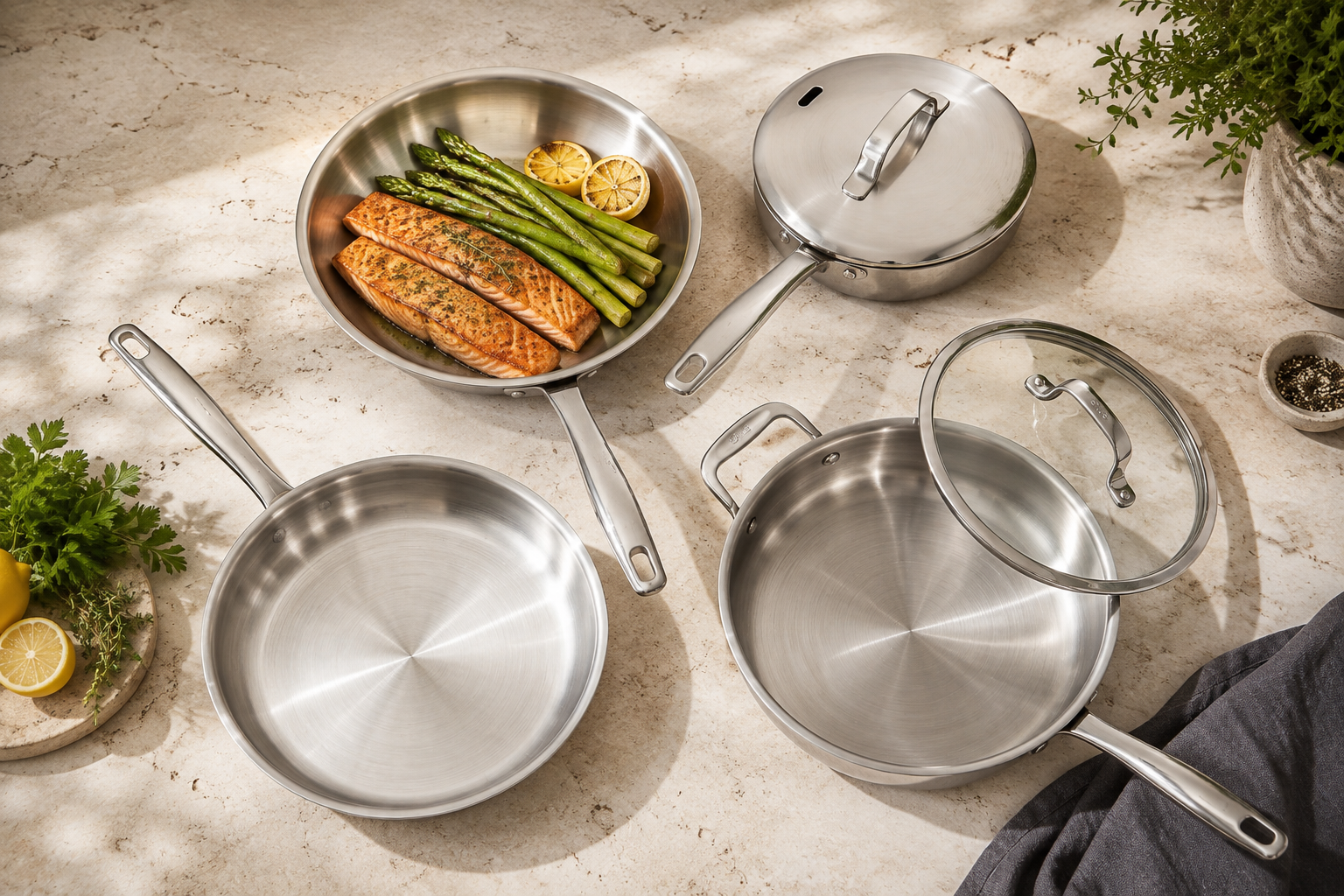
Alva's Maestro Stainless is fully clad 5-ply, base to rim — steel / aluminium / steel / aluminium / steel, with an uncoated 18/10 cooking surface. No coating to wear out, metal-utensil safe, oven-safe to 500°F, induction-ready, and backed by a lifetime warranty.
Maestro 5-Ply Frying Pan — from $129 → · 6-Piece Pot Set — $425 · Full stainless range
Want everything about clad stainless in one place — construction, technique, care and comparisons? Start with our 5-ply stainless steel cookware guide.
Frequently asked questions
What is the difference between 3-ply and 5-ply stainless steel?
3-ply bonds three layers (steel, aluminium, steel); 5-ply bonds five (steel, aluminium, steel, aluminium, steel). The extra layers add thermal mass, so 5-ply holds heat better and drops less in temperature when cold food is added. 3-ply heats faster, weighs less, and costs less.
Is 5-ply stainless steel worth it?
It is if you sear, brown, or build pan sauces — the extra thermal mass means the pan doesn't crash in temperature when cold food hits it, which is what gives you a crust instead of grey, steamed meat. If you mostly cook fast and light, or you find heavy pans hard to handle, a quality fully clad 3-ply is plenty.
Does more ply always mean better cookware?
No. A well-made 3-ply pan beats a poorly made 5-ply pan. And ply count says nothing about whether the layers run up the sidewalls — a disc-bottom pan can be sold as "5-ply" while its walls are thin single-ply steel. Fully clad construction matters more than the number.
Is 5-ply heavier than 3-ply?
Yes. The extra metal layers add real weight, which is a genuine downside if you have grip or wrist issues, or if you toss food in the pan.
Next: fully clad vs disc-bottom, or how to cook on stainless without sticking. Take $30 off your first $200+ order.
Comparing premium stainless brands? See our All-Clad vs Made In comparison — and where Alva’s 5-ply undercuts both on price.
Our top pick5-Ply Stainless Steel Frying PanShop now →Want the full build sheet? See Maestro Stainless construction specs — and how it compares to All-Clad D3 and Tramontina Tri-Ply.


Laisser un commentaire
Ce site est protégé par hCaptcha, et la Politique de confidentialité et les Conditions de service de hCaptcha s’appliquent.