






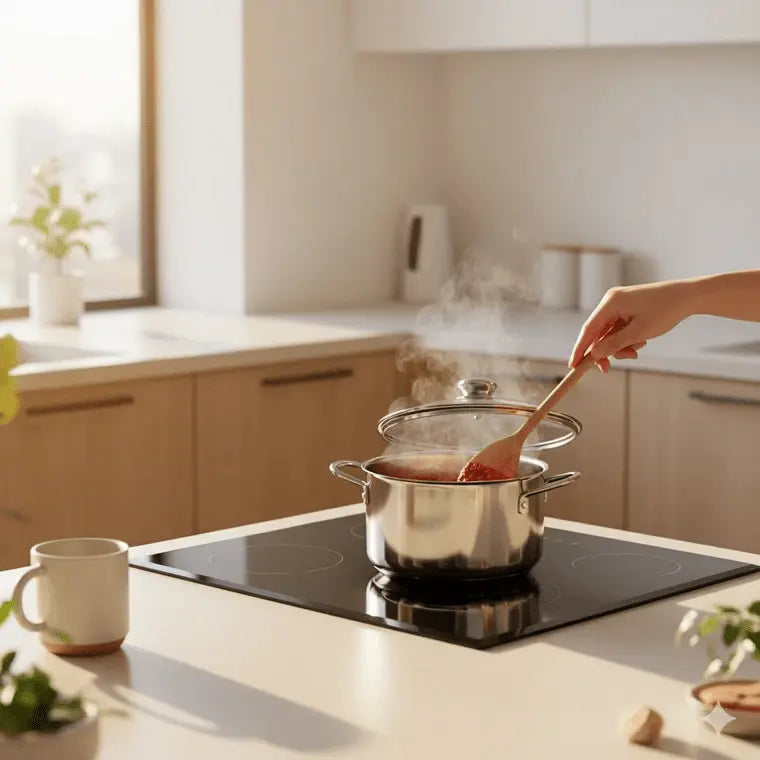
What Is a Saucepan? Uses, Types & How It Differs from Pots and Pans
A saucepan is a deep, round pan with tall, straight sides, a single long handle and usually a lid. The tall sides slow evaporation, which makes it the pan for anything liquid: sauces, grains, soups, custards and reheating. It is the piece most kitchens reach for more than any other.
What is a saucepan used for?
- Simmering sauces, gravies and reductions
- Cooking rice, grains and oatmeal
- Boiling or steaming vegetables, eggs and pasta portions
- Heating soups, stocks and small-batch stews
- Melting butter and chocolate, and warming milk
- Custards, pastry cream and anything that needs gentle, controlled heat
The common thread is liquid. A saucepan's narrow footprint and tall walls mean less surface area exposed to the air, so liquid reduces slowly and predictably instead of boiling away.

Our Top Pick
5-Ply Stainless Steel Saucepan with Lid
Fully clad 5-ply stainless steel for sauces, grains and gentle simmering. Uncoated, induction-ready and backed by a lifetime warranty.
From $139
Shop the 5-Ply SaucepanWhat size saucepan do you need?
| Size | Best for | Feeds |
|---|---|---|
| 1 to 1.5 qt | Sauces, melting butter, a single portion of oatmeal, warming milk | 1–2 |
| 2 to 3 qt | Rice and grains, pasta portions, soup for the family, most everyday jobs | 2–4 |
| 4 qt and up | Batch cooking, stock, blanching, boxed pasta | 4+ |
If you own one, make it 2 to 3 quarts. If you own two, add a small one — our full saucepan size guide matches each size to household and task. Buying too large is a genuine mistake: a shallow layer of liquid in a wide pan has more exposed surface, so it reduces faster than the recipe expects and catches on the bottom.
Saucepan vs pot vs frying pan vs saucier
A saucepan has tall straight sides and one long handle, built for stovetop liquid cooking. A pot or stockpot is larger and wider with two loop handles, made for volume. A frying pan has low flared sides for searing and sauteing, where evaporation is the point rather than the problem. A saucier is a saucepan with curved, sloping sides so a whisk can reach every part of the base — useful for custards and risotto, unnecessary for most people.
The comparison people get wrong most often is saucepan against saute pan. They look similar because both have straight sides, but they do opposite jobs: here is the full breakdown.
What is a saucepan made of, and does it matter?
It matters more than for almost any other pan, because a saucepan holds acidic liquid at heat for long stretches.
- Fully clad stainless steel — non-reactive, so tomato, wine and citrus reductions do not pick up a metallic edge. Cladding that runs up the sidewalls is what stops the scorch ring at the bottom edge. The default choice.
- Ceramic nonstick — easiest cleanup, best for milk, oatmeal and anything that catches. Gentler heat only, and the coating wears eventually.
- Bare aluminium — reacts with acidic food. Avoid for sauces.
- Enamelled cast iron — excellent heat retention, but heavy for a pan you lift and pour from constantly.
Construction matters as much as material: a disc-bottom pan bonds a thick plate to the base only, leaving thin single-ply walls, which is exactly where sauces scorch. Fully clad vs disc-bottom covers how to tell them apart.
What to look for when buying one
- A lid that sits flush — controlling evaporation is the entire point
- A long handle that stays cool, ideally hollow or riveted stainless
- A slightly flared or rolled rim, so pouring a reduction does not run down the side
- A flat base, and magnetic if you cook on induction
- An oven-safe rating if you finish dishes under heat
Ready to choose one? Our best saucepan guide covers materials and sizes, and the stainless steel buying guide goes deeper on cladding and construction.
How to look after a saucepan
Let it cool before washing — thermal shock is what warps bases. Use low to medium heat, since a saucepan rarely needs more. For stainless, preheat before adding oil and use Bar Keepers Friend to lift scorching or rainbow tint. For ceramic nonstick, hand wash, skip aerosol sprays and keep the heat moderate.
Frequently asked questions
What is a saucepan?
A saucepan is a deep, round stovetop pan with tall straight sides, a single long handle and usually a lid. The depth slows evaporation, which makes it suited to liquid cooking: sauces, grains, soups and custards.
What size saucepan do I need?
A 2 to 3 quart saucepan covers most everyday cooking for two to four people. Choose 1 to 1.5 quarts for sauces and single portions, and 4 quarts or more for batch cooking and stock. If you are buying one, 3 quarts is the most flexible.
What is the difference between a saucepan and a pot?
A saucepan is narrower and deeper with one long handle, for stovetop liquid cooking. A pot or stockpot is wider and larger with two loop handles, made for boiling and batch cooking in volume.
Can you fry in a saucepan?
You can shallow-fry in one, and the tall sides contain splatter well. It is a poor choice for searing or sauteing, though: the narrow base gives little contact area, so food steams rather than browns. Use a frying pan for that.
What is the best material for a saucepan?
Fully clad stainless steel for most people, because it is non-reactive and heats evenly up the sidewalls. Ceramic nonstick is easier to clean and better for milk and oatmeal, but it needs gentler heat and the coating wears over time.
Is a saucepan oven safe?
It depends on the pan. Alva 5-ply stainless saucepans are oven safe to 500°F and ceramic nonstick to 400°F. Handles and lid knobs usually set the limit before the body does, so check the specific pan.
Browse saucepans and pots, or read our safety standards. Free U.S. shipping over $99.


Dejar un comentario
Este sitio está protegido por hCaptcha y se aplican la Política de privacidad de hCaptcha y los Términos del servicio.