






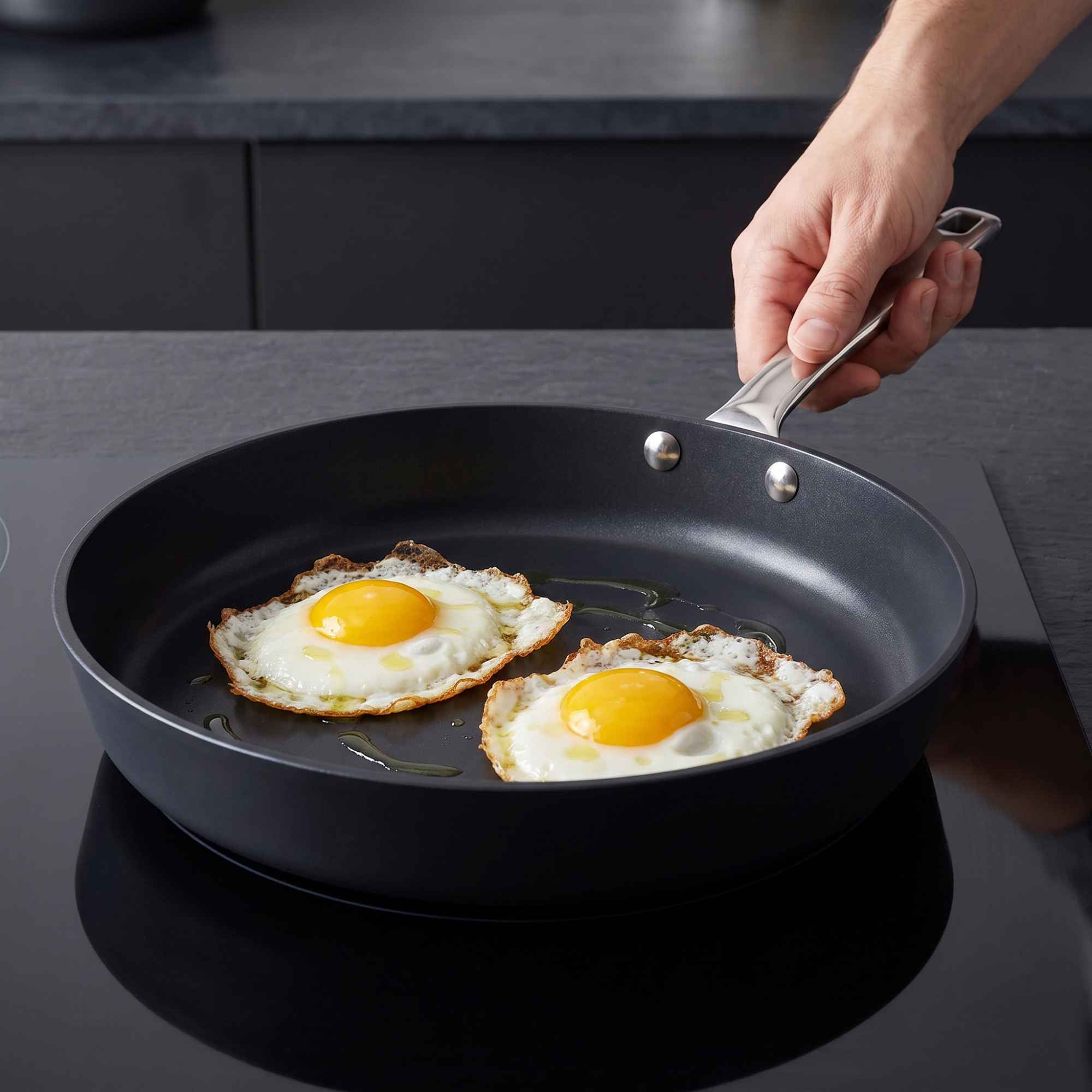
What Are PFAS, PFOA & PTFE? A Plain-English Guide
PFAS are a family of thousands of synthetic "forever chemicals" prized for repelling water, oil, and heat. PTFE (best known as Teflon) is one specific PFAS used as the slick coating on traditional nonstick pans, and PFOA is a different PFAS that was historically used to manufacture PTFE until it was phased out over health concerns. So: PFOA and PTFE are both PFAS — but they are not the same thing, and "PFOA-free" does not mean "PFAS-free."
The three terms, decoded
The acronyms get used interchangeably in marketing copy, which is exactly why they confuse people. Here is the plain-English version of each.

Our Top Pick
Ceramic Nonstick Cookware Set, 12-Piece
A complete ceramic nonstick kitchen in one set. Made without PFAS, PTFE or PFOA, supported by published third-party testing, induction-ready and backed by a 10-year limited warranty.
From $599
Shop the 12-Piece Set| Term | What it is | Where you meet it | Key thing to know |
|---|---|---|---|
| PFAS | An umbrella family of thousands of per- and polyfluoroalkyl substances | Nonstick coatings, waterproof fabrics, food packaging, firefighting foam | Called "forever chemicals" because they break down extremely slowly in the environment and the body |
| PTFE | Polytetrafluoroethylene — a specific PFAS polymer, sold under brand names like Teflon | The actual slick coating on traditional nonstick pans | Inert at normal cooking temperatures, but begins to degrade when a pan is overheated well above typical cooking heat |
| PFOA | Perfluorooctanoic acid — a PFAS formerly used as a processing aid to make PTFE | Phased out of U.S. cookware manufacturing (completed by 2015) | Linked to health concerns in studies of exposed communities; "PFOA-free" is now true of virtually all new pans and says little by itself |
Why these chemicals ended up in cookware
Nonstick cookware exists because PTFE is remarkably good at its job: almost nothing bonds to it, so eggs slide and cleanup is trivial. For decades PFOA was used in the factory process that turns raw PTFE into a pan coating. When PFOA was linked to health concerns, manufacturers phased it out — which is why every nonstick pan sold today can honestly say "PFOA-free" while still being coated in PTFE, a PFAS.
What the evidence says about risk
The strongest health evidence concerns PFOA and similar long-chain PFAS in drinking water and industrial exposure — not intact PTFE coatings on pans. An undamaged PTFE pan used at normal temperatures is generally considered low-risk by regulators. The practical concerns are overheating (PTFE begins to break down at very high, empty-pan temperatures and can release fumes) and scratched or flaking coatings. If you cook hot and hard, or your nonstick pan is visibly damaged, that is when replacement makes sense.
How to tell what's in your cookware
Manufacturers rarely print "contains PFAS" on the box, so read labels this way: "PTFE" or "Teflon" means the pan is coated with a PFAS. "PFOA-free" alone tells you almost nothing — assume PTFE unless stated otherwise. "PFAS-free" is the stronger claim, and it should be backed by independent testing rather than taken on faith. Uncoated stainless steel, cast iron, and carbon steel contain no nonstick coating at all, so the question doesn't arise. Our non-toxic cookware guide walks through each material in detail.
Where Alva stands
Alva's coated lines use a sol-gel ceramic nonstick that is made without PFAS, PTFE, or PFOA — and we don't ask you to take our word for it: the coatings are independently tested by TÜV Rheinland. You can read exactly what we test and why on our testing & materials page and in our safety standards.
If you want PFAS-free nonstick that covers a whole kitchen, the Maestro Essentials 9-Piece Ceramic Nonstick Set ($499) is the one we'd point you to: ceramic-coated, oven-safe to 400°F, and backed by a 10-year warranty. Free U.S. shipping over $99.
One honest caveat
Ceramic nonstick is not a life-for-life swap for PTFE. A well-treated PTFE coating typically stays slick longer than ceramic, which trades some longevity for a coating made without PFAS. If maximum coating lifespan matters more to you than avoiding PTFE, a conventional nonstick pan used gently at moderate heat is a defensible choice — and uncoated stainless or cast iron will outlast both.
Frequently asked questions
Is PTFE the same as PFAS?
PTFE is one member of the PFAS family. All PTFE is a PFAS, but PFAS includes thousands of other chemicals too. A "PTFE-free" pan may still involve other PFAS unless it is explicitly tested PFAS-free.
Does "PFOA-free" mean a pan is safe and PFAS-free?
No. PFOA has been out of U.S. cookware manufacturing since 2015, so "PFOA-free" is true of essentially every new pan — including PTFE-coated ones. It does not mean the pan is free of PFAS.
Is it dangerous to use a scratched nonstick pan?
Swallowed flakes of PTFE are considered inert and pass through the body, but a scratched coating degrades faster and can expose the layer beneath. Most manufacturers, including us, recommend replacing any nonstick pan with a damaged coating.
What cookware contains no PFAS at all?
Uncoated stainless steel, cast iron, and carbon steel have no nonstick coating, so PFAS isn't part of the equation. Ceramic (sol-gel) nonstick coatings like Alva's are made without PFAS, PTFE, or PFOA and independently tested to verify it.
At what temperature does PTFE become a problem?
PTFE is stable at normal cooking temperatures. Degradation becomes a concern when an empty pan is overheated far beyond typical cooking heat — one reason never to preheat an empty nonstick pan on high.

%20is%20one%20specific%20PFAS%20used%20as%20the%20slick%20coating%20on%20traditional%20...)
Dejar un comentario
Este sitio está protegido por hCaptcha y se aplican la Política de privacidad de hCaptcha y los Términos del servicio.