





All-Clad vs Made In: Which Stainless Cookware Is Worth It?
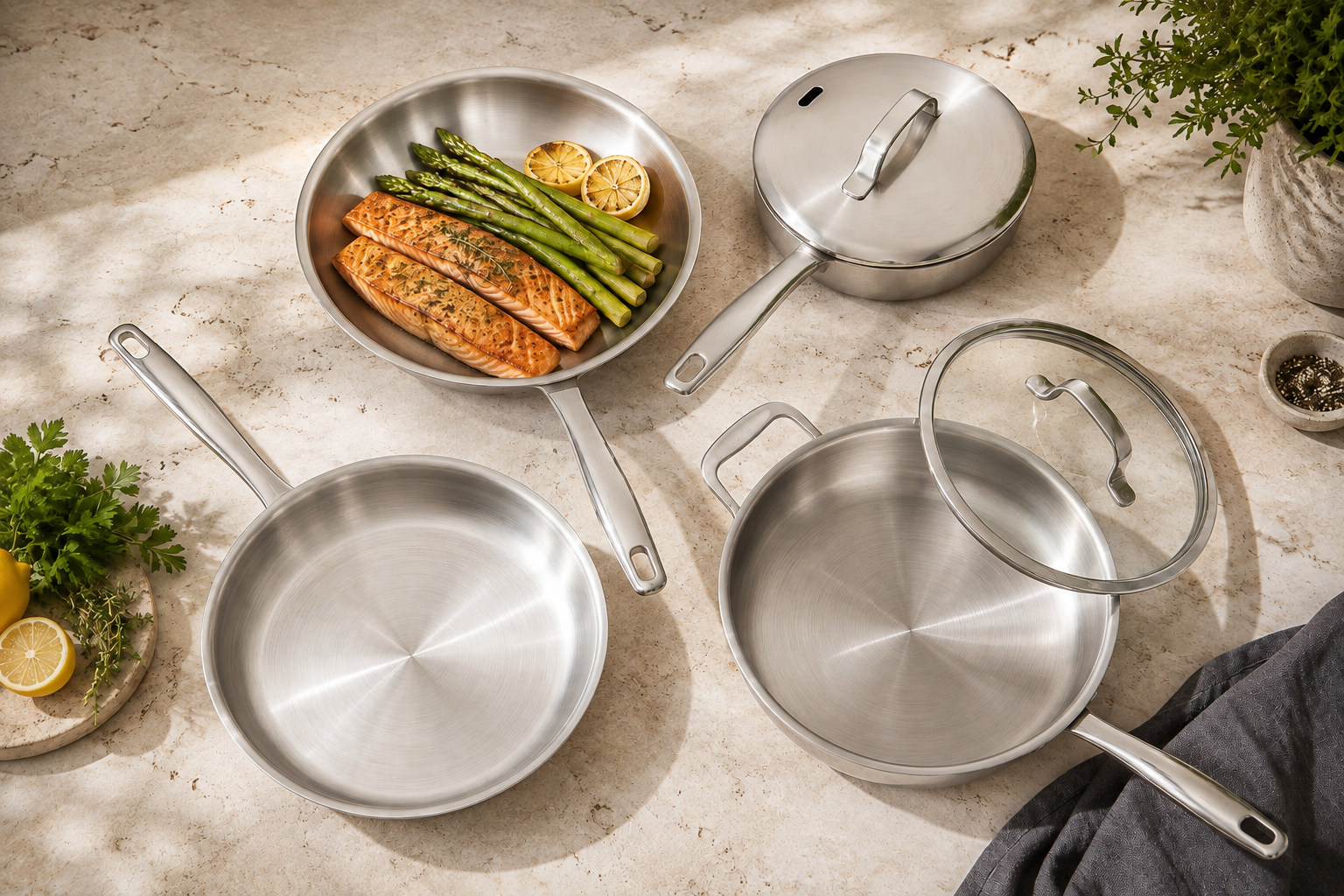
All-Clad and Made In are the two names that come up whenever someone asks what stainless cookware is actually worth buying. They are more different than they look: one is tri-ply and bonded in Pennsylvania from global components, the other is 5-ply and made on two continents. Here is how they compare, and where a third option makes more sense than either.
The short answer: All-Clad D3 is the heritage choice, bonded in Pennsylvania, oven-safe to 600°F. Made In Stainless Clad is thicker, 5-ply, and oven-safe to 800°F for the same set price. If you want 5-ply construction and a lifetime warranty without the $799 entry point, Alva's 5-ply stainless starts at $565.
At a glance
| All-Clad D3 | Made In Stainless Clad | Alva 5-Ply Stainless | |
|---|---|---|---|
| Construction | Tri-ply (3 layers), aluminum core | 5-ply, 5 layers of 4 metals | 5-ply |
| Thickness | Not published | 2.7mm frying pans, 2.3mm rest | 5-ply throughout |
| Oven safe | 600°F (glass lids 350°F) | 800°F | 500°F |
| Dishwasher | "Handwash Only" per All-Clad | "Technically dishwasher safe," hand wash advised | Hand wash advised |
| Induction | Yes | Yes | Yes |
| Warranty | Limited lifetime | Lifetime | Lifetime |
| Made in | "Made in the USA with global components" — Canonsburg PA | Italy and USA — two parallel SKU lines | Belgian-engineered |
| Published lab reports | No — "third-party tested" claim only | Names Light Labs and a test date; no report PDF | Yes — TÜV Rheinland reports published |
| Set price | $799.99 / 10-pc | $799 / 10-pc | $565 / 7-pc, $865 / 14-pc |
| 10" fry pan | $149.99 | $139 | Included in sets |
Competitor specs verified from all-clad.com and madeincookware.com on 20 August 2026. Prices change frequently — check current listings before buying.
Tri-ply vs 5-ply: does it matter?
This is the single real construction difference, and it is smaller than the marketing on either side suggests.
All-Clad D3 is tri-ply: an aluminum core between two layers of stainless, bonded from base to rim. Made In Stainless Clad is 5-ply — five layers of four different metals, with an aluminum and aluminum-alloy core sandwiched between 18/10 stainless on the cooking surface and ferritic 430 on the base.
More plies mean more mass, which means more even heat and better heat retention, but also more weight and a slower response. Tri-ply heats faster and reacts quicker; 5-ply holds temperature better when you add cold food. Both are fully clad to the rim, which is the thing that actually matters — it is what separates real clad cookware from a cheap disc-bottom pan where the aluminum stops at the base and the sides heat unevenly.
For most home cooking the difference is marginal. Where 5-ply earns its keep is searing several batches in a row and holding a steady simmer. If you want the deeper explanation, we wrote one on whether 5-ply is actually worth it over 3-ply.
Where each brand is genuinely stronger
All-Clad: the American-made argument, with an asterisk
All-Clad has been bonding cookware in Canonsburg, Pennsylvania since 1971, and that heritage is real. Their own wording is precise, though, and worth repeating exactly: "Made in the USA with global components." Not simply "made in the USA." On their D3 Everyday glass-lid pieces, the site separately discloses that the glass lids are made in China.
One thing All-Clad is clearer about than most retailers repeat: D3 is handwash only. Their product pages end the details block with exactly that, and their warranty excludes damage from "cleaning in the dishwasher." Anywhere you read that All-Clad D3 is dishwasher safe, that is not what All-Clad says.
Made In: more pan for the same money, made on two continents
At the same $799 set price, Made In gives you 5-ply instead of 3-ply and an 800°F oven rating instead of 600°F. That is a straightforwardly better spec sheet.
The complication is origin. Made In runs two parallel SKU lines at identical prices — one made in Italy, one made in the USA. Their site footer says "Made in Italy and USA from Domestic and Imported Components." The 10-piece set page you would land on by default is badged "Made in Italy," while its own body copy says "Crafted in the United States." If American manufacture matters to you, you have to seek out the US-specific product URLs deliberately.
What neither brand publishes
Both brands make safety claims. On the pages we reviewed, neither publishes a downloadable report.
All-Clad's product pages say each piece is "third-party tested for safety," but name no laboratory, no standard, no method and provide no certificate. Made In goes further — it cites a European Food Contact Safety Regulations report number, names Light Labs, gives a September 2025 test date and describes LC-MS/MS methodology — but still does not publish a downloadable report.
This matters less for bare stainless than for coated cookware, since uncoated stainless has no coating to test in the first place. But if published, verifiable testing is your deciding factor, it is worth knowing that "third-party tested" and "here is the report" are not the same claim.

The third option
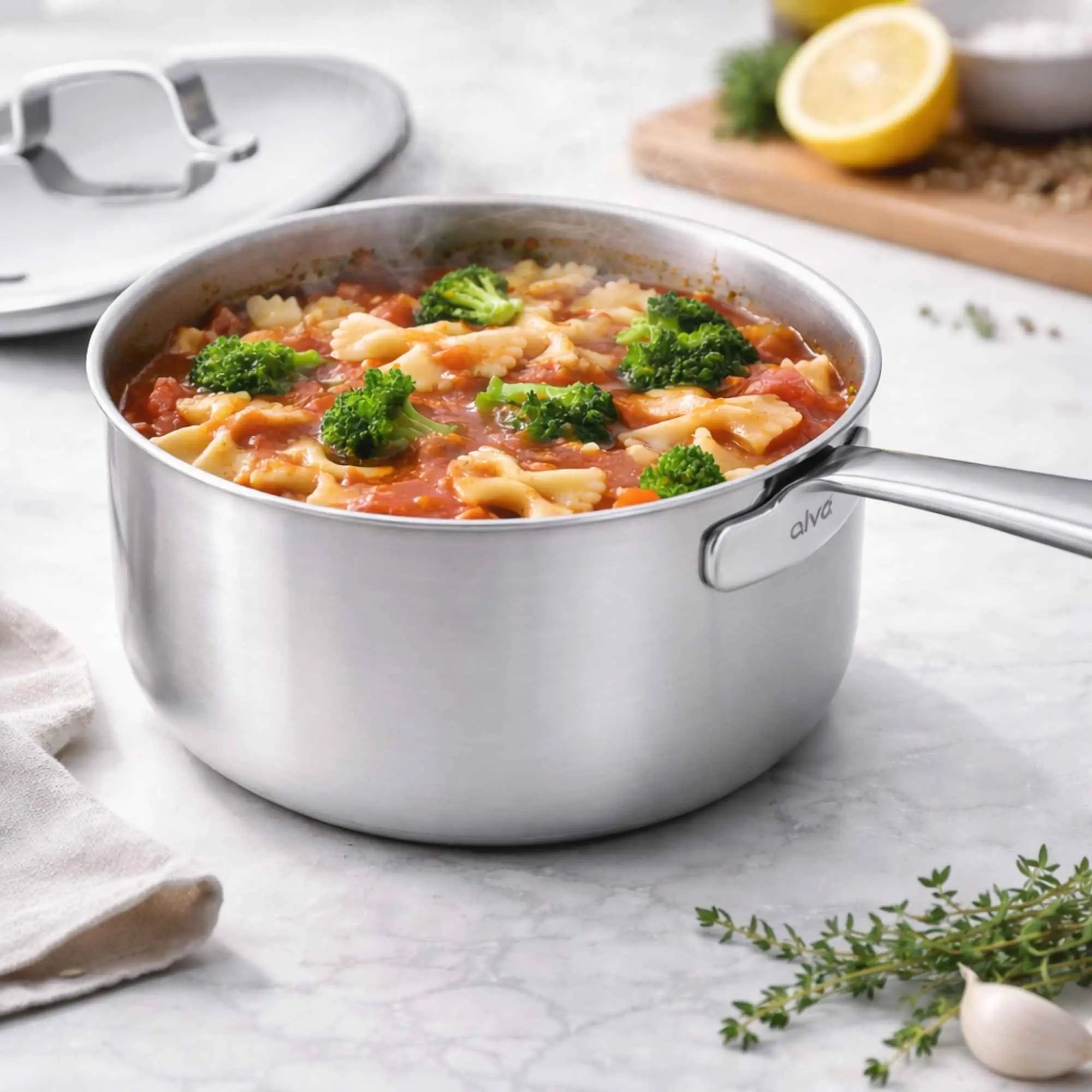
Alva 5-Ply Stainless, 7-Piece
5-ply construction and a lifetime warranty at $234 less than either 10-piece set. Uncoated, oven-safe to 500°F, induction-ready, and made without PFAS, PTFE or PFOA — with the third-party lab reports actually published.
$565 · 14-piece $865
Shop the Stainless SetWho should buy which
- You want the heritage brand and Pennsylvania bonding. All-Clad D3. Accept handwash-only and the 600°F ceiling.
- You want the best spec sheet at $799. Made In. 5-ply and 800°F beat tri-ply and 600°F on paper.
- You specifically want American-made. Made In's US SKU line, or All-Clad — but read the origin wording on the exact product page, because both brands qualify it.
- You want 5-ply and a lifetime warranty without paying $799. Alva's 7-piece 5-ply set is $565. The honest trade-off: it is rated to 500°F rather than Made In's 800°F or All-Clad's 600°F, and it does not carry a Pennsylvania or Italian manufacturing story — if either of those is what you are buying, the other two earn their premium.
- You want published third-party lab reports, not just the claim. Alva publishes TÜV Rheinland results with report numbers and dates.
- You mainly cook eggs and delicate fish. None of these. Bare stainless is the wrong tool — look at ceramic nonstick instead.
Frequently asked questions
Is All-Clad or Made In better?
Made In has the stronger spec sheet at the same price: 5-ply construction and an 800°F oven rating against All-Clad D3's tri-ply and 600°F. All-Clad's advantage is heritage and Pennsylvania bonding. Both carry lifetime warranties and both work on induction. For most home cooks the cooking difference is small enough that price, origin and oven ceiling should decide it.
Is All-Clad D3 dishwasher safe?
No. All-Clad's own D3 product pages state "Handwash Only," and their warranty specifically excludes damage caused by "cleaning in the dishwasher." Many third-party listings describe D3 as dishwasher safe, but that contradicts what the manufacturer publishes. Hand wash it if you want the warranty to stand.
Is Made In cookware actually made in America?
Partly. Made In runs two parallel Stainless Clad lines at the same prices — one manufactured in Italy, one in the USA — and their site footer describes the range as "Made in Italy and USA from Domestic and Imported Components." The default 10-piece set page is badged "Made in Italy." If US manufacture matters, look for the US-specific product URLs.
What does 5-ply mean, and is it better than tri-ply?
Ply counts the bonded metal layers. Tri-ply is aluminum between two stainless layers; 5-ply adds two more. More layers means more mass, so heat is more even and better retained, but the pan is heavier and slower to respond. Tri-ply heats faster. Both are fully clad to the rim, which matters more than the layer count for everyday cooking.
Do these brands publish third-party testing?
On the pages we reviewed, neither publishes a downloadable report. All-Clad states its cookware is "third-party tested for safety" without naming a lab or standard. Made In goes further, citing a European Food Contact Safety Regulations report number and naming Light Labs with a test date, though we did not find a downloadable certificate. Alva publishes its TÜV Rheinland reports with report numbers and test dates.
Does stainless steel cookware contain PFAS?
Uncoated stainless steel has no nonstick coating, so there is no PFAS or PTFE in the cooking surface by design. The question only becomes meaningful for nonstick versions — All-Clad, for instance, discloses that its D3 Nonstick lines contain PFAS, while the plain D3 stainless does not. Always check whether you are looking at the coated or uncoated version of a line.
Will a stainless set last 10 years?
Uncoated stainless routinely outlasts that. With nothing to wear off, the usual failure modes are warping from thermal shock and cosmetic pitting from salt added to cold water — neither of which ends the pan's life. All three brands here carry lifetime warranties on the pan itself, though all exclude cosmetic wear, and All-Clad excludes dishwasher damage.
Related reading: is stainless steel cookware safe?, the best stainless cookware for induction, and stainless steel vs carbon steel.


Dejar un comentario
Este sitio está protegido por hCaptcha y se aplican la Política de privacidad de hCaptcha y los Términos del servicio.