







The Complete Guide to Choosing Premium Cookware for Your Kitchen Style
Premium cookware is worth it when the extra money buys construction you can point to — full cladding, a thicker base, a welded handle, a longer warranty — and not worth it when it buys a brand name and a heavier box. The honest split: spend on the pieces you use daily and on anything uncoated, and save on specialist pieces and anything with a coating that will wear out regardless of price.
Looking for the full buying process instead? See the complete cookware buying guide, or the four-step framework for choosing cookware. This page is only about whether paying more is justified.

Our Top Pick
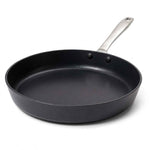
Ceramic Nonstick Cookware Set, 12-Piece
A complete ceramic nonstick kitchen in one set. Made without PFAS, PTFE or PFOA, supported by published third-party testing, induction-ready and backed by a 10-year limited warranty.
From $599
Shop the 12-Piece SetWhat more money actually buys
Four things separate expensive cookware from cheap cookware, and all four are checkable before you buy.
- Cladding that runs up the sidewalls. A cheap pan bonds an aluminium disc to the base and leaves the walls thin single-ply steel. That seam is where sauces scorch. Fully clad construction costs more to make and is the single biggest performance difference you can pay for.
- Base thickness and stability. Thin bases warp, and a warped base on induction or a glass top loses contact and heats unevenly. Weight is a crude proxy, but a pan that flexes when you press the centre is telling you something.
- Handle construction. Welded or properly riveted stainless outlasts a screwed-on handle, and a hollow or long handle stays cooler on the stovetop. Handles are usually the first thing to fail on budget pans.
- Warranty length. This is the most honest signal a manufacturer gives you, because it is the one claim that costs them money if it is wrong. Alva uncoated lines carry a lifetime warranty; ceramic carries 5 or 10 years depending on the line.
Where the money is well spent
| Piece | Spend or save | Why |
|---|---|---|
| Everyday frying pan | Spend | Used daily; construction and coating quality show up fastest here |
| Saucepan | Spend | Long simmers on thin sidewalls scorch; cladding matters most |
| Dutch oven | Spend | Uncoated and effectively permanent — a lifetime purchase |
| Stock pot | Save | Mostly boils water; cladding earns little |
| Specialist pans (crepe, fish, grill) | Save | Occasional use rarely justifies the premium |
| Anything coated | Middle | All coatings wear out; buy quality, but do not buy heirloom pricing |
The coated-versus-uncoated rule
This is the clearest way to think about it. Uncoated cookware — fully clad stainless, cast iron, carbon steel — has nothing to wear out, which is why it carries lifetime warranties and why paying more for better construction pays back over decades. Coated cookware has a finite life no matter what you spend, because every nonstick surface loses release eventually.
So: pay up for uncoated pieces you will keep forever, and buy coated pieces on quality and warranty rather than on prestige. Our Maestro 5-Ply Stainless Frying Pan starts at $129 with a lifetime warranty; the Maestro Ceramic Nonstick starts at $109 with 10 years. That gap is small, and the reasoning behind it is the point.
What premium does not buy
It does not buy nonstick that lasts forever — no coating does, at any price. It does not buy skill: a $300 stainless pan will stick just as badly as a $30 one if you do not preheat it properly. And it does not automatically buy safety. "Non-toxic" is unregulated, so a high price is not evidence of anything — only published lab testing is.
It also does not buy you a 15-piece set worth owning. Most boxed sets pad the count with lids and pieces you will not use. Three to five pieces covers the overwhelming majority of home cooking.
Where cheap cookware is the right answer
If you are furnishing a first apartment, a rental, or a student kitchen, buying inexpensive now and upgrading the two pans you actually use later is a perfectly rational plan. The same goes for anything you are unsure you will use — buy the cheap wok first and find out whether you stir-fry before you buy the good one.
A sensible way to spend
Start with one very good frying pan and one very good saucepan, both uncoated or well-warrantied, and fill in around them. That is roughly $250 to $300 of cookware that will handle most of what you cook, versus $500 on a boxed set where half the pieces sit in a cupboard.
See what most people start with → Free U.S. shipping over $99.
Frequently asked questions
Is expensive cookware worth it?
For pieces you use daily and for anything uncoated, yes — the extra money buys full cladding, a thicker base, better handles and a longer warranty, all of which last decades. For specialist pieces and anything coated, the return is much smaller, because coatings wear out regardless of price.
What is the difference between cheap and expensive cookware?
Mainly construction. Cheap pans bond a disc to the base and leave thin sidewalls; expensive pans clad the whole body. Base thickness, handle attachment and warranty length are the other three differences, and all four are checkable before you buy.
Does expensive cookware cook better?
It heats more evenly, which matters most for sauces, reductions and anything that scorches. It will not make you a better cook, and it will not stop food sticking to stainless if the pan is not preheated properly.
Is a cookware set cheaper than buying pieces separately?
Usually yes per piece, but only if you use all the pieces. Sets pad their counts with lids and specialist pans. Buying three to five pieces you will actually use is often cheaper in practice than a discounted 12-piece set.
How much should I spend on a good frying pan?
Enough for fully clad construction and a real warranty. In our range that starts around $109 for ceramic nonstick with a 10-year warranty and $129 for 5-ply stainless with a lifetime warranty. Below roughly $50 you are generally buying a disc base and a short life.


Laisser un commentaire
Ce site est protégé par hCaptcha, et la Politique de confidentialité et les Conditions de service de hCaptcha s’appliquent.