






Mortar and Pestle vs Spice Grinder: Which Should You Buy?
Buy an electric spice grinder for speed and volume; buy a mortar and pestle for texture control and flavor. The grinder wins when you process cupfuls of spices weekly. The mortar crushes instead of slicing — releasing more aromatic oils — handles pastes and guacamole, and has no motor to burn out. Here's the honest breakdown of where each tool genuinely wins, so you only buy the one you'll use.
Grind like it's 1949.
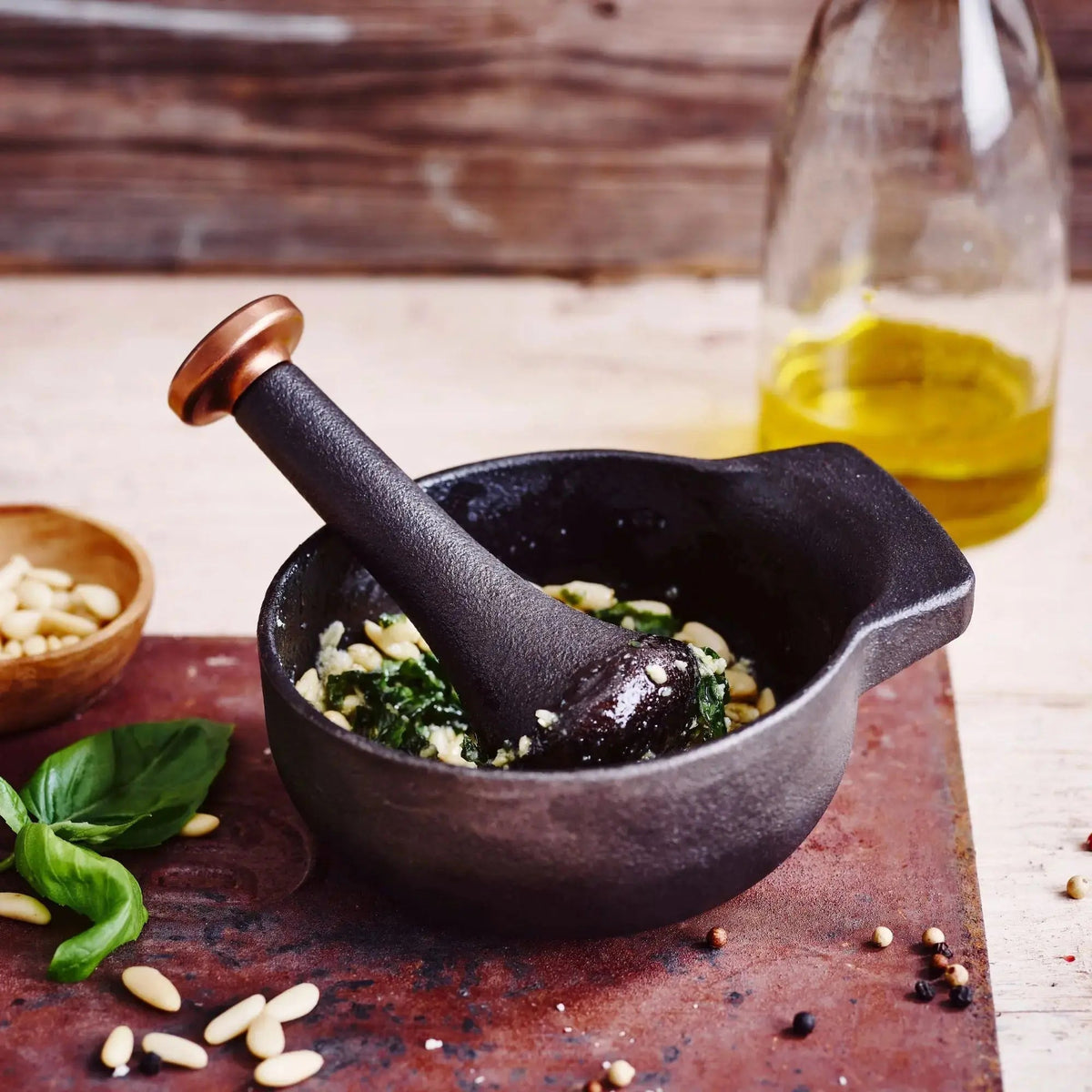
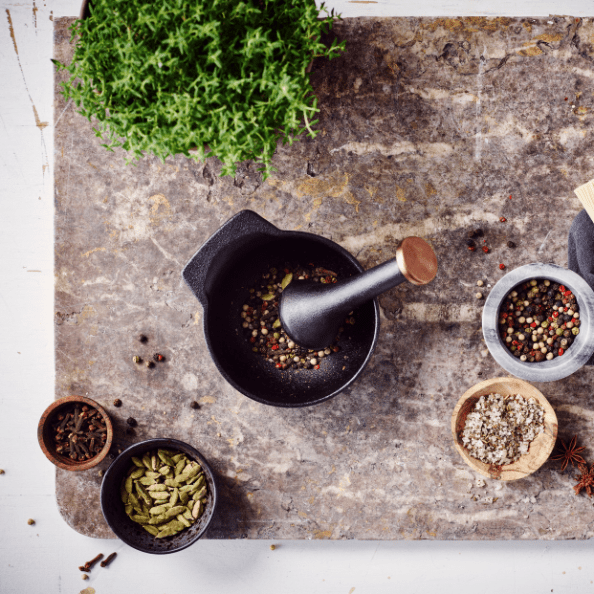
The Alva Nori mortar & pestle is enameled cast iron — 2-cup capacity, serious weight for real crushing power, and a textured grinding surface that grips herbs and spices instead of letting them slide.
They don't do the same thing to a spice
An electric spice grinder is a blade mill: a small motor spins a blade at high speed and chops spices into progressively smaller pieces. It's fast and uniform, but the blade slices — and the friction of a longer grind warms the spices, driving off some of the volatile aromatics you were trying to capture.
A mortar and pestle crushes and shears. Pressure ruptures the cell walls of a spice or herb and squeezes the oils out intact, which is why a paste of garlic mashed in a mortar tastes rounder and more fragrant than the same clove minced or blitzed. You also control the endpoint completely: cracked for a crust, coarse for a rub, fine for a curry — and everything in between. With a grinder you get whatever a two-second pulse gives you.
Mortar and pestle vs spice grinder: head to head
| Factor | Mortar & pestle | Electric spice grinder |
|---|---|---|
| Speed | Slower — a minute or more per batch | Winner: seconds to a fine powder |
| Volume | Small batches | Winner: cup-scale batches, back to back |
| Texture control | Winner: everything from cracked to paste | Coarse-to-fine only, easy to overshoot |
| Flavor | Winner: crushing releases oils; no heat | Blade friction warms spices |
| Wet pastes, guacamole, muddling | Winner: built for them | Not designed for wet loads |
| Durability | Winner: no motor to burn out | Motors and blades wear out |
| Cleanup | Wash the bowl | Blade cavity traps powder; often can't be rinsed |
| Noise | Quiet thuds | Loud |
When the spice grinder is the right call
Honesty first: if you grind large quantities of dry spices on a schedule — weekly batches of garam masala, jars of chili powder, coffee-adjacent volumes — an electric grinder is the right tool. It turns a half-cup of whole spices into uniform powder in fifteen seconds, and no amount of pestle technique competes with that throughput. Buy one if speed and volume are your bottleneck, and accept the tradeoffs: one texture setting in practice, a cavity that's fiddly to clean, cross-contamination between batches, and a motor with a finite life.
When the mortar and pestle wins
Texture control. Cracked peppercorns for a steak crust, coarsely bashed coriander for a rub, garlic worked to a silky paste — a mortar stops exactly where you want. A blade grinder goes from chunks to dust with little in between.
Flavor. Crushing releases the oils that slicing leaves locked in fragments, with none of the motor heat. Small quantities also aren't a problem: a mortar grinds a single teaspoon of cumin happily, while most electric grinders need a minimum load before the blade even catches.
Wet work a grinder can't touch. Guacamole, pesto, chimichurri, curry pastes, aioli, muddled herbs for drinks — these are crushing jobs, and they're where a mortar becomes a daily tool instead of a spice gadget. Our guide on how to use a mortar and pestle walks through the crushing, grinding and muddling motions each one needs.
Nothing to burn out. A mortar and pestle has no motor, no blade to dull, no cord and no counter footprint by the outlet. It's the rare kitchen tool where the failure mode is "you dropped it on your foot."
Our recommendation
For most home cooks, the mortar and pestle is the better first buy: it does the everyday jobs (spices in cooking quantities, garlic, pastes, guacamole) with better flavor and texture, and it never wears out. Add an electric grinder later only if batch volume becomes a real need — the two coexist happily.
If you go the mortar route, weight and material decide everything — our best mortar and pestle guide compares granite, marble, wood, porcelain and cast iron honestly. Our own pick is the Alva Nori enameled cast iron mortar & pestle: a 2-cup, 4-inch bowl with the heavyweight stability that keeps it planted while you grind, a textured interior that grips ingredients instead of letting them slide, and simple hand-wash care. It's made without PFAS, PTFE, PFOA, lead and cadmium, and at $99 it's also a favorite from our cast iron gift guide.
Frequently asked questions
Is a mortar and pestle better than a spice grinder?
For flavor, texture control and wet pastes, yes; for speed and volume, no. A mortar crushes spices and releases their oils without motor heat, and it handles guacamole, pesto and garlic paste that a grinder can't. An electric grinder is better when you need cup-scale batches of uniform powder in seconds.
Can a coffee grinder or blender replace a mortar and pestle?
Only partially. A blade coffee grinder handles dry spices (dedicate one, or your coffee will taste like cumin), but neither it nor a blender can produce a proper small-batch paste — blenders need volume and liquid to work, and both chop rather than crush. Muddling and coarse cracking remain mortar-only jobs.
What can a mortar and pestle do that a spice grinder can't?
Wet and semi-wet work: guacamole, pesto, curry pastes, aioli, chimichurri, muddled herbs, and garlic or ginger paste. It can also stop at any texture — cracked, coarse or fine — and grind tiny quantities like a single teaspoon of seeds, which most electric grinders can't even catch under the blade.
Do electric spice grinders wear out?
Yes. Small blade grinders rely on high-speed motors that dull, overheat and eventually fail, especially under hard spices like cinnamon stick or dried turmeric. A heavy mortar and pestle has no moving parts — a solid cast iron or stone one is effectively a lifetime tool.
Is grinding spices fresh really worth it?
Yes — it's the single biggest flavor upgrade per dollar in the spice drawer. Whole spices keep their volatile oils locked inside until they're broken; pre-ground versions lose those aromatics steadily from the day they're milled. Crushing just before cooking, by either tool, beats any jar of pre-ground.
Bottom line: grinder for throughput, mortar for everything you actually taste. Start with our best mortar and pestle guide, then learn the technique in how to use a mortar and pestle.


Laisser un commentaire
Ce site est protégé par hCaptcha, et la Politique de confidentialité et les Conditions de service de hCaptcha s’appliquent.