






How to Use a Mortar and Pestle (Grind, Crush & Muddle Properly)
To use a mortar and pestle, hold the pestle like a dagger, press and twist it against the bowl to grind, strike straight down to crush, and roll it gently to muddle. Work in small batches, start with the hardest ingredients, and add soft ones last. Those three motions cover everything from cracked peppercorns to pesto — the rest is order, patience and a bowl heavy enough to stay put.
Grind like it's 1949.
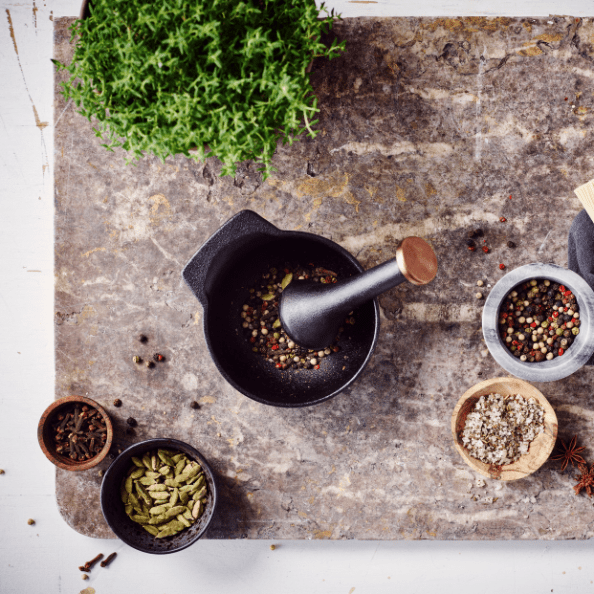
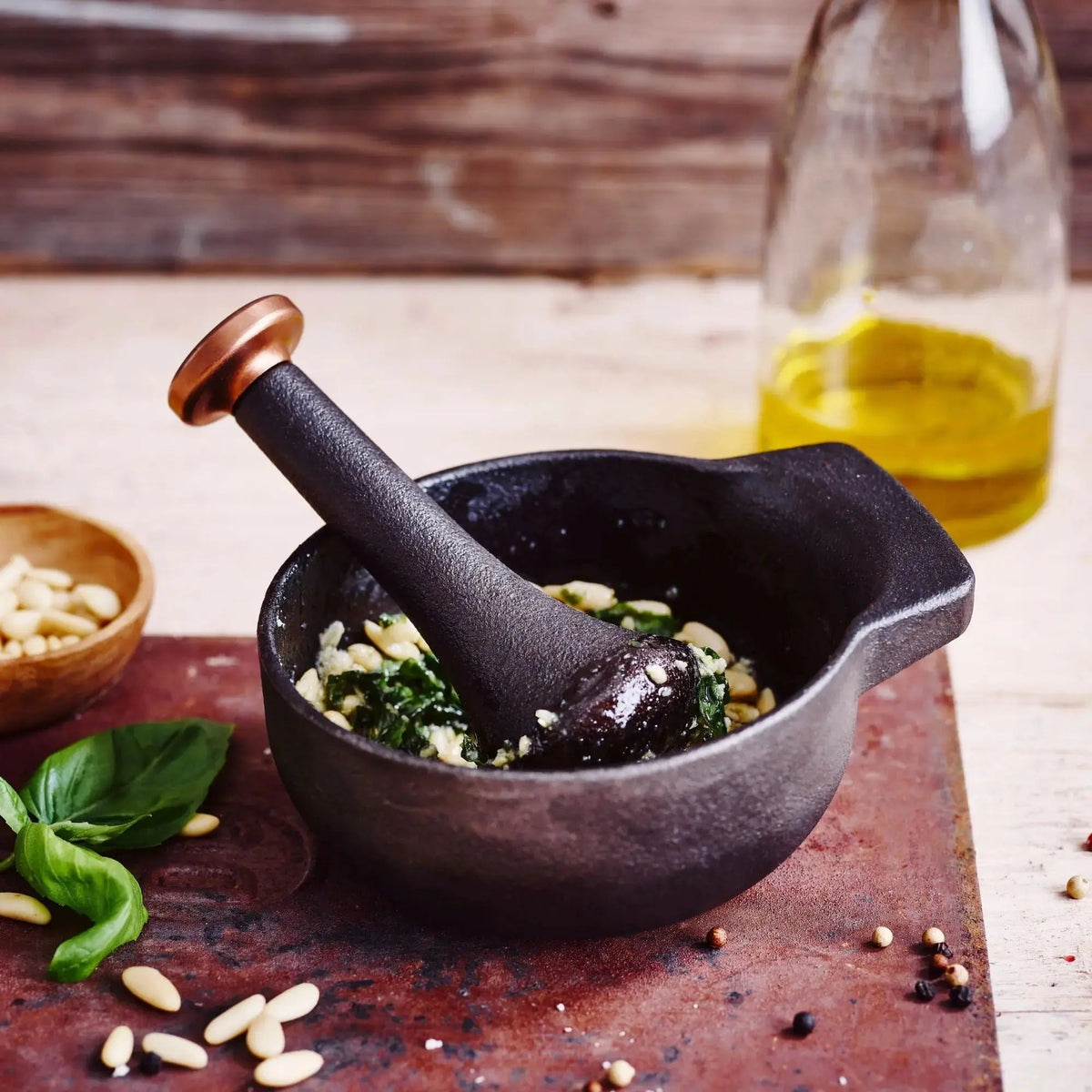
The Alva Nori mortar & pestle is enameled cast iron — 2-cup capacity, serious weight for real crushing power, and a textured grinding surface that grips herbs and spices instead of letting them slide.
The three motions: crushing, grinding and muddling
Crushing is the downward strike. Hold the pestle firmly, keep your wrist loose, and bring it straight down onto whole spices, garlic cloves or nuts. The goal isn't force so much as commitment — a decisive tap cracks a peppercorn cleanly, while a hesitant one sends it flying. Keep your other hand cupped loosely over the rim of the bowl for the first few strikes; once everything is cracked, nothing can escape. This is where a heavy mortar earns its price: the mass absorbs each blow so the bowl doesn't jump, and the ingredient has nowhere to go but apart.
Grinding is the press-and-twist. After the initial crush, press the pestle head against the ingredients and rotate your wrist in firm half-circles, working the material against the wall and base of the bowl. This is the motion that takes cracked spices to powder and mashed garlic to a smooth paste. A textured interior matters most here — it grips particles so they shear apart under the pestle rather than skating around the bowl.
Muddling is the gentle roll. For fresh herbs, berries or citrus peel, you want to bruise cell walls and release oils without shredding the leaf into a bitter pulp. Press lightly and roll the pestle over the ingredients a few times, then stop. If your mint looks like a smoothie, you've muddled too far.
Pastes: the order of ingredients matters
Every classic pestle paste — aioli, pesto, curry paste, zhug — follows the same logic: hardest and driest first, softest and wettest last. Each stage becomes the abrasive that helps break down the next.
- Salt and hard spices first. Coarse salt is your grit; whole spices need the empty bowl and full striking room.
- Garlic, ginger and other firm aromatics next. Crushed against the salt and spice base, garlic collapses into a paste in seconds.
- Fibrous ingredients third. Herbs, chilies or nuts go in once there's a rough paste to grind them against.
- Liquids last, and slowly. Oil, lime juice or fish sauce should be worked in a little at a time. Add liquid too early and the pestle aquaplanes over everything instead of gripping it.
Work in small batches — a bowl more than a third full grinds slowly and jumps ship constantly. A 2-cup mortar handles a full batch of pesto or guacamole for two comfortably; bigger jobs are better done in two rounds than one overfilled one.
Dry spices vs fresh herbs
Dry spices reward a two-stage approach: crush first with straight-down taps until every seed is cracked, then switch to the grinding twist to take them as fine as you want. Toasting whole spices in a dry pan for a minute before crushing makes them brittle and dramatically more aromatic. Grind only what the recipe needs — the entire point of whole spices is that the oils stay locked in until the moment you crush them.
Fresh herbs want the opposite: minimal violence. Muddle basil, mint or cilantro with a pinch of coarse salt, which acts as a gentle abrasive and draws out moisture. For pesto, alternate short grinding passes with scraping the bowl walls; the finished texture should be a rough, glistening paste, not a purée. If a recipe calls for both spices and herbs, always do the spices first while the bowl is dry.
Cleaning: enamel vs porous stone and wood
How you clean depends entirely on what your mortar is made of — it's one of the biggest practical differences covered in our best mortar and pestle guide.
Enameled cast iron keeps it simple: hand wash with warm water and mild dish soap, rinse promptly after oily or strongly colored ingredients, and dry thoroughly before storing. Skip long soaks, metal scrapers and abrasive cleaners to protect the finish. That's the whole routine — no re-seasoning, no ritual.
Porous granite and wood need more care. Unsealed stone can absorb soap along with odors, so most owners rinse with hot water only and scrub with a stiff brush, then grind a spoonful of plain rice through the bowl to pull out lingering garlic or chili residue. Wood shouldn't be soaked at all and holds onto oils regardless — which is why yesterday's spice blend can haunt today's dessert work.
Five mistakes that ruin the result
- Overfilling the bowl. Ingredients ride up the walls and escape; grind in batches instead.
- Adding liquid too early. The pestle slides instead of grips. Paste first, liquid last.
- Pounding when you should grind. Once things are cracked, switch to the twist — pounding paste just splatters it.
- Muddling herbs to a pulp. Bruised releases oils; pulverized releases bitterness.
- Using a mortar that's too light. If the bowl moves more than the food, no technique can save you. Weight is the fix — it's why we like solid cast iron for this job.
Still deciding whether you need one at all? Our mortar and pestle vs spice grinder comparison lays out exactly when each tool wins.
Frequently asked questions
Do you pound or twist a mortar and pestle?
Both, in sequence. Pound straight down first to crack hard ingredients, then press and twist to grind them fine. Pounding alone splatters; twisting alone can't break hard spices. For soft herbs and fruit, use a third motion — a gentle rolling press called muddling.
What can you make in a mortar and pestle?
Freshly cracked spices and spice rubs, garlic and ginger pastes, pesto, guacamole, aioli, chimichurri, curry pastes, salsas, marinades and dressings. Anything that benefits from crushed-not-chopped texture and freshly released oils is a candidate.
Why does food fly out of my mortar and pestle?
Three usual causes: the bowl is overfilled (keep it under a third full), you're striking too hard after everything is already cracked (switch to grinding), or the mortar is too small and light for the job. A wider, heavier bowl with a textured interior keeps ingredients under the pestle instead of airborne.
How do you clean a mortar and pestle after garlic or chili?
With enameled cast iron, wash promptly with warm water and mild soap, then dry thoroughly. With porous granite or wood, rinse with hot water, scrub with a brush, and grind a little dry rice through the bowl to lift embedded odors — repeat until the rice smells clean.
Should you wet a mortar and pestle before using it?
No — start dry for spices, since moisture makes powders clump and stick. The exception is paste-making, where wet ingredients like garlic and herbs supply their own moisture as you work. Only brand-new porous stone mortars need a wet break-in: grinding rice through them before first use.
Ready to put technique into practice? Start with the right tool in our best mortar and pestle guide — or go straight to the Alva Nori mortar & pestle.


Laisser un commentaire
Ce site est protégé par hCaptcha, et la Politique de confidentialité et les Conditions de service de hCaptcha s’appliquent.