






Best Pancake Pan (2026): Pan vs Griddle, Non-Toxic Picks
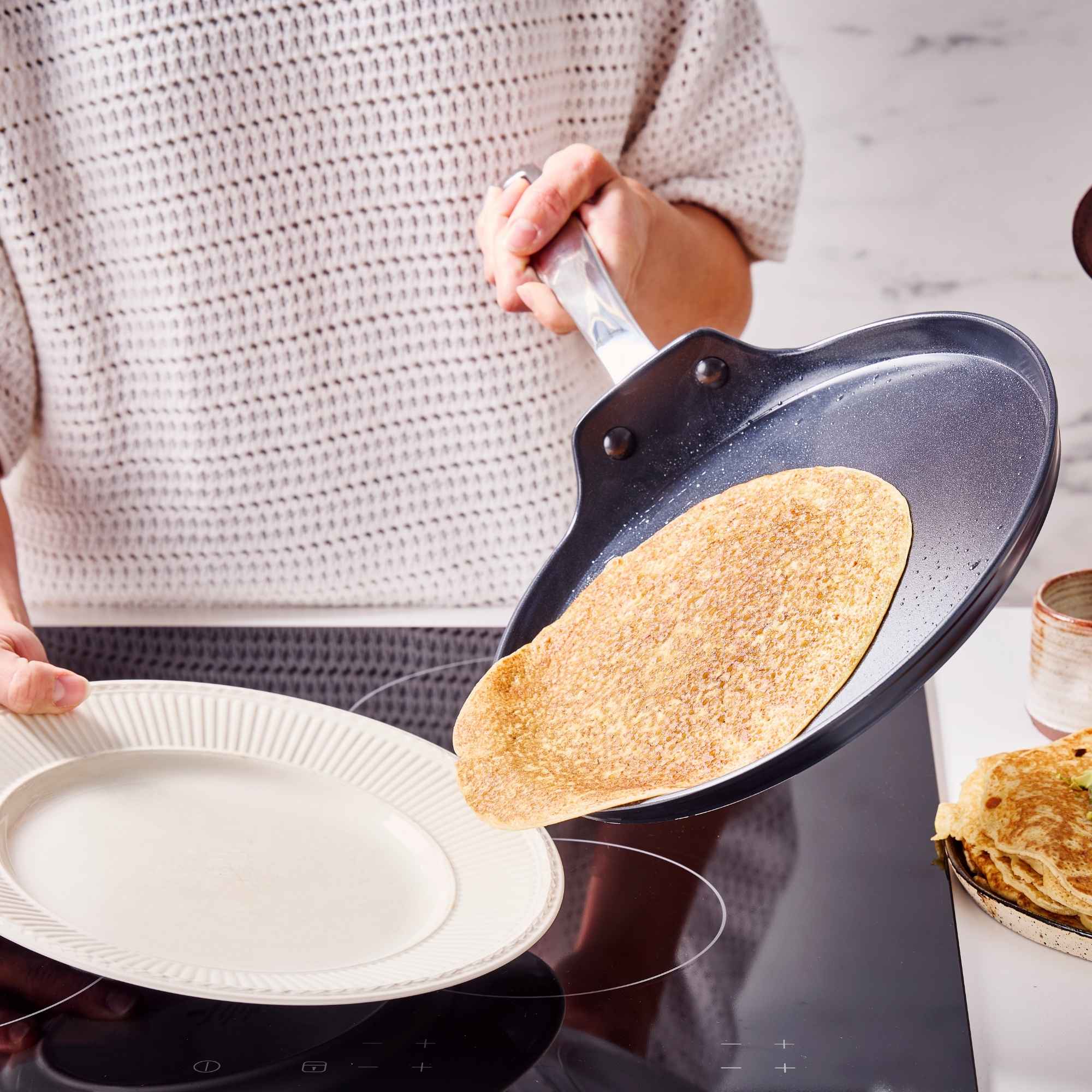
The best pancake pan has a wide flat cooking surface, low sides you can slide a spatula over, and heat even enough that the edges brown at the same rate as the center. Our pick is Alva's Ceramic Nonstick Crepe Pan, 10" ($129) — PFAS-free ceramic release, a 4.5mm forged base that won't give you pale-centered pancakes, and induction-ready. Below: whether you need a griddle instead, our picks, and the heat setting that fixes most pancake problems.
At a glance
| Pan | Price | Best for | Oven-safe | Warranty |
|---|---|---|---|---|
| Ceramic Nonstick Crepe Pan, 10" | $129 | Pancakes, crepes, and eggs — our pick | 400°F | 10-year |
| Ceramic Nonstick Frying Pan, 11" | $129 | Bigger batches, doubles as your everyday pan | 400°F | 10-year |
| 5-Ply Stainless Frying Pan, 11" | $149 | Buy-it-for-life, deep golden crust | 500°F | Lifetime |
| Carbon Steel Frying Pan, 11" | $109 | High-heat cooks who want a natural patina | 500°F | Lifetime |
Pancake pan vs pancake griddle
This is the real decision, so let's settle it. A griddle — electric, or a flat plate across two burners — gives you more surface area, so you can cook four to six pancakes at once. That's the whole advantage, and for a household of five on a Sunday it's a genuine one.

Our Top Pick
Ceramic Nonstick Crepe Pan, 10"
A low-sided ceramic nonstick pan designed for crepes, pancakes, eggs and easy flipping. Made without PFAS, PTFE or PFOA and induction-ready.
From $129
Shop the Crepe PanThe costs: an electric griddle is a single-purpose appliance that takes real storage space, runs on a thermostat that's slower to correct than a burner, and has an element and cord that eventually fail. A two-burner stovetop griddle plate solves the storage problem but introduces a worse one — the section over each burner runs hot while the middle stays cool, which is exactly the uneven browning you were trying to avoid.
A good pancake pan cooks two to three pancakes at a time, heats evenly across the whole surface, responds to a burner adjustment in seconds, stores with your other pans, and then makes crepes, omelettes, and quesadillas the rest of the week. For most kitchens, that's the better trade. Note that "non toxic pancake griddle" is a common search for a reason — many griddle plates use PTFE-based coatings and few publish lab results.
What to look for in a pancake pan
- A flat, wide cooking surface. Pancakes need contact. A pan with a small flat area and a lot of curve gives you thick pancakes with a pale ring.
- Low sides. You need room to get a spatula under a pancake and flip it in one motion — tall walls are why flipping in a saucepan-shaped frying pan is awkward.
- An even, thick base. Hot spots are the number one cause of pancakes that are scorched in one patch and raw in another. A 4.5mm forged base spreads heat evenly.
- Reliable release. Pancake batter is sticky with sugar and milk solids. A smooth PFAS-free ceramic surface handles it with a light film of butter.
- 10–11 inches. Fits two or three standard pancakes; still light enough to handle.
- Induction compatibility if you cook on induction — look for a magnetic stainless base.
Our pick: Ceramic Nonstick Crepe Pan, 10" ($129)
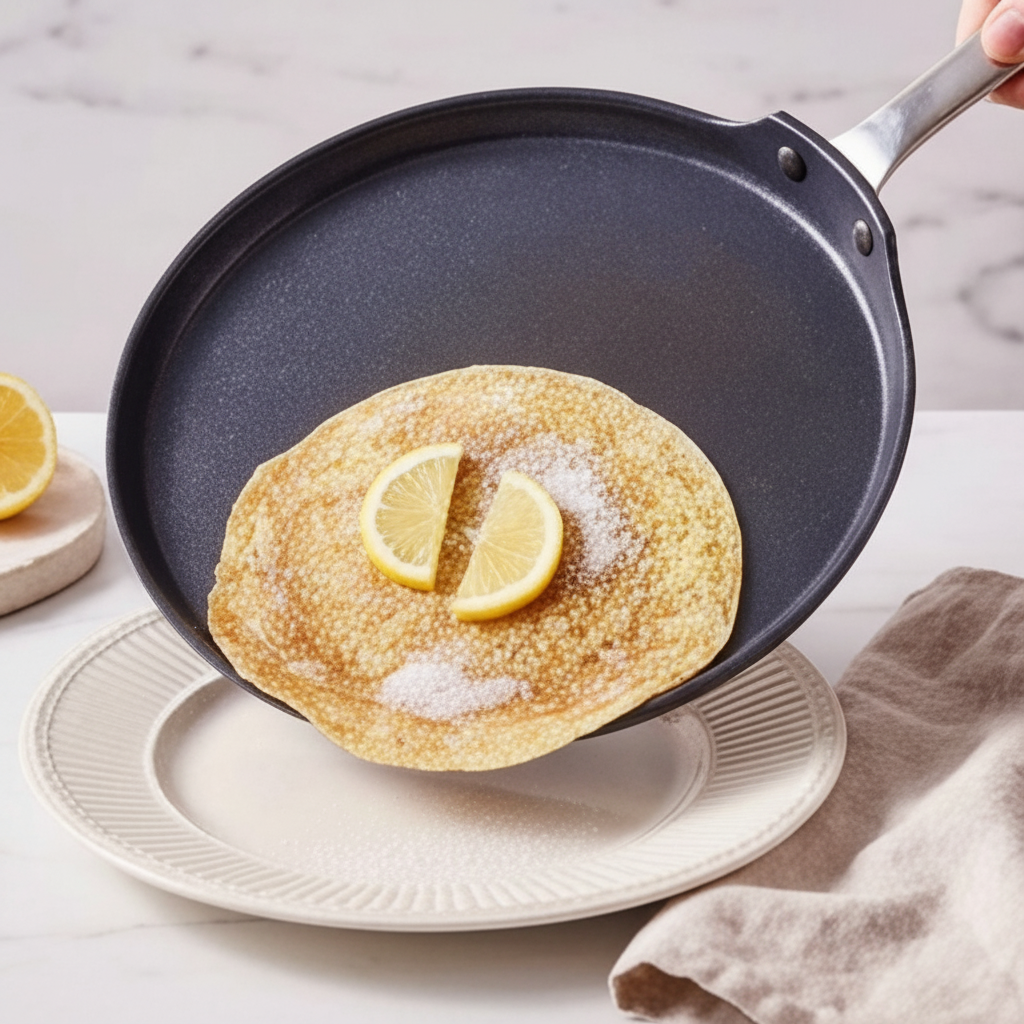
It's sold as a crepe pan, but the shape is exactly what pancakes want: a wide flat surface, low sloping sides, and even heat. The Ceramic Nonstick Crepe Pan has a sol-gel ceramic cooking surface made without PFAS, PTFE, or PFOA — independently tested by TÜV Rheinland, with the reports published on our safety standards page — over a 4.5mm forged aluminum body with a stainless induction base. It's 2.1 lbs, oven-safe to 400°F, and carries a 10-year warranty.
What we like: pancakes release with just butter, the low sides make flipping genuinely easy, and edge-to-edge browning is even.
Good to know: ceramic wants low-to-medium heat, silicone or wooden utensils, and hand-washing — it isn't dishwasher-safe. Pancakes shouldn't be cooked hot anyway, so this suits the job.
Shop the Ceramic Nonstick Crepe Pan — $129
If you want a bigger batch
The Ceramic Nonstick Frying Pan in 11-inch ($129) gives you more surface for three or four smaller pancakes and doubles as your everyday frying pan. It has slightly taller sides than the crepe pan — a little less convenient for flipping, more useful for everything else.
The buy-it-for-life routes
The 5-Ply Stainless Frying Pan (from $129) produces the deepest golden crust of anything here once you've mastered the preheat — see how to cook on stainless without sticking. No coating to wear out, dishwasher-safe, lifetime warranty. Carbon steel is the other route: the Black Angus (from $99) builds a natural nonstick patina and takes real heat, oven-safe to 500°F with a lifetime warranty. Both demand more technique than ceramic; both outlast it.
The heat setting is the whole game
Medium-low. Almost every pancake problem — burnt outside, raw middle, uneven color — is heat that's too high. Preheat the pan for two or three minutes so the whole surface is at temperature, then use a thin film of butter (wipe out the excess), and pour from a ladle so the pancakes are consistent. Wait for bubbles to form and pop across the surface before flipping, not just appear. Flip once. Every additional flip presses out the air you just built.
If your first pancake is pale and your third is dark, the pan is climbing — turn the burner down a notch after the first batch.
It's a crepe pan too
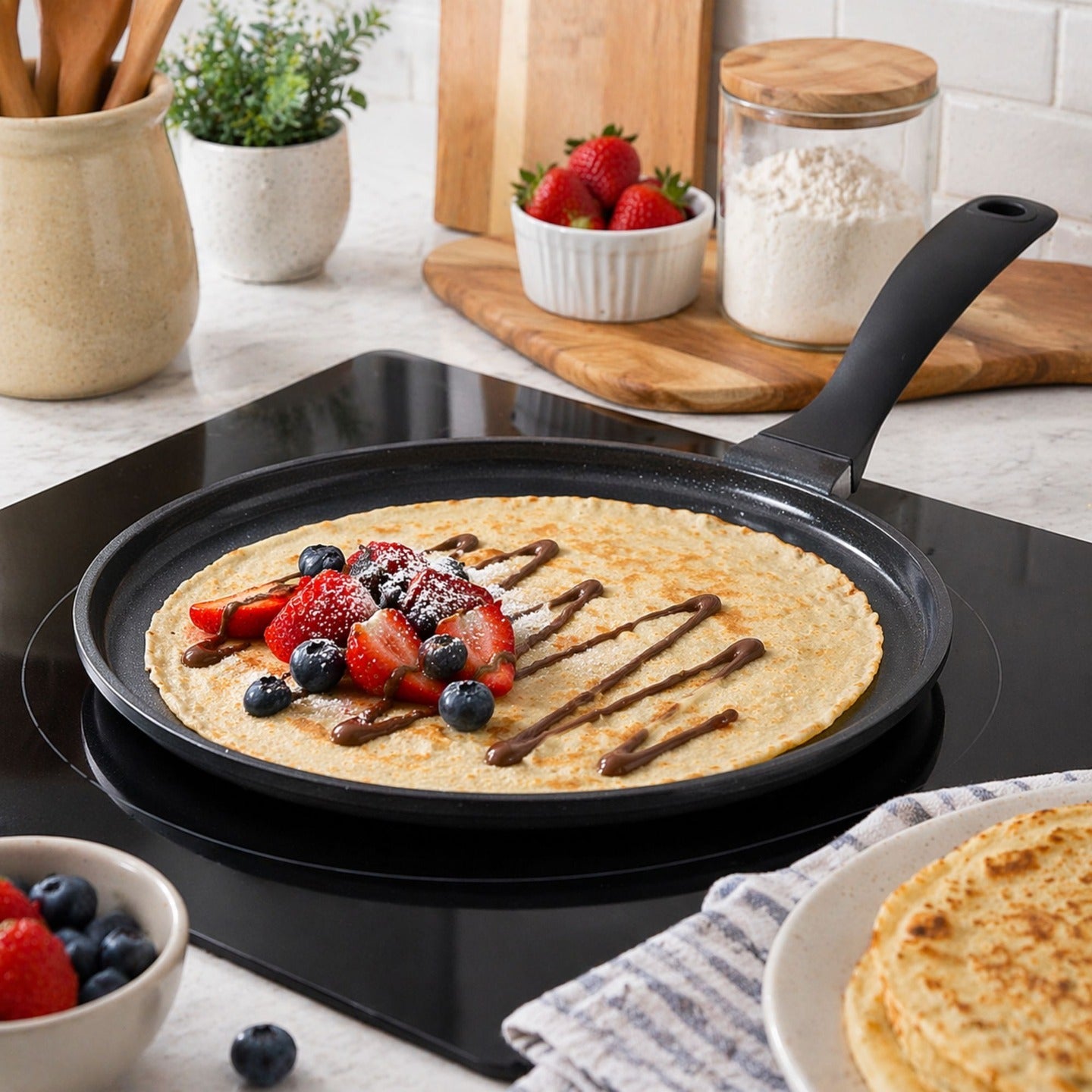
Same shape, thinner batter. If you make both, one pan covers both — see our best crepe pan guide for the crepe technique, and best pan for eggs if breakfast usually means eggs. Weighing a stovetop pan against an appliance? Read crepe pan vs crepe maker.
Keeping the release
Low-to-medium heat, soft utensils, no aerosol sprays, hand-wash once cooled. Full routine in how to clean a nonstick pan, and the safety background in are ceramic pans safe.
Frequently asked questions
What is the best pan for pancakes?
A 10–11 inch pan with a flat surface, low sides, and an even thick base. A PFAS-free ceramic nonstick is the most forgiving; Alva's Ceramic Nonstick Crepe Pan ($129) is our pick.
Is a griddle better than a pan for pancakes?
Only for batch size. A griddle cooks four to six at once, which matters for a big household. A pan heats more evenly, responds faster to heat adjustments, stores easily, and does other jobs the rest of the week.
What is a non-toxic pancake pan?
One with no PFAS, PTFE, or PFOA in the cooking surface — verified by published third-party lab results, not just a label. Uncoated stainless and carbon steel qualify by definition since they have no coating at all.
What heat should pancakes be cooked on?
Medium-low, and preheat the pan for two to three minutes first. Too-high heat is the cause of nearly every pancake that's dark outside and undercooked inside.
Why are my pancakes pale in the middle?
A pan with hot spots or too much curve, so the center never makes full contact with even heat. A flat, thick-based pan fixes it.
Can I use the same pan for pancakes and crepes?
Yes — they want identical things from a pan: flat surface, low sides, even moderate heat. Only the batter thickness changes.
The bottom line
For even, easy pancakes get the Ceramic Nonstick Crepe Pan, 10" ($129) and keep the burner at medium-low. Want one pan that outlives every coating? The 5-Ply Stainless (from $129). Free U.S. shipping over $99.
More things worth making in it: our diner-style fluffy buttermilk pancakes, skillet cinnamon rolls and bacon, the no-mess way.
Our top pickCeramic Nonstick Crepe Pan, 10"Shop now →


Laisser un commentaire
Ce site est protégé par hCaptcha, et la Politique de confidentialité et les Conditions de service de hCaptcha s’appliquent.