






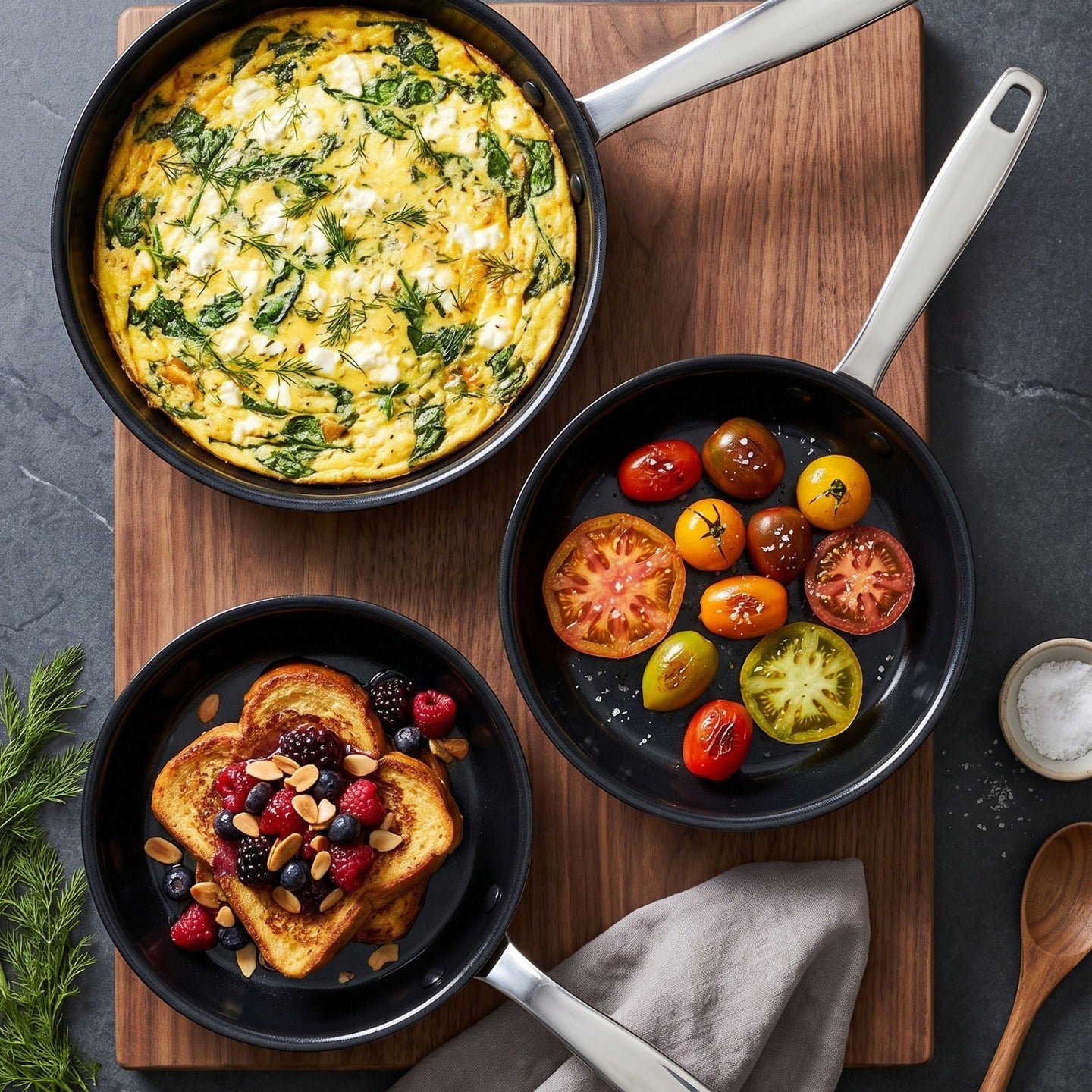
Best Induction Cookware (2026): What Works, What Doesn't, and How to Choose
Updated for 2026.
The best induction cookware matches a magnetic (ferrous) base to the job: fully-clad stainless for searing, ceramic nonstick for eggs, carbon steel for high heat, and enameled cast iron for braising. This 2026 guide ranks the best induction cookware by type and use-case so you can pick by how you actually cook.
Short answer: The best induction cookware is magnetic (ferrous) with a flat, fully-clad base — which means fully-clad stainless steel, cast iron, and carbon steel all work beautifully. Some aluminum and older nonstick pans don't work unless they have a magnetic base plate. The quick test: if a fridge magnet sticks firmly to the bottom of the pan, it's induction-compatible.
Ready to shop induction-ready cookware?
Alva's coated cookware is made without PFAS, PTFE or PFOA and independently tested by TÜV Rheinland against a 638-substance panel — with the lab reports published. Backed by 5–10 year warranties.
Compare Alva collectionsSee the lab reportsHow induction cooktops actually work
Induction burners heat the pan directly using a magnetic field, not a hot element. That means the cookware itself must be magnetic (contain iron) for the field to generate heat. It's why induction is fast, efficient, and precise — but also why not every pan works on it.

Our Top Pick
Ceramic Nonstick Frying Pan
Easy ceramic nonstick for everyday meals. Made without PFAS, PTFE or PFOA, supported by published third-party testing, induction-ready, oven-safe to 400°F and backed by a 10-year limited warranty.
From $109
Shop the Maestro Frying PanThe 30-second magnet test
Hold a household magnet to the base of any pan. If it grabs firmly, the pan will work on induction. A weak or no pull means it won't heat properly. Do this before buying anything if induction is your stove.
Which materials work on induction
- Stainless steel (magnetic grade): Most quality fully-clad stainless is induction-ready. This is the best all-around induction choice. See Best Stainless-Steel Cookware for Induction and shop the Maestro 5-ply collection.
- Cast iron & enameled cast iron: Naturally magnetic and excellent on induction — just lift rather than slide to protect the glass top. Shop cast iron.
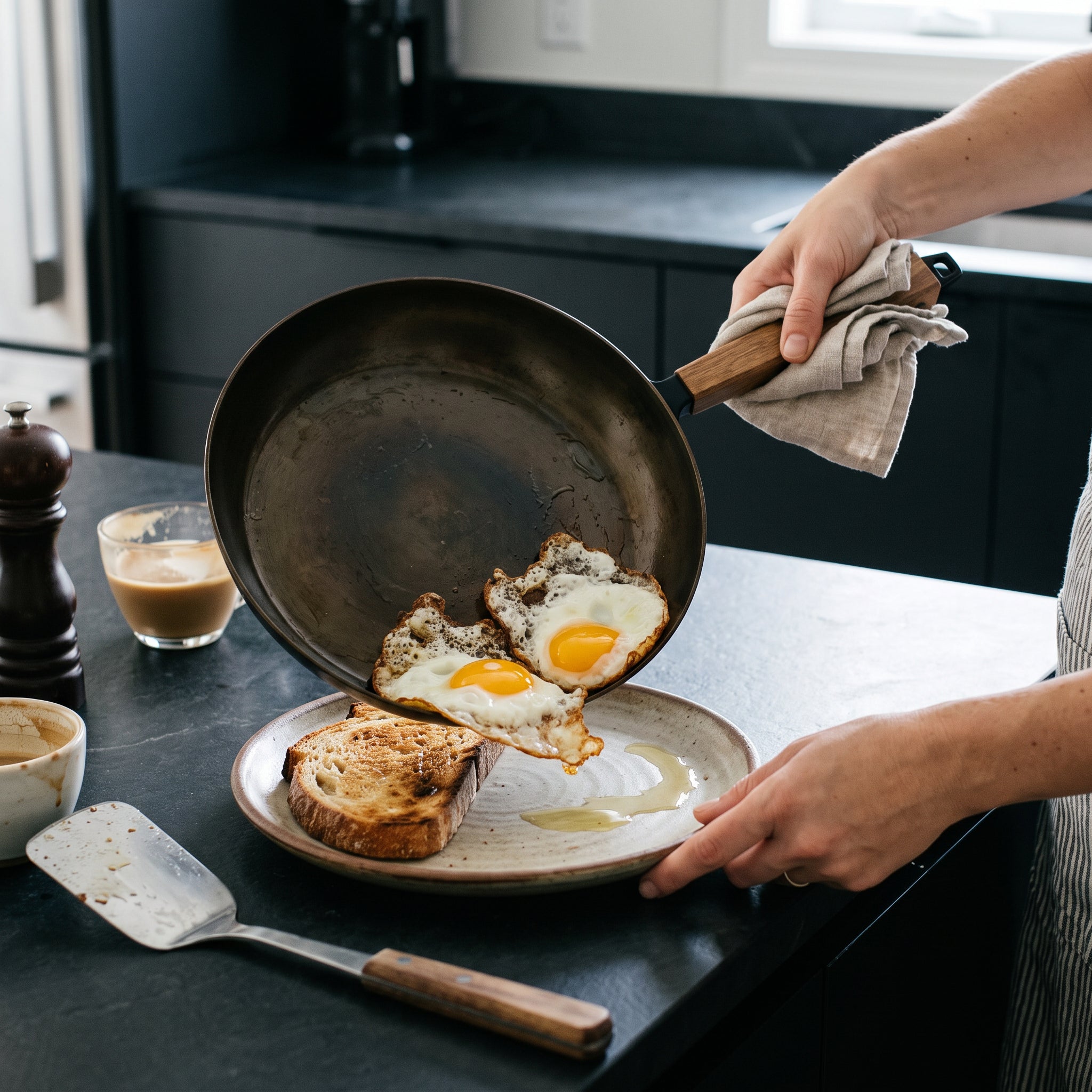
- Carbon steel: Magnetic, fast-heating, and induction-friendly. Shop carbon steel.
- Ceramic nonstick: Works if the pan has a magnetic (usually stainless) base. Check that it's labeled induction-compatible. Shop ceramic nonstick.
What doesn't work
Pure aluminum, copper, and glass cookware won't work on induction unless they have a bonded magnetic base plate. Many older or budget nonstick pans also fail the magnet test. When in doubt, look for the induction symbol (a coil of loops) or test with a magnet.
What to look for in induction cookware
- A flat, fully-clad base for full contact and even heating.
- Magnetic construction confirmed by the magnet test or induction label.
- Non-toxic materials — stainless, cast iron, carbon steel, and PFAS-free ceramic are all safe choices. See Best Non-Toxic Cookware.
- Flat bottoms, not warped — warping kills contact and efficiency, so quality construction matters more on induction than any other cooktop.
Best induction cookware by need
All Alva lines are induction-ready across every material — ceramic nonstick, 5-ply stainless, carbon steel and enameled cast iron — so these picks come down to how you cook, not whether the pan will switch the hob on.
- Best overall: Maestro Stainless 5-Ply — fully-clad magnetic stainless that couples across the whole base, sears and simmers, and is oven-safe to 500°F. See the 5-ply stainless steel cookware guide.
- Best nonstick for induction: Maestro Ceramic — PFAS-free ceramic on a bonded stainless induction base for eggs and delicate food. More in the ceramic cookware guide.
- Best stainless for searing: Maestro 5-Ply Stainless Frying Pan — uncoated 18/10 interior that browns and builds fond, dishwasher- and metal-utensil-safe.
- Best carbon steel: Alva carbon steel — thin, ferrous and fast to searing heat; pre-seasoned and naturally induction-friendly.
- Best enameled cast iron: Nori Enameled Cast Iron Dutch Oven — naturally magnetic, no seasoning or rust, oven-safe to 500°F for braising and bread.
- Best value: Energy ceramic nonstick — everyday PFAS-free ceramic that's induction-ready and oven-safe to 400°F.
- Best set: Neat 5-Piece Stackable Set — five induction-ready pieces that nest into one stack for small kitchens.
Not sure which line fits your hob and cooking style? Find your cookware or compare Alva collections side by side.
Best induction cookware compared
| Pick | Material | Best for | Oven-safe | Warranty | Shop |
|---|---|---|---|---|---|
| Maestro Stainless 5-Ply | 5-ply stainless steel | Searing & everyday cooking | 500°F | Lifetime | Shop |
| Maestro Ceramic | Ceramic nonstick (PFAS-free) | Eggs & delicate food | 400°F | 10-year | Shop |
| Nori | Enameled cast iron | Braising & bread | 500°F | Lifetime | Shop |
| Forest | Carbon steel | High-heat searing | Stovetop only | 10-year | Shop |
| Neat | Ceramic nonstick set | Small kitchens & value | 400°F | 5-year | Shop |
How we chose
Induction heats through a magnetic field, so every pick here has a magnetic (ferrous) base that a fridge magnet grabs firmly — the one non-negotiable for induction. All Alva lines are induction-ready across ceramic nonstick, 5-ply stainless, carbon steel and enameled cast iron, so material choice comes down to how you cook. From there we prioritised a flat, fully-clad or solid ferrous base for even heating, oven range, warranty, and non-toxic construction: Alva's coated lines are made without PFAS, PTFE and PFOA and independently tested by TÜV Rheinland against a 638-substance panel, with the lab reports published; the uncoated stainless, carbon steel and cast iron lines have no coating at all. Lead and cadmium are documented for the Neat line.
Best induction cookware: our picks by job
Every pan below passes the magnet test and has a flat, fully clad or solid ferrous base. Prices are current at the time of writing.
| Job | Pick | Price | Oven safe | Warranty |
|---|---|---|---|---|
| All-round skillet | Maestro 5-Ply Stainless Frying Pan | From $129 | 500°F | Lifetime |
| Eggs and delicate food | Maestro Ceramic Nonstick Frying Pan | From $109 | 400°F | 10-year |
| Sauces and grains | Maestro 5-Ply Stainless Saucepan | From $139 | 500°F | Lifetime |
| Braising and bread | Nori Enameled Cast Iron Dutch Oven, 5-Qt | $249 | 500°F | Lifetime |
| High-heat searing | Forest Carbon Steel Frying Pan | From $99 | Stovetop only | 10-year |
| Small kitchens | Neat 5-Piece Stackable Set | $229 | 400°F | 5-year |
Best all-round: Maestro 5-Ply Stainless Frying Pan (from $129)
Fully clad five-ply construction with a magnetic stainless exterior, so the induction field couples to the whole base rather than a disc in the middle. Uncoated 18/10 interior, oven-safe to 500°F, metal-utensil safe, and the only Alva line that is dishwasher safe. If you buy one induction pan, buy this one.
Best for eggs: Maestro Ceramic Nonstick Frying Pan (from $109)
Forged aluminium body with a bonded stainless induction base, so it heats on induction where plain aluminium nonstick will not. Oven-safe to 400°F, 10-year warranty, made without PFAS, PTFE or PFOA. Hand wash only — the dishwasher shortens the life of any ceramic coating. If you want a coated pan on induction specifically, read does nonstick work on induction cooktops.
Best Dutch oven: Nori Enameled Cast Iron, 5-Qt ($249)
Cast iron is naturally ferrous, so it is the most reliably induction-compatible material there is. Enamelled means no seasoning and no rust. Oven-safe to 500°F with a lifetime warranty. One caution specific to induction: lift it on and off rather than sliding, because a heavy cast iron base will scratch a glass cooktop.
Best for searing: Forest Carbon Steel Frying Pan (from $99)
Thin, ferrous and fast — carbon steel reaches searing temperature quicker than stainless on an induction hob. Pre-seasoned, 10-year warranty. Be aware this pan is stovetop only and not oven safe, so it is a searing specialist rather than an all-rounder.
Best for a small kitchen: Neat 5-Piece Stackable Set ($229)
Five induction-ready pieces that nest into one stack, in ceramic nonstick with a magnetic base. Oven-safe to 400°F, 5-year warranty. The obvious pick if cabinet space, not performance, is your limiting factor.
Where none of these is the right answer
If your existing pans already pass the magnet test, you do not need to replace anything. Induction compatibility is a property of the metal, not a quality grade — a cheap magnetic pan works on induction and an expensive copper one does not. Replace pans because they are worn or warped, not because you switched cooktops.
Shop induction-ready cookware → Free U.S. shipping over $99.
Building an induction set
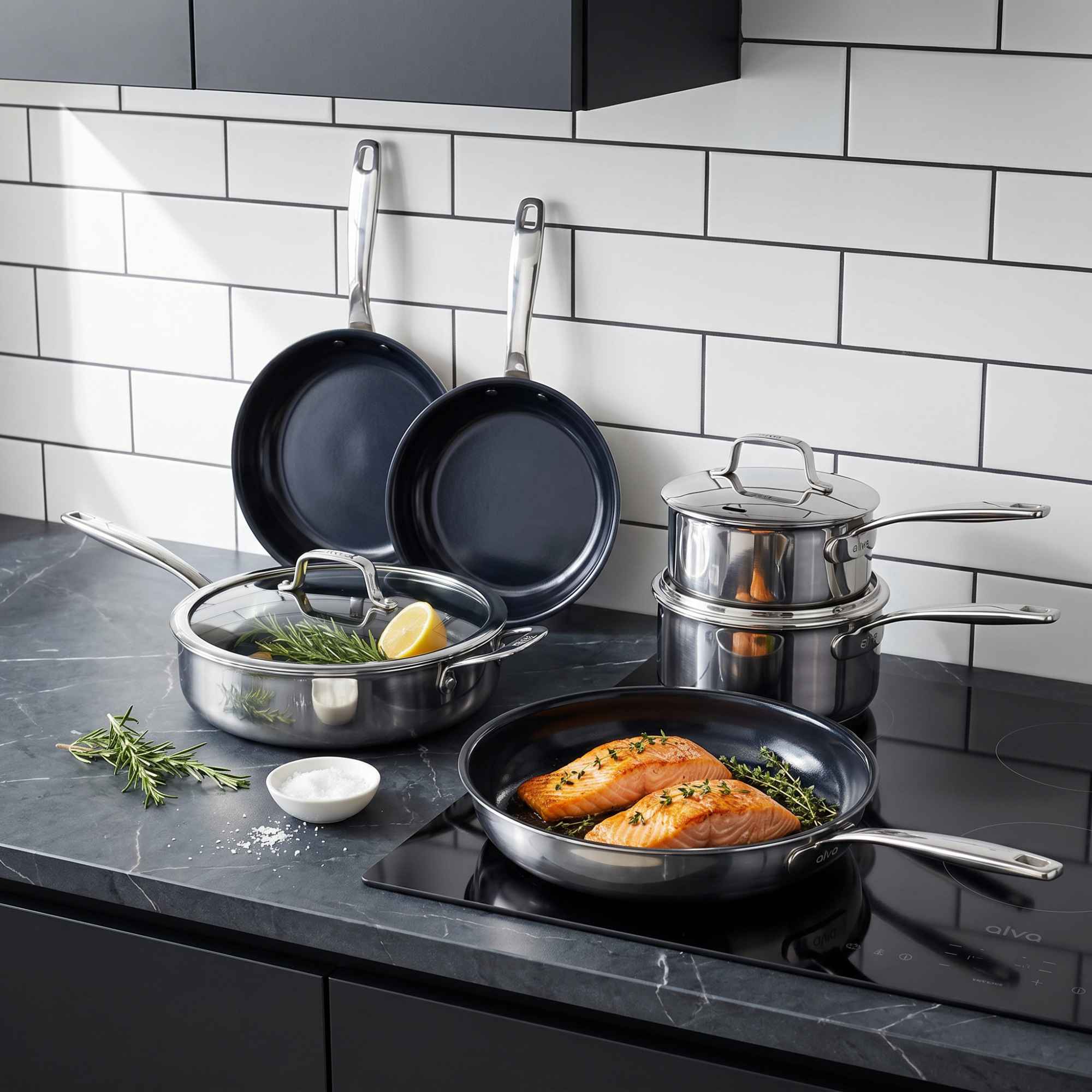
A fully-clad stainless skillet, an induction-ready nonstick, a saucepan, and a Dutch oven or stockpot cover most cooking — all available induction-ready. Browse cookware sets or all cookware. New to buying cookware? Start with the Complete Cookware Buying Guide.
Frequently asked questions
What cookware works best on an induction cooktop?
Fully-clad magnetic stainless steel is the best all-around choice; cast iron and carbon steel also work excellently. Any pan works if it's magnetic and has a flat base — confirm with the magnet test.
How do I know if my cookware is induction-compatible?
Hold a magnet to the base. If it sticks firmly, the pan is induction-compatible. You can also look for the induction symbol (a looped coil) on the bottom or packaging.
Does stainless steel work on induction?
Most quality fully-clad stainless steel is magnetic and works on induction. A few non-magnetic stainless grades don't, so test with a magnet if unsure.
Why doesn't my pan work on my induction stove?
It's likely non-magnetic — pure aluminum, copper, or glass — or has a warped base that prevents full contact. Induction only heats magnetic cookware with a flat bottom.
Is induction cookware non-toxic?
It can be — induction compatibility is about magnetism, not safety. Choose induction-ready pans made from non-toxic materials like stainless, cast iron, carbon steel, or PFAS-free ceramic, ideally with published lab testing.
Do you need special pots and pans for induction?
Not special, just magnetic. Any pan with enough iron in its base works — stainless steel, cast iron and carbon steel usually do; aluminium, copper and glass do not unless a magnetic plate is bonded to the bottom. The magnet test settles it in five seconds.
Is induction cookware different from regular cookware?
Not fundamentally. "Induction cookware" simply means cookware with a magnetic (ferrous) base. Stainless steel, cast iron and carbon steel pans are usually induction-ready as-is, while aluminium, copper or glass pans only work if a magnetic plate is bonded to the base. The same pan behaves identically on gas or standard electric.
Is stainless or nonstick better for induction?
Both work well on induction as long as the base is magnetic. Fully-clad stainless is the better all-rounder for searing, browning and oven work up to 500°F, while ceramic nonstick is easier for eggs and delicate food and wipes clean. Many kitchens keep one of each — a stainless skillet plus an induction-ready ceramic pan.
Will cast iron scratch an induction cooktop?
It can. Induction tops are glass, and a rough or heavy cast iron base will mark them if dragged. Lift pans on and off rather than sliding, and check the base for burrs on bare cast iron. Enamelled cast iron is smoother and gentler on the glass.
Why does my pan buzz or rattle on induction?
A faint hum is normal — it is the magnetic field vibrating the layers of the pan, and it is loudest in multi-ply pans at high power. Rattling usually means a slightly warped base making uneven contact. Neither is dangerous, but a badly warped pan will heat unevenly.
Does the pan need to match the burner size?
Roughly, yes. Most induction hobs need the pan base to cover a minimum diameter before they will switch on at all, and a base much smaller than the ring wastes energy and heats unevenly. Check your hob manual for its minimum pan size.
Shop induction-ready, lab-tested cookware in the Maestro 5-ply collection or browse our best sellers.

%20base%20to%20the%20job:%20fully-clad%20stainless%20for%20searing,%20ceramic%20nonstick%20for%20eggs,%20carbon%20steel%20for%20high%20heat,%20and%20enameled%20cas...)
Laisser un commentaire
Ce site est protégé par hCaptcha, et la Politique de confidentialité et les Conditions de service de hCaptcha s’appliquent.