






How to Choose Cookware (2026): A Simple Framework for Any Kitchen
Short answer: Choose cookware in four steps — (1) list the 3–4 things you cook most, (2) match each to the right material (clad stainless for searing and sauces, ceramic nonstick for eggs and fish, cast iron or carbon steel for high heat), (3) check construction (fully clad, solid handles) and cooktop compatibility, and (4) buy only the pieces you'll actually use. Skip the 15-piece set; 5–7 good pieces cover almost everything.
Not sure which material is right for you?

Our Top Pick
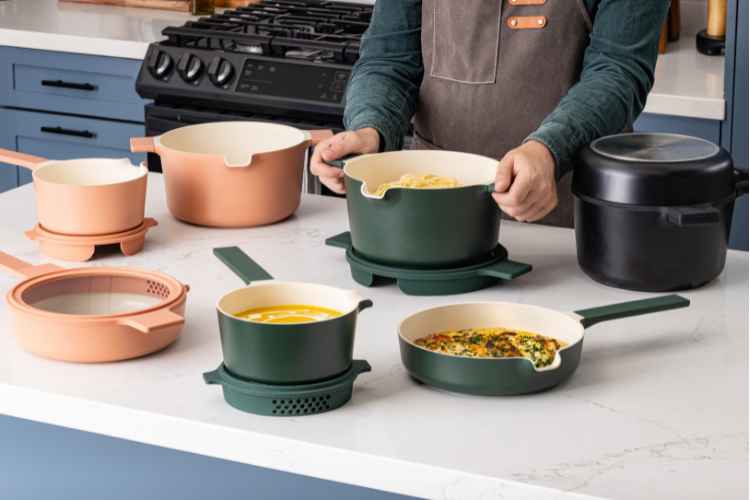
Ceramic Nonstick Cookware Set, 12-Piece
A complete ceramic nonstick kitchen in one set. Made without PFAS, PTFE or PFOA, supported by published third-party testing, induction-ready and backed by a 10-year limited warranty.
From $599
Shop the 12-Piece SetTake our 2-minute quiz and get a personalized cookware recommendation based on how you cook — nonstick, stainless, carbon steel, or cast iron.
Find your cookware →This framework keeps you from overspending on pans you'll never reach for.
Step 1: Start with how you cook
Write down the handful of dishes you make weekly. Eggs and fish? You need a good nonstick. Steaks and pan sauces? Clad stainless. Soups, pasta, chili? A stockpot or Dutch oven. Stir-fry and high-heat searing? Carbon steel or cast iron. Your habits, not a catalog, decide your set.
Step 2: Match the task to the material
Each material has a job it does best. For a material-by-material breakdown of how each one actually behaves on the stove, see Cookware Materials Explained. For the full side-by-side, see Types of Pans, plus our head-to-head comparisons: Ceramic vs Stainless Steel and Carbon Steel vs Cast Iron.
- Searing, browning, sauces, acidic foods: fully-clad stainless steel
- Eggs, pancakes, fish, low-fat cooking: ceramic nonstick
- High-heat searing, frying, baking: cast iron
- Fast high-heat + natural nonstick: carbon steel
- Soups, braises, pasta: stockpot or Dutch oven
Step 3: Judge construction, not just material
Two "stainless" pans can perform completely differently. Prefer fully clad (metal layers through the whole pan) over disc-bottom; look for 3-ply or 5-ply; check that handles are solid and stay cool; and pick a pan with balanced heft — too light warps, too heavy is awkward.
Step 4: Confirm it works on your cooktop
Gas and electric take almost anything. Induction needs magnetic cookware — if a fridge magnet sticks to the base, it works. Most stainless, cast iron, and carbon steel qualify. See Best Stainless-Steel Cookware for Induction.
Step 5: Prioritize non-toxic materials
If safety matters to you, favor materials that don't shed or leach — stainless, ceramic, cast iron, carbon steel — and choose brands that publish independent lab tests. See Best Non-Toxic Cookware and our Testing & Materials page.
Step 6: Buy the core, skip the filler
A 5-piece core — clad skillet, nonstick pan, saucepan, stockpot/Dutch oven, and one cast iron or carbon steel pan — covers most cooking. Browse cookware sets or build your own from Shop All Cookware.
Frequently asked questions
How do I choose the right cookware?
Start with the dishes you cook most, match each to the material that does that job best, check for fully-clad construction and cooktop compatibility, and buy only the pieces you'll use. Most kitchens need just 5 to 7 pieces.
What cookware do beginners need?
A beginner is well covered by three pieces: a clad stainless skillet, a ceramic nonstick pan, and a saucepan or small pot with a lid. Add a Dutch oven or cast iron pan as your cooking grows.
What should I look for in quality cookware?
Fully-clad construction, solid and secure handles, balanced weight, oven safety, and cooktop compatibility. For safety, look for PFAS-free materials and published third-party testing.
Is expensive cookware worth it?
For pieces you use daily and want to last decades — a main skillet, a Dutch oven — yes. For pieces with a natural lifespan like ceramic nonstick, a mid-range option you replace periodically is usually the better value.
Need the full decision tree? Read the Complete Cookware Buying Guide, or start shopping our best sellers.
Go deeper by material
Dedicated guides to each cookware material — what it is, safety, care, and how to choose:

%20list%20the%203%E2%80%934%20things%20you%20cook%20most,%20(2)%20match%20each%20to%20the%20right%20material%20(clad%20stainless%20for%20searing%20and%20sauces,%20ceramic%20nonstick%20for%20eggs%20and%20fish,...)
Deixar comentário
Este site é protegido por hCaptcha e a Política de privacidade e os Termos de serviço do hCaptcha se aplicam.