





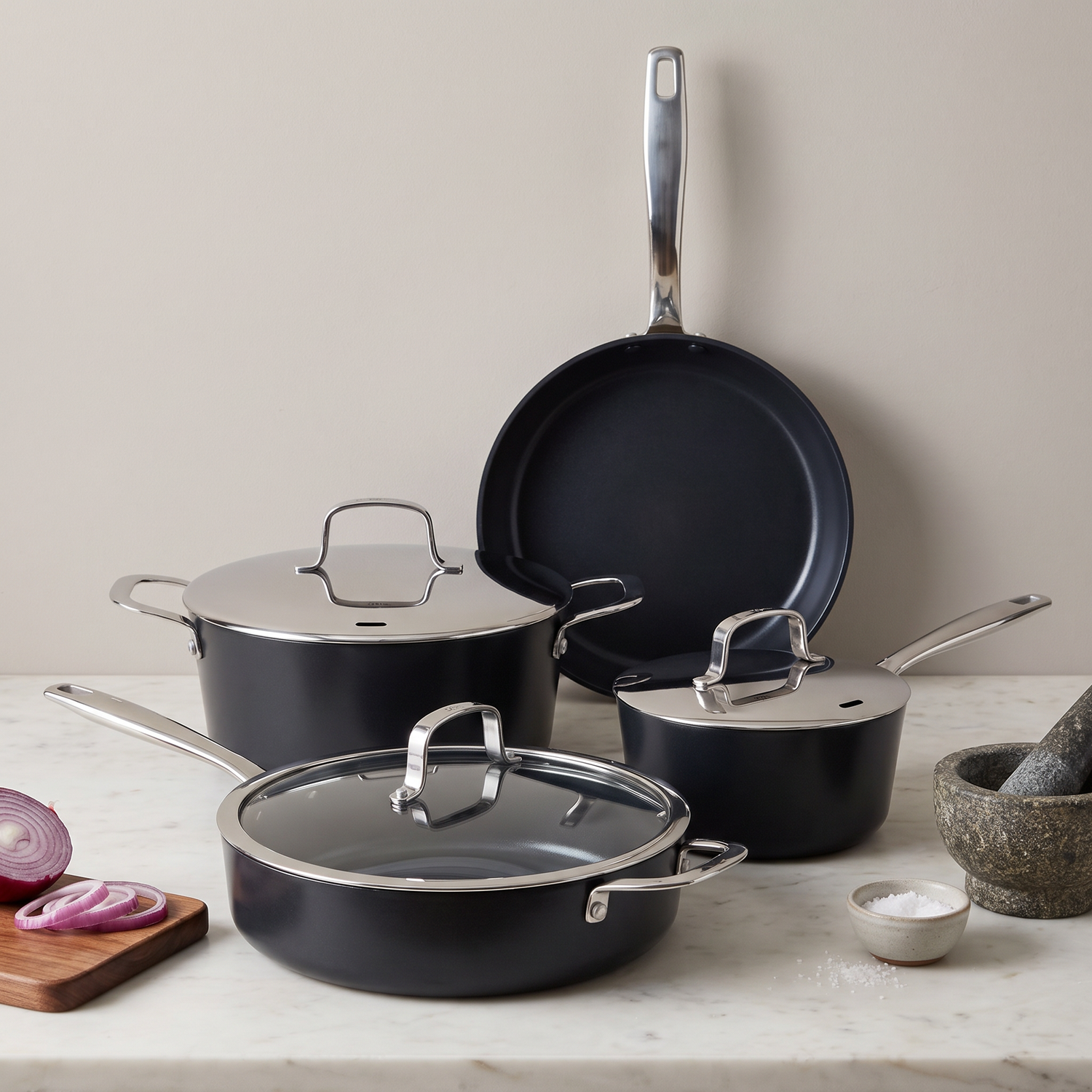
Caraway vs GreenPan: Which Ceramic Nonstick Lasts Longer?
GreenPan invented the ceramic nonstick category in 2007. Caraway arrived a decade later and made it a design object. Both sell pans coated in a sand-derived ceramic instead of PTFE, and both are bought by people who want out of conventional nonstick. The difference shows up in durability claims, in what each brand publishes, and — most sharply — in how long each will stand behind the coating.
The short answer: GreenPan has the deeper technical pedigree and a higher oven rating, and is the only one of the two that is dishwasher safe. Caraway has better storage, a PFAS claim stated without qualifiers, and published lab reports. On coating warranty, both are short: two years and one year respectively.
At a glance
| Caraway | GreenPan | Alva Maestro | |
|---|---|---|---|
| Coating | "Proprietary non-stick ceramic," mineral-based | Thermolon™, silicon-dioxide precursors via sol-gel | Ceramic nonstick |
| Body | Aluminum body, stainless base plate | Varies: hard-anodized, 3-ply or 5-ply stainless | Aluminum |
| Coating warranty | 1 year | 2 years (pan body: lifetime) | 10 years |
| Oven safe | 550°F | 600°F (lids 425°F, Reserve Pro lids 392°F) | 400°F |
| Dishwasher | No — "never be put in your dishwasher" | Yes — "They're also dishwasher safe" | Hand wash recommended |
| PFAS wording | "Made without PTFE, PFOA, and PFAS" | "Made Without Intentionally Added PFAS"* | Made without PFAS, PTFE or PFOA |
| Published lab reports | Yes — linked, scope stated inconsistently | No — names FDA and LFGB standards, no reports | Yes — TÜV Rheinland, 638-substance panel |
| Storage system | Yes, with full sets | Not found on sets reviewed | Neat line nests; Maestro does not |
| Made in | China | China; Stanley Tucci line in Italy | Belgian-engineered |
| Set price | $445 (from $675) / 12-pc | $449.99 / 11-pc Valencia Pro | $445 / 7-pc, $499 / 9-pc, $599 / 12-pc |
| Fry pan | $125 / 10.5" | $79.99 / 10", $99.99 / 12" | $109 / 8", $129 / 11" |
*GreenPan's PFAS claim carries that asterisk on their own site and is scoped to the coated food-contact surface, not the whole pan. Verified 20 August 2026; GreenPan was running a promotion at time of writing, so check current pricing.
The warranty detail almost nobody reads
GreenPan product pages cite "a limited lifetime warranty on manufacturer defects." The warranty page sets out the full terms, and they are worth quoting:
"The warranty period for the product's Thermolon ceramic non-stick coating is limited to two (2) years... For all other warranty claims unrelated to the product's Thermolon ceramic non-stick coating, the warranty period... lasts until the end of your lifetime."
So: lifetime on the pan, two years on the coating. Since the coating is the part that wears out — and the only part most people ever need to claim on — the practical warranty on a GreenPan is two years. Their product pages cite the lifetime figure; the two-year coating term is on the warranty page. Worth reading both.
Caraway is shorter still at one year for ceramic, and their exclusions explicitly cover "non-stick deterioration... due to high heat, prolonged heat exposure."
This is not a knock on ceramic as a material. It is how the category prices risk: coatings are consumable, so brands cap their exposure. It does mean that when you see "lifetime warranty" on a ceramic pan, the useful question is lifetime on what?
What GreenPan does better
GreenPan has been refining Thermolon since 2007 and is now on its ninth generation. They are also the most technically transparent brand in the category about how the coating is made — describing a sol-gel process where silicon-dioxide-derived precursors are turned into a sprayable solution and cured at low temperature, applied without glues or additives.
Two practical advantages. Their oven rating is the highest here at 600°F. And GreenPan cookware is dishwasher safe — stated plainly, with no hand-wash caveat attached to the cookware — which is unusual in ceramic and genuinely convenient, even though hand washing will still extend coating life.
Worth knowing: GreenPan, GreenLife, Blue Diamond and Merten & Storck are all brands of the same parent, The Cookware Company. Merten & Storck no longer has its own storefront — it redirects to GreenPan — and sells no ceramic nonstick line at all, only carbon steel, stainless and enameled steel.
What Caraway does better
Caraway states its PFAS claim without a qualifier: "made without PTFE, PFOA, and PFAS." They also publish third-party lab reports.
GreenPan's equivalent claim is footnoted on every page of their site as "Made Without Intentionally Added PFAS" — a meaningfully narrower statement — and their strong claims are scoped specifically to the "coated food contact surface." Their California AB 1200 disclosure states that they "have chosen to disclose the listed chemicals that may be present in the substrate layers beneath the food-contact surface." GreenPan names the standards it tests against, FDA 21 CFR 175.300 and German LFGB, but we did not find a published report or a named laboratory on their site.
Caraway also wins on storage: full sets ship with organizers, and we did not find an equivalent storage system offered with GreenPan sets.
One caveat on Caraway's testing: their site describes the scope as "over 200 types of PFAS" in one place and "over 600 types of forever chemicals" in another. Both appear on carawayhome.com. Worth checking which applies before repeating either.

The third option
Alva Maestro Ceramic Nonstick
Ten years of coating warranty, against two and one. Made without PFAS, PTFE or PFOA, verified by TÜV Rheinland across a 638-substance panel, with every substance below the laboratory reporting limit and the reports published in full. The honest trade-off: 400°F is the lowest oven rating of the three, so if you finish dishes at high heat, GreenPan handles it better.
From $109 · Sets from $445
Shop the Ceramic PanWho should buy which
- You want to put your pans in the dishwasher. GreenPan. It is the only one of the three that permits it.
- You want the highest oven temperature. GreenPan at 600°F, though check the lower lid rating for your line.
- You want a set that stores neatly. Caraway. We did not find an equivalent offered with GreenPan sets.
- You want the cheapest entry point. GreenPan, at $79.99 for a 10" frying pan.
- You want a PFAS claim stated without a qualifier, backed by published reports. Alva states its cookware is made without PFAS, PTFE or PFOA and publishes the lab reports; Caraway states "made without PTFE, PFOA, and PFAS" and publishes testing. GreenPan's claim carries an "intentionally added" qualifier and is scoped to the coating surface only.
- You want the longest coating warranty. Alva at 10 years, against GreenPan's 2 and Caraway's 1.
- You want a pan that never wears out at all. Skip ceramic entirely — 5-ply stainless or carbon steel have no coating to fail.
Frequently asked questions
Is GreenPan or Caraway more durable?
Judged by what each brand guarantees, GreenPan: two years on the Thermolon coating against Caraway's one year. GreenPan also tolerates the dishwasher and a higher oven temperature, both of which suggest a more robust surface. Caraway's advantage is elsewhere — storage, a PFAS claim stated without qualifiers, and published lab reports. Neither approaches the ten-year coverage Alva offers on its ceramic.
Does GreenPan really have a lifetime warranty?
On the pan body, yes. On the coating, no — GreenPan's warranty page limits Thermolon coating coverage to two years, while everything unrelated to the coating is covered for life. Since the coating is the part that wears out, the practical warranty on a GreenPan is two years. The lifetime figure is what appears on product pages; the coating term is on the warranty page.
Is GreenPan PFAS-free?
GreenPan's own wording is "Made Without Intentionally Added PFAS," footnoted across their site, and their stronger claims are scoped to the "coated food contact surface" rather than the whole pan. Their California AB 1200 disclosure states they disclose chemicals "that may be present in the substrate layers beneath the food-contact surface." It is a narrower claim than a statement covering the whole pan, and worth reading precisely.
What is Thermolon and how is it made?
Thermolon is GreenPan's ceramic nonstick coating, first launched in 2007 and now in its ninth generation. GreenPan describes it as made from silicon-dioxide-derived precursors — originating from sand — turned into a sprayable solution through a sol-gel process, applied to the pan without glues or additives, then cured in an oven at relatively low temperature.
Can you put GreenPan in the dishwasher?
Yes. GreenPan states plainly that its pans "are also dishwasher safe," with no hand-wash caveat attached to cookware, and advises only against abrasive detergents, steel wool and iron sponges. This makes it unusual in the ceramic category — Caraway, Our Place and Alva all recommend hand washing. Hand washing will still extend coating life on any ceramic pan.
Are GreenPan and Merten & Storck the same company?
Yes. GreenPan, GreenLife, Blue Diamond and Merten & Storck are all brands of The Cookware Company. Merten & Storck no longer operates an independent storefront — its domain redirects to a GreenPan collection page — and it sells no ceramic nonstick line, only carbon steel, stainless and enameled steel cookware.
Which ceramic cookware lasts 10 years?
No ceramic coating is permanent, so the honest signal is what each brand will guarantee. Caraway covers ceramic for one year, GreenPan's coating for two, and Alva's Maestro ceramic for ten. Whichever you buy, coating life depends most on heat: keep to medium, never preheat an empty pan, avoid metal utensils, and hand wash where recommended.
Related reading: is ceramic cookware safe?, what ceramic cookware actually is, and how Alva's third-party testing works.


Deixar comentário
Este site é protegido por hCaptcha e a Política de privacidade e os Termos de serviço do hCaptcha se aplicam.